How Long Does a 20LB Turkey Take to Smoke: Perfect BBQ Guide
You’ll smoke a 20-pound turkey for about 4.5 to 5 hours at 325–350°F.
Add roughly 15 minutes if it’s stuffed. If you prep by fully thawing, brining, and inserting a probe thermometer in the breast, you get better results and more even cooking.
Techniques like spatchcocking or quartering can cut this time to 3–3.5 hours or so.
Adjust temperatures and times carefully to guarantee safe, tender meat. There’s more to weigh for perfect smoking success.
Key Takeaways
- Smoking a 20 lb turkey at 225–250°F takes approximately 10–13 hours, following 30–40 minutes per pound guideline.
- At 325–350°F, an unstuffed 20 lb turkey smokes for about 4.5–4.75 hours; stuffing adds around 15 minutes.
- Spatchcocking a 20 lb turkey reduces smoking time to approximately 3–3.5 hours at 325–350°F.
- Variables like bird age, weather, and smoker type can add 1–2 hours, so plan an extra hour buffer.
- Use a continuous probe thermometer to monitor breast (160°F) and thigh (175°F) temperatures for doneness.
Smoking Time Estimates for a 20LB Turkey

Typically, you’ll estimate smoking a 20-pound turkey to take between 10 and 13 hours at low temperatures of 225-250°F, following the general rule of 30 to 40 minutes per pound.
This range accounts for variations such as bird age, weather conditions, and smoker type, which can add 1-2 hours unpredictably.
If you increase the temperature to 325-350°F, the smoking time reduces markedly to approximately 4.5 to 4.75 hours for an unstuffed bird, with an additional 15 minutes if stuffed.
Spatchcocking the turkey further cuts the time to around 3 to 3.5 hours at this higher temperature.
Monitoring internal temperatures rather than relying solely on time guarantees safety and tenderness.
Planning an extra hour as a buffer helps accommodate these variables effectively.
After smoking, it’s important to reheat the turkey to at least 165°F internal temperature to ensure food safety and optimal moisture retention.
Ideal Smoking Temperatures for a 20LB Turkey?
Understanding the appropriate smoking temperature plays a key role in managing the cooking time and achieving the desired texture and safety for your 20-pound turkey.
Mastering the right smoking temperature ensures perfect cooking time, texture, and safety for your 20-pound turkey.
Smoking at 225-250°F is common, requiring 10-13 hours. This allows low and slow heat to tenderize the meat gradually.
Alternatively, raising the temperature to 325-350°F shortens the time to about 4.5-4.75 hours. However, you must monitor carefully to prevent drying.
Target internal temperatures are essential: 160°F in the breast (resting to 165°F) and 175°F in the thigh for tenderness, meeting USDA safety standards.
Using a probe thermometer continuously guarantees accuracy, as temperature influences both safety and moisture retention.
Adjust your smoker’s heat based on these benchmarks to balance cooking duration with prime texture and food safety.
For best results, avoid opening the smoker lid frequently to maintain steady temperature and smoke concentration throughout the cooking process.
Preparing Your 20LB Turkey to Save Smoking Time
If you want to reduce your smoking time without compromising flavor or safety, proper preparation of your 20-pound turkey is essential. Start by fully thawing the bird to guarantee even heat penetration, preventing cold spots that extend cooking.
Brine it for 12-18 hours to retain moisture, then dry thoroughly to promote better smoke adherence and crust formation. Apply a salt-based rub with garlic and onion to enhance flavor and assist heat conduction.
Stuff the cavity with aromatics like onions and apples; this adds flavor but increases smoking time by about 15 minutes if done. Use a probe thermometer inserted in the thickest breast area before smoking to monitor temperature continuously.
This allows you to pull the bird precisely at USDA-recommended temps, thereby avoiding prolonged cooking and saving time safely. Additionally, letting the turkey rest at room temperature for about two hours after thawing helps ensure even temperature for uniform cooking.
How Spatchcocking and Parting Affect Smoking Time?
After preparing your 20-pound turkey properly, you can further reduce smoking time by altering its shape.
Spatchcocking flattens the bird, increasing surface area for more even heat exposure. This method cuts the smoking time to about 3–3.5 hours at 325-350°F.
Parting the turkey into quarters allows quicker, more controlled cooking. This typically finishes in around 3 hours at 275°F, with wings done first at roughly 1 hour 46 minutes.
Key points to keep in mind:
Spatchcocking reduces thickness, speeding heat penetration and minimizing total cook time.
Parting enables staggered cooking of parts, improving temperature control and safety.
Both methods markedly lower smoking duration compared to whole birds, which take 4.5-13 hours depending on temperature.
Choosing either method optimizes smoking efficiency without compromising safety or tenderness.
Spatchcocking also promotes even heat penetration through flattening, resulting in juicier, more tender meat.
Adjusting Smoking Time for Stuffed vs. Unstuffed Turkeys
When you stuff a turkey, you increase its overall mass and density, which directly affects the smoking time by adding approximately 15 minutes to the standard cook duration at 325-350°F.
This adjustment accounts for the slower heat penetration through the denser cavity filled with stuffing, which acts as an insulator.
For a 20lb turkey, the unstuffed smoking time typically ranges from 4.5 to 4.75 hours. With stuffing, plan on about 4 hours and 45 minutes to 5 hours.
However, you should avoid extending smoking times beyond this, as prolonged heat exposure risks drying out both meat and stuffing.
Precise temperature monitoring remains critical since stuffing can alter internal heat distribution, necessitating careful attention to achieve safe and even cooking.
Using an instant-read thermometer ensures you reach the proper internal temperature without overcooking.
Using a Thermometer to Know When Your Turkey’s Ready?
How do you determine the exact moment your smoked turkey reaches ideal doneness? Relying on time alone isn’t precise due to variables like bird size and smoker type.
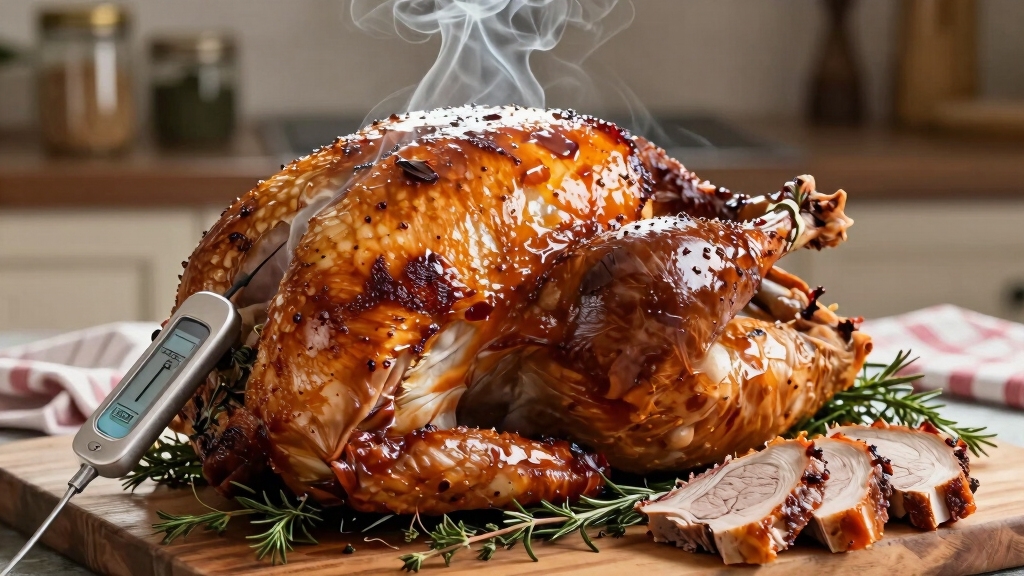
Instead, use a reliable probe thermometer inserted into the thickest part of the breast and thigh. Target a breast temperature of 160°F (it will rise to 165°F during resting) and 175°F for the thigh to guarantee tenderness.
Key points to monitor include continuous temperature readings, ignoring strict timing.
Pull the bird promptly at target temps to avoid overcooking. Rest the turkey 15-30 minutes after smoking for juice redistribution.
This evidence-based approach guarantees your turkey is safely cooked, juicy, and flavorful every time. For optimal safety and texture, remember to ensure the final internal temperature reaches 165°F (74°C).
Safety Tips for Smoking a Large Turkey
Because smoking a large turkey involves extended cooking times and variable temperatures, prioritizing safety is crucial to prevent foodborne illness. You must guarantee the turkey is fully thawed before smoking to avoid uneven cooking.
Maintain smoker temperatures between 225°F and 350°F, monitoring frequently with a probe thermometer inserted into the thickest breast and thigh parts. Target internal temperatures are 160°F for the breast (holding 5 minutes to reach 165°F) and 175°F for the thigh for tenderness.
Avoid leaving the turkey in the danger zone (40-140°F) for more than 4 hours. If stuffing, limit cooking time extensions to 15 minutes and confirm the stuffing reaches 165°F.
Rest the bird for 15-30 minutes post-smoke to allow juices to redistribute, guaranteeing safe, juicy results.
To ensure consistent results and maintain smoker performance, clean the smoker thoroughly after each use, removing ash, grease, and food residues to prevent buildup and odors during future cooks, following cleaning and maintenance guidelines.
Frequently Asked Questions
What Type of Wood Pellets Enhance the Flavor of Smoked Turkey?
You should use Turkey Blend wood pellets to enhance your smoked turkey’s flavor.
These blends typically combine mild woods like apple, cherry, and pecan, which provide a balanced, slightly sweet, and nutty smoke profile that complements turkey without overpowering it.
Using these pellets guarantees a nuanced taste, helping your bird maintain juiciness while developing a savory, aromatic crust.
Avoid strong woods like mesquite, which can overwhelm the delicate turkey flavor.
Can I Use a Pellet Smoker for a 20LB Turkey?
Yes, you can use a pellet smoker for a 20lb turkey, but consider your smoker’s capacity first.
Pellet smokers provide consistent low-and-slow heat, ideal for even cooking.
For a 20lb bird, expect around 6 hours at 225°F, though times vary.
Spatchcocking can reduce time to about 3-3.5 hours at higher temps.
Always monitor internal temps closely; aim for 160°F breast and 175°F thigh to guarantee safety and juiciness.
How Long Should I Rest the Turkey After Smoking?
You should rest your turkey for 15 to 30 minutes after smoking to allow juices to redistribute evenly.
Studies show holding the bird at this stage raises the internal temperature slightly, improving tenderness and flavor.
Resting also prevents juice loss when carving. Use a loose foil tent to retain warmth without steaming.
This precise window balances food safety and ideal texture, ensuring your turkey stays moist and delicious before serving.
Does Turkey Age Affect Smoking Time or Flavor?
Yes, turkey age affects both smoking time and flavor. Older birds tend to have tougher meat, requiring longer smoking to achieve tenderness, especially in thighs.
Younger turkeys usually cook faster and have milder flavor. Aging also influences moisture retention; fresher birds often stay juicier.
You should adjust your smoking time accordingly and monitor internal temperatures closely to avoid drying out the meat while ensuring safe doneness.
What Is the USDA Safe Internal Temperature for Turkey?
Think of the USDA safe internal temperature as the gatekeeper to food safety.
You need to reach 165°F instantly in the turkey’s thickest part to kill harmful bacteria effectively.
Alternatively, holding 160°F for at least 16.9 seconds also meets safety standards.
Always use a reliable probe thermometer to measure precisely.
This ensures your turkey is both safe and juicy, avoiding undercooking risks while preserving quality.
Bringing It All Together: The Secret to a Juicy Smoked Turkey
Think of smoking your 20lb turkey like timing a symphony; each minute and degree matters. Just as a conductor makes certain every instrument plays in harmony, you’ll need to maintain an ideal 225-250°F and monitor internal temps closely.
Remember, a 20lb bird typically takes about 30-40 minutes per pound. So patience and precision are your best tools. Nail these details, and your smoked turkey will hit all the right notes: juicy, safe, and delicious every time.