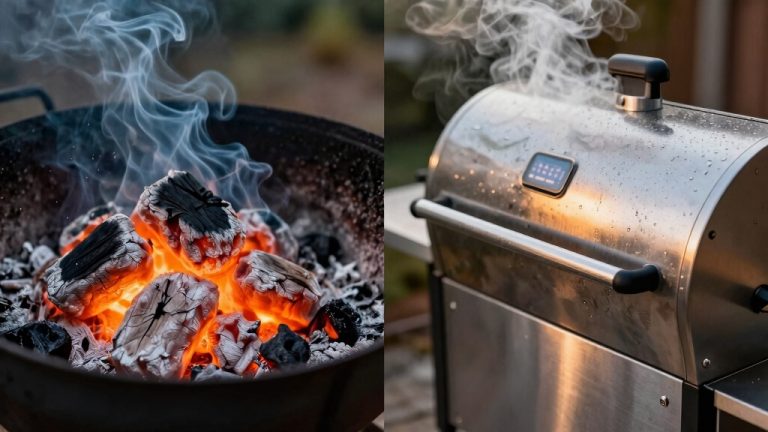
Cold Smoke vs Hot Smoke: What’s the Difference?
When you choose cold smoking, you’re locking in a firm, silky texture with subtle, deep smoke flavors. This is achieved by keeping temps low and preserving raw characteristics.
Hot smoking cooks your food through with higher heat, giving you bold, intense smokiness and tender, flaky results that are ready to eat.
Both methods impact moisture and flavor differently, so your choice shapes the final bite. Keep going to uncover how to match these methods to your culinary goals.
Key Takeaways
- Cold smoking uses low temperatures (5–30°C) to flavor food without cooking, preserving texture and producing subtle smoky notes.
- Hot smoking cooks food at higher temperatures (90–160°C), combining heat and smoke for bold flavor and ready-to-eat safety.
- Cold smoking requires longer smoke times, airflow control, and curing to prevent bacterial growth and maintain quality.
- Hot smoking yields moist, tender, flaky textures with pronounced surface smokiness due to simultaneous cooking and smoking.
- Choose cold smoking for delicate, firm-textured items like salmon; choose hot smoking for hearty cuts needing full cooking, like sausages.
Cold Smoke or Hot Smoke Quick Comparison Table
| Feature | Cold Smoking | Hot Smoking |
|---|---|---|
| Purpose | Adds smoky flavor without cooking | Cooks and flavors food simultaneously |
| Temperature Range | 5–30°C (41–77°F) | 90–160°C (195–320°F) |
| Cooking Process | Food remains raw or partially preserved | Food becomes fully cooked and ready to eat |
| Smoking Duration | Long process (12–48 hours) | Shorter process (1–3 hours typically) |
| Texture | Firm, silky, dry, and translucent | Tender, moist, flaky, and soft |
| Flavor Profile | Subtle, deep smoky notes | Bold, intense smoky flavor |
| Smoke Penetration | Penetrates deeply into food | Mostly affects the surface |
| Moisture Content | Drier texture | Juicier and more moist |
| Appearance | Raw-like appearance | Golden-brown cooked crust |
| Food Safety | Requires curing and careful storage | Safer because food is fully cooked |
| Preparation Needed | Brining, curing, pellicle formation required | Usually simpler preparation |
| Airflow & Humidity Control | Critical for success | Less sensitive compared to cold smoking |
| Best Foods | Salmon, cheese, cured meats | Turkey, sausages, ribs, ham |
| Shelf Life | Longer preservation potential | Shorter storage life |
| Equipment Needs | Separate smoke source to keep temperatures low | Standard smoker with heat source |
| Difficulty Level | More technical and patience-intensive | Easier for beginners |
| Flavor Intensity | Delicate and nuanced | Rich and robust |
| Main Advantage | Preserves texture while adding smoke flavor | Fully cooks food with strong smoky taste |
| Main Drawback | Higher food safety risks if done improperly | Less subtle flavor and texture preservation |
| Best Use Case | Delicate foods needing preservation and subtle smoke | Ready-to-eat meals with bold smoky flavor |
What Is Cold Smoking?

Mastering cold smoking means understanding how it gently infuses food with smoky flavor without cooking it. You expose your food to smoke at temperatures between 5 to 30°C, carefully separating it from any heat source.
Cold smoking delicately infuses smoky flavor by exposing food to cool smoke without cooking it.
This slow, delicate process, often lasting 12 to 48 hours, allows smoke to deeply penetrate, enhancing taste while preserving texture. Before smoking, you salt-cure or brine and air-dry the food to form a pellicle, a tacky surface that holds smoke flavor.
You must control airflow and humidity precisely to avoid cooking or drying out the food excessively. The result? A firmer, drier texture and a silky, translucent appearance, like cold smoked salmon.
Cold smoking is about subtlety, layering smoky complexity without altering the raw essence of your ingredients. Smoke is generated separately from the food using smoldering hardwood to maintain low temperatures and avoid cooking.
What Is Hot Smoking?
Hot smoking is all about combining heat and smoke to cook your food while giving it that delicious, smoky flavor. You usually do this at temperatures between 90°C and 160°C, which ensures your food is fully cooked and ready to dig into.
What’s really cool about hot smoking is how it changes both the texture and taste of your food. It’s a dynamic technique that really stands out when you compare it to cold smoking, which doesn’t quite deliver the same results. So, if you’re looking to elevate your meals, hot smoking is definitely the way to go! Maintaining smoker temperatures between 225°F and 250°F helps maximize smoke absorption and flavor development during hot smoking.
Heat and Smoke Combination
Imagine infusing your food with rich, smoky flavors while it cooks to perfection. That’s exactly what hot smoking does. You combine heat and smoke in one chamber, allowing the food to absorb bold smoky notes as it cooks through.
This process transforms texture and taste, giving you tender, flaky results ready to enjoy immediately.
Here’s what you can expect when you hot smoke:
- Intense smoky flavor that penetrates while cooking.
- Softer, moist texture compared to cold smoking.
- A golden-brown appearance signaling doneness.
- Food that’s fully cooked and safe to eat right away.
With hot smoking, you’re not just adding flavor. You’re creating a mouthwatering masterpiece that’s both delicious and ready without extra prep. For best results, it’s important to maintain a stable smoker temperature around 225–275°F to ensure even cooking and smoke absorption.
Cooking Process Temperatures
Although it requires careful temperature control, hot smoking delivers a powerful combination of heat and smoke that cooks your food while infusing it with bold flavors.
You’ll work within temperatures ranging from 90°C to 160°C, depending on whether you use direct or indirect heat. This heat not only flavors but fully cooks your food, transforming salmon into a moist, flaky delight with a golden hue.
You’ll start with salt-curing or brining, then develop a pellicle before smoking for one to three hours. The intense heat seals the surface, locking in juices while creating that irresistible, smoky crust.
Hot smoking demands your attention to temperature precision, but the result is a robust, ready-to-eat masterpiece that’s as safe as it’s delicious.
Maintaining an internal temperature of 160°F for at least 30 minutes is essential to ensure food safety during hot smoking.
Temperature Differences in Cold vs Hot Smoking
You’ll notice that cold smoking keeps temperatures low, typically between 5 and 30°C. This means you can infuse your food with that delicious smokiness without actually cooking it. Pretty neat, right?
On the flip side, hot smoking cranks up the heat to over 90°C. This method cooks and smokes your food at the same time, giving you a bold, ready-to-eat product.
For safe cold smoking, it’s essential to maintain the temperature between 50°F and 60°F to prevent cooking and inhibit bacterial growth, often requiring curing before smoking.
Temperature Ranges Explained
Understanding temperature ranges is essential when distinguishing cold smoking from hot smoking because the heat level directly shapes the process and outcome.
When you control temperature, you control flavor, texture, and safety. Here’s what you need to know:
- Cold smoking stays between 5-30°C (41-77°F), infusing smoke without cooking, preserving texture and moisture.
- Hot smoking uses direct heat from 90-135°C (195-275°F), cooking and flavoring simultaneously.
- Indirect hot smoking ranges from 100-160°C (210-320°F), offering gentler cooking with intense smoke.
- Cold smoked salmon sits near 27°C (80°F), while hot smoked salmon cooks at 105-135°C (225-275°F).
Mastering these ranges lets you harness the distinct art of smoking, creating either silky, raw-like cold-smoked delicacies or tender, fully cooked hot-smoked favorites.
For cold smoking cheddar specifically, maintaining ambient temperatures between 40°F and 65°F is critical to prevent melting while maximizing smoke adherence.
Heat Impact On Smoking
Controlling temperature shapes every aspect of smoking, but heat itself plays a defining role in how smoke interacts with food.
When you hot smoke, you cook and flavor simultaneously at 90°C to 160°C, transforming texture. This process softens meat, renders fat, and creates that flaky, moist bite you crave. The heat also seals the surface, limiting smoke’s penetration while delivering bold, intense smokiness.
Cold smoking, held below 30°C, lets smoke slowly infuse without cooking, preserving a raw-like, silky texture. This low heat keeps food drier and firmer, allowing deeper smoke absorption and subtle, nuanced flavors.
Using proper heat-resistant gloves can help safely manage temperature control during the smoking process.
Texture and Flavor Differences in Cold vs Hot Smoking
While both cold and hot smoking infuse food with smoky goodness, their effects on texture and flavor couldn’t be more distinct.
Cold and hot smoking both add smoky flavor, but their textures and tastes are uniquely different.
When you choose cold smoking, expect a firmer, drier texture that’s perfect for thin slicing, like with meat or silky cold-smoked salmon.
Hot smoking, on the other hand, softens and flakes the food, making it moist and ready to eat right away.
Flavor-wise, cold smoking delivers a subtle, deep smoky character, while hot smoking offers a bold, intense smokiness fused with rich cooked flavors.
Here’s what you’ll notice:
- Cold smoking creates a raw-like, translucent appearance.
- Hot smoking browns the surface, creating a golden crust.
- Cold smoke penetrates fully, flavoring inside.
- Hot smoke flavors mostly the surface, forming a tasty barrier.
Your choice shapes both taste and texture profoundly.
Cold smoking is typically done at temperatures between 80°F and 100°F to maintain texture without cooking the meat.
Foods Ideal for Cold and Hot Smoking
Choosing the right foods for cold and hot smoking can transform your culinary experience. It reveals layers of flavor and texture that you won’t get any other way.
Cold smoking suits delicate, thinly sliced items like salmon and meat. It enhances preservation and subtle smokiness without cooking.
Hot smoking, on the other hand, cooks and flavors hearty cuts like sausages, turkey. It delivers bold, moist, flaky results you can enjoy immediately.
| Cold Smoking Foods | Hot Smoking Foods | Ideal Qualities |
|---|---|---|
| Salmon | Turkey | Texture retention |
| Meat | Sausages | Flavor depth |
| Cheese | Meat | Moisture and safety |
Proper preparation, such as forming a pellicle on salmon before smoking, is essential to maximize flavor absorption and texture.
How to Choose Cold vs Hot Smoking for Your Recipe?
Deciding between cold and hot smoking hinges on the texture, flavor, and safety you want in your final dish. When choosing, consider these key points:
- Desired Texture: Pick cold smoking for a firm, silky finish. Hot smoking creates flaky, tender results.
- Flavor Intensity: Cold smoking offers subtle, deep smoke notes. Hot smoking delivers bold, robust flavors.
- Safety and Cooking: Hot smoking fully cooks your food, making it safe to eat immediately. Cold smoked items need further cooking.
- Time Commitment: Cold smoking demands patience with longer smoke times and airflow control. Hot smoking is faster and more straightforward.
Choose cold smoking to highlight delicate smokiness and preservation.
Opt for hot smoking for ready-to-eat, richly flavored dishes that satisfy quickly.
Additionally, understanding the differences in processing temperature and duration can help you tailor the smoking method to your culinary needs.
Frequently Asked Questions
How Long Can Cold Smoked Foods Be Safely Stored?
You can safely store cold smoked foods for about two to three weeks in the fridge if they’re properly cured and vacuum-sealed.
If you freeze them, they’ll last up to three months without losing flavor.
Just remember, cold smoking doesn’t cook the food, so you need to keep it chilled and consume it within this timeframe to avoid spoilage or foodborne illness.
Always trust your senses and check for off smells or textures before eating.
What Types of Wood Are Best for Cold Smoking?
You’ll want to choose mild, fruitwoods like apple, cherry, or alder for cold smoking. These woods deliver a delicate, sweet smoke that won’t overpower your food’s natural flavors.
Hickory and maple work too but use them sparingly. They’re stronger and can mask subtle notes.
Avoid resinous woods like pine; they create harsh, bitter smoke.
Pick seasoned, dry wood to keep your smoke clean and smooth, ensuring a perfect, authentic cold-smoked taste.
Can Cold Smoking Be Done Indoors Safely?
You can cold smoke indoors safely, but you’ve got to be cautious.
Make sure you have excellent ventilation and use an electric or pellet smoker designed for indoor use to minimize smoke buildup.
Avoid open flames or traditional charcoal indoors, as they produce harmful gases.
Monitor temperature carefully to keep it below 30°C, preventing cooking.
With proper airflow, humidity control, and safety measures, you’ll enjoy flavorful cold-smoked foods without risking your indoor air quality.
Are There Health Risks Associated With Cold Smoked Foods?
Yes, you need to be cautious with cold smoked foods because they aren’t cooked.
Harmful bacteria like Listeria can survive. If you eat cold smoked salmon or meat without proper handling, you risk foodborne illness.
Always store these foods correctly and cook them thoroughly before eating.
When you respect these safety steps, you can enjoy their delicate flavors without putting your health in danger.
Don’t skip proper preparation!
How Do Humidity Levels Affect Cold Smoking Outcomes?
Did you know that maintaining humidity around 65-75% can make or break your cold smoking success?
If it’s too dry, your food dries out and cracks, ruining texture and flavor.
Too humid, and smoke won’t penetrate well, leading to a weak smokiness and possible spoilage.
You’ve got to balance airflow and moisture carefully to create that silky, deeply smoked finish that cold smoking promises.
Choose the Right Smoking Method for Perfect Flavor and Texture
Now that you know cold smoking keeps temps below 90°F, preserving delicate flavors, while hot smoking cooks food at 165–185°F for that tender, smoky bite, you can choose confidently.
Did you know cold smoking can take up to 48 hours? It’s a patient art worth mastering.
Whether you crave silky smoked salmon or juicy smoked ribs, understanding these differences lets you create mouthwatering dishes that truly celebrate smoke’s magic.