How Much Brisket per Person: Easy BBQ Serving Guide
You should plan on about 1 pound of raw brisket per adult to yield roughly 0.5 lb cooked after 40–50% shrinkage from slow cooking. For kids, allocate 0.25–0.33 lb raw each; big eaters need up to 2 lbs raw.
If you serve many sides or multiple meats, reduce brisket by 20–30%. Opt for a whole packer brisket for large groups, but a flat cut shrinks less. More specifics on portion adjustments and cooking details follow.
Key Takeaways
- Plan about 1 pound of raw brisket per adult to yield roughly 0.5 pound cooked serving after shrinkage.
- For children, allocate 0.25–0.33 pound raw brisket per child due to smaller appetites.
- Reduce brisket to 0.5 pound raw per person when serving multiple meats or filling side dishes.
- Expect 40–50% weight loss during cooking from moisture evaporation and fat rendering.
- Increase portions to 1.5–2 pounds raw per big eater for generous servings.
How Much Brisket to Buy Per Person?

When planning how much brisket to buy per person, you should start with the standard guideline of 1 pound of raw brisket per adult guest.
Begin your brisket planning with the simple rule: one pound of raw meat per adult guest.
This baseline accounts for typical shrinkage during cooking, ensuring you have enough cooked meat to serve approximately 0.5 to 0.7 pounds per adult.
For children, adjust portions to about 0.25 to 0.33 pounds of raw brisket.
If your guests are big eaters or if brisket is the main course without many sides, consider increasing the raw amount to 1.5 or even 2 pounds per person.
Conversely, if you’re serving multiple side dishes, you can reduce the raw brisket to 0.5 pounds per adult.
Use these calculations to scale accurately for any group size, maintaining balance between quantity and waste.
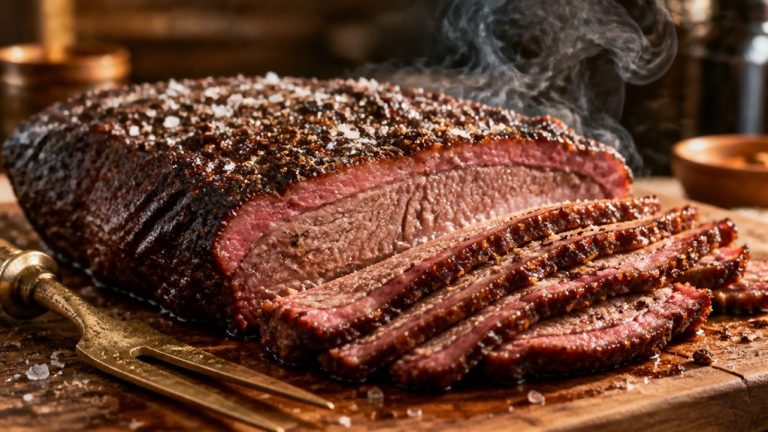
A whole packer brisket weighing 12–14 pounds typically serves about 12–15 people, making it a convenient choice for larger gatherings.
Brisket Cooking Shrinkage and Portions
Although brisket’s rich texture makes it a favorite, its significant cooking shrinkage demands careful portion planning. Expect 30-50% weight loss during slow cooking due to moisture evaporation and fat rendering, especially since brisket comes from a heavily exercised chest muscle.
For example, 1 lb of raw brisket yields roughly 0.5–0.7 lb cooked. The flat cut shrinks less than the point, owing to lower fat content. When calculating portions, aim for about 1 lb raw per adult to guarantee 0.5 lb cooked servings.
Keep in mind untrimmed fat can reduce edible yield further. If you’re serving sides, you can slightly reduce brisket quantity, but always factor in shrinkage to avoid shortages. Accurate portion control hinges on understanding these shrinkage variables. Choosing a whole packer brisket weighing 12–15 pounds balances portions and cooking efficiency.
Adjusting Brisket Portions for Kids and Big Eaters
When you’re figuring out portion sizes, keep in mind that kids usually eat less. A good rule of thumb is to reduce raw brisket to about ¼ to ⅓ pound per child. This way, you can cater to their smaller appetites and cut down on waste.
Now, if you’re dealing with big eaters, you’ll want to ramp things up a bit. Aim for around 1 to 2 pounds of raw brisket for them. This ensures there’s enough to go around after you factor in the typical 50% shrinkage during cooking.
For best results, be sure to pull your brisket at the optimal internal temperature to maximize tenderness and juiciness.
Kid-Friendly Brisket Portions
You’ll often need to adjust brisket portions to accommodate children and big eaters accurately. For kids, plan on ¼ to ⅓ lb of raw brisket per child, which yields approximately 0.125 to 0.17 lb cooked after accounting for 30-50% shrinkage.
This reduced portion reflects smaller appetites and helps avoid waste. When calculating total brisket, separate the number of children from adults to apply these different multipliers.
Remember, side dishes can further reduce required brisket for kids, allowing you to lean toward the lower end of the portion range. Keep in mind that trimming fat also affects yield, so factor in leaner cuts for kids when possible.
Careful portioning makes certain you serve appropriate amounts without overestimating, optimizing both cost and satisfaction for younger guests. Cooked brisket should be refrigerated within two hours and consumed within 3–4 days to ensure safety and freshness.
Serving Sizes For Big Eaters
Many big eaters require between 1 to 2 pounds of raw brisket each to guarantee adequate portions after cooking shrinkage.
Since brisket typically loses 40-50% of its weight during slow cooking, you’ll want to plan for the higher end of that range to ensure satisfying servings.
For these guests, allocate around 0.5 to 1 pound cooked brisket per person.
If you’re serving children or guests with smaller appetites alongside, reduce their portions accordingly—about ¼ to ⅓ pound raw per child.
Remember, trimming fat impacts yield, and leaner cuts like the flat shrink less than the point.
Adjust your total brisket weight by factoring in the number of big eaters versus others to ensure you don’t run short during your event.
Consider also how wrapping during the stall can affect moisture retention and ultimately the final cooked weight and texture.
Reducing Brisket Portions When Serving Side Dishes
When you’re serving up hearty side dishes, you can actually cut back on your brisket portions to about ⅓ to ½ pound cooked per person. And guess what? This won’t leave anyone feeling unsatisfied!
Just keep in mind that you’ll need to adjust your raw brisket quantities to about ½ pound per guest. This is important because brisket typically shrinks by about 50% during cooking.
To ensure the best results, maintain a steady smoker temperature between 225°F and 250°F for temperature consistency throughout the cooking process.
Adjusting Portions With Sides
Incorporating side dishes into your meal plan allows you to reduce the amount of brisket needed per person without compromising satisfaction. When sides provide substantial calories, fiber, and flavor, you can confidently lower brisket portions from the typical 1 lb raw per adult to approximately ½ lb raw.
This adjustment accounts for brisket’s 30-50% cooking shrinkage and guarantees balanced plate composition. To optimize portion planning, consider:
Serving nutrient-dense sides like beans, salads, or roasted vegetables to enhance fullness.
Calculating brisket reduction based on side quantity and variety.
Monitoring guest appetite and event context (e.g., lunch vs. dinner).
Adjusting brisket weight proportionally if sides are minimal or absent.
This approach maintains guest satisfaction while minimizing waste and cost. For optimal cooking results, consider wrapping brisket in uncoated butcher paper to balance moisture retention and bark quality during smoking.
Impact On Raw Brisket
Although brisket serves as the main protein, you can markedly reduce the raw quantity needed by strategically serving substantial side dishes alongside it.
When you provide hearty sides, such as baked beans, mac and cheese, or roasted vegetables, you cut down the brisket portion per person from the standard 1 lb raw to about ½ lb raw.
This reduction accounts for the fact that sides contribute calories and fullness, lowering individual meat consumption.
Given brisket’s typical 50% shrinkage during slow cooking, reducing raw brisket to ½ lb per guest yields roughly ¼ lb cooked meat per person, which pairs well with sides.
To maintain optimal serving quality, brisket should be held at 140°F–165°F to preserve tenderness and moisture before serving.
Balancing Meat And Sides
Since side dishes contribute substantially to the overall meal volume and caloric intake, you can confidently reduce the raw brisket portion per person without compromising satisfaction.
When you serve hearty sides, the brisket portion can decrease from the standard 1 lb raw per adult to approximately ½ lb raw. This adjustment accounts for both the caloric density and the volume of complementary foods, ensuring guests remain satiated without excess meat waste.
To optimize portions when balancing meat and sides, consider:
- Reducing brisket to ⅓–½ lb raw per person with filling sides.
- Selecting nutrient-dense, high-fiber vegetables to increase satiety.
- Adjusting brisket serving size based on side dish richness and quantity.
- Monitoring guest appetite profiles for precise portion customization.
This systematic approach prevents overestimation while maintaining meal balance and guest satisfaction. For best results when storing or preparing brisket leftovers, proper cooling before freezing helps maintain meat quality and texture.
Packer vs. Flat Cut Brisket Differences
Anyone choosing between packer and flat cut brisket should understand their distinct characteristics and cooking implications.
Choosing between packer and flat cut brisket requires knowing their unique traits and cooking effects.
The packer brisket includes both the flat and the point muscles, weighing 12–16 pounds raw. It contains more fat and connective tissue, which renders during slow cooking, yielding about 50-60% cooked weight.
The flat cut is leaner, typically 5–8 pounds, with less marbling and connective tissue, resulting in less shrinkage but a drier texture if overcooked.
You’ll want to allocate roughly 1 pound raw per person for packer brisket due to its higher fat content and flavor. For flat cut, consider slightly less weight because of reduced shrinkage, but plan for careful cooking to preserve moisture.
Your choice impacts portion size, cooking time, and final yield.
To maintain quality and safety, it is important to freeze brisket promptly at 0°F (-18°C) or lower using vacuum sealing or multiple layers of wrap before storage.
Calculating Brisket for Small, Medium, and Large Groups
When planning brisket quantities for varying group sizes, you’ll need to scale raw weight proportionally to guarantee adequate servings after cooking shrinkage. Use a baseline of 1 lb raw brisket per adult, accounting for roughly 50% weight loss during slow cooking.
For small groups (up to 10), 10 lbs raw guarantees about 5 lbs cooked, sufficient for 10 people. Medium groups (20-30 guests) require 20-30 lbs raw, yielding 10-15 lbs cooked.
Large groups (50+) demand 50+ lbs raw brisket to maintain portions.
Small group: 1 lb raw per adult. Medium group: scale linearly to 20-30 lbs raw. Large group: 50 lbs raw or more.
Account for shrinkage; expect 40-50% loss. This method guarantees enough cooked brisket regardless of group size.
How Event Type and Timing Affect Brisket Portions?
Although brisket portion sizes generally follow standard weight guidelines, you’ll need to adjust quantities based on the event type and timing to optimize servings.
For example, a lunch event typically demands smaller portions, closer to 0.5 lb cooked per adult, since guests often prefer lighter meals. Conversely, dinner events justify increasing portions up to 0.7 lb cooked per person due to larger appetites.
Additionally, casual gatherings with multiple courses or significant sides allow you to reduce brisket servings accordingly, often by 20-30%. The timing influences hunger levels; earlier morning or late-night events might require more substantial portions to accommodate increased appetite or fewer available sides.
Planning Brisket Portions When Serving Other Meats
Since you’re serving multiple meats, you’ll need to adjust brisket portions to prevent over-serving and reduce waste. Instead of the standard 1 lb raw brisket per person, scale down based on the other protein quantities and types.
Consider the total protein intake guests expect, balancing brisket with alternatives like pulled pork or sausage. Reduce brisket to ½ lb raw per person if offering two or more meat options.
Account for cooked yield shrinkage (30-50%) when calculating combined portions. Adjust portions upward for big eaters or mainly meat-focused events.
Use side dishes to lower brisket servings to ⅓ lb cooked equivalent. This precision guarantees peak portioning, controlling costs while satisfying appetite diversity effectively.
Frequently Asked Questions
What Is the Best Way to Store Leftover Cooked Brisket?
The best way to store leftover cooked brisket is to cool it quickly and refrigerate within two hours.
Slice the brisket against the grain, wrap it tightly in foil or plastic wrap, then place it in an airtight container to prevent moisture loss.
Keep it in the fridge at or below 40°F, and consume within 3-4 days.
For longer storage, freeze brisket in vacuum-sealed bags or heavy-duty freezer bags, removing excess air to avoid freezer burn.
How Long Should Brisket Rest Before Slicing?
You should let your brisket rest for at least 30 to 60 minutes before slicing.
This resting time allows the juices to redistribute evenly throughout the meat, preventing them from spilling out when you cut.
Wrap the brisket loosely in foil and keep it in a warm spot or an insulated cooler to maintain temperature.
Resting guarantees tender, juicy slices and improves overall texture and flavor.
Don’t rush this essential step.
What Internal Temperature Indicates Perfectly Cooked Brisket?
You’ll know your brisket is perfectly cooked when its internal temperature reaches about 195°F to 205°F. This range allows the collagen to break down fully, rendering the meat tender and juicy.
Don’t pull it too early; below 190°F, it’ll be tough. Use a reliable probe thermometer inserted into the thickest part, avoiding fat pockets.
Rest the brisket after cooking to let juices redistribute for peak texture.
Can Brisket Be Frozen Before or After Cooking?
Think of brisket like a time capsule. You can lock in freshness before or after cooking.
You can freeze raw brisket safely for up to 12 months, tightly wrapped to prevent freezer burn.
Cooked brisket freezes well too, lasting around 2-3 months. Just cool it completely, slice or shred, then seal airtight.
Proper freezing preserves moisture and flavor, so when you thaw, your brisket tastes as close to fresh as possible.
What Are Ideal Side Dishes to Serve With Brisket?
You’ll want classic sides like creamy mashed potatoes or roasted vegetables to balance brisket’s rich texture.
Coleslaw adds crisp acidity, cutting through the fat.
Baked beans provide smoky sweetness that complements the meat’s profile.
Consider cornbread for a slightly sweet, crumbly contrast.
Pickled vegetables or a vinegar-based barbecue sauce introduce sharpness, enhancing flavor complexity.
These choices create a well-rounded plate that highlights brisket’s savory, tender characteristics efficiently.
Smart Brisket Planning Prevents Running Out at the BBQ
You might think eyeballing brisket amounts is enough, but precision matters, especially when shrinkage turns your generous buy into a modest meal.
Don’t let hunger strike because you underestimated portions or ignored your picky eaters and side dishes.
Calculate carefully, considering packer or flat cuts and event specifics. After all, nothing screams “expert host” like running out of brisket at the big feast. So measure, adjust, and conquer your brisket-buying with exact science, not guesswork.