Can I Inject Turkey the Night Before: Expert Tips Inside
Yes, you can inject your turkey the night before cooking, but you need to refrigerate it immediately afterward and keep the temperature at or below 40°F (4°C).
Injected turkeys are more prone to bacterial growth, so it’s essential not to leave it out at room temperature longer than two hours.
Aim to cook the turkey within 24 hours after thawing and no later than 36 hours post-injection for safety and best flavor.
Learn how timing and technique affect juiciness and taste.
Key Takeaways
- Yes, injecting turkey the night before is recommended for even marinade dispersion and optimal flavor absorption.
- After injection, refrigerate the turkey immediately and keep it at or below 40°F (4°C) to prevent bacterial growth.
- Injected turkey stored overnight should be cooked within 24 hours after thawing for safety and quality.
- Do not exceed 36 hours of refrigerated storage after injection to avoid spoilage risks.
- Ensure the turkey is fully thawed before injecting and brining for safe, even heat penetration during cooking.
Can You Inject Turkey the Night Before Cooking?
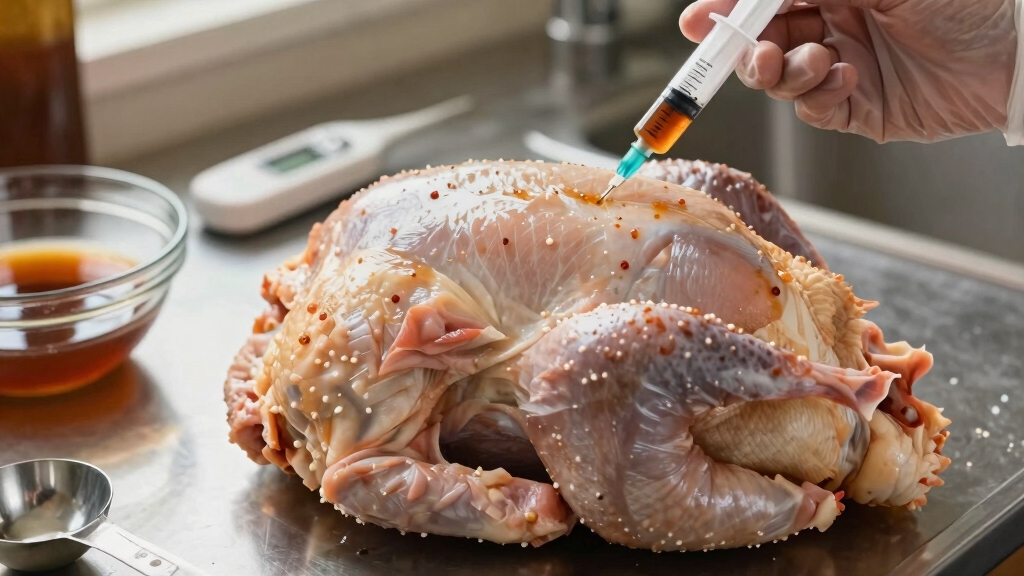
You can inject your turkey the night before cooking, as long as you keep it refrigerated and cook it within 24 hours after thawing.
Injecting up to 24 hours ahead allows the marinade to disperse evenly through the meat, enhancing moisture and flavor.
Use a large syringe with a thick needle to insert about two teaspoons of injection liquid per point, targeting dense areas like breasts and thighs.
Inject fully, then pull back slightly while pressing the plunger to ensure proper delivery.
Inject before applying any seasoning rub to avoid washout from leakage.
Store the injected bird in the fridge, maintaining safe temperatures to prevent bacterial growth.
This timing works well for roasting, smoking, or frying, giving you a juicy, flavorful turkey without sacrificing food safety or taste.
Proper refrigeration is essential during this process to keep the meat below 40°F and prevent bacterial growth.
How Long Can Injected Turkey Sit in the Fridge?
After injecting your turkey the night before cooking, proper refrigeration becomes key to maintaining both safety and quality. You should store the turkey in the fridge immediately after injection, keeping it at or below 40°F (4°C). The maximum recommended time for an injected turkey to sit in the fridge is 36 hours. This window guarantees flavor penetration without compromising food safety.
| Injection Timing | Fridge Storage Limit | Safety Note |
|---|---|---|
| Immediate Cooking | 0 hours | No refrigeration needed |
| Night Before Injection | Up to 36 hours | Store at ≤ 40°F (4°C) |
| Over 36 Hours | Not recommended | Risk of bacterial growth |
Keep your refrigerator temperature consistent and avoid leaving injected turkey at room temperature to prevent spoilage. For best results and safety, always monitor and maintain the fridge temperature below 40°F to prevent the turkey from entering the bacterial danger zone.
Why Refrigeration Matters for Injected Turkey?
Though injection enhances flavor and moisture in turkey, refrigeration plays a vital role in preserving food safety and meat quality after the process.
Once injected, your turkey becomes more susceptible to bacterial growth because the liquid creates pockets inside the meat, providing an environment for pathogens if left at room temperature.
Refrigerate the bird promptly, ideally within two hours, and keep it below 40°F to inhibit bacterial proliferation.
Proper chilling also maintains the structural integrity of muscle fibers, preventing texture degradation.
Remember, you should never exceed 36 hours of refrigerated storage after injection to guarantee optimal safety and quality.
Failing to refrigerate properly risks foodborne illness and compromises the juicy, tender results injection aims to achieve.
For best results, store the injected turkey in airtight containers to lock in moisture and prevent contamination.
How to Inject Your Turkey So Every Bite’s Juicy?
Proper injection technique consistently guarantees that every bite of your turkey stays juicy and flavorful.
Use a large syringe with a thick needle, inserting it fully into the thickest parts like the breast and thighs. As you slowly pull the needle back, press the plunger to distribute about two teaspoons of marinade per injection point.
Inject from multiple angles across the entire bird to secure even flavor penetration. Prioritize the lean breast meat, then target thighs to balance moisture and fat.
After injection, gently wipe away any excess liquid to prevent seasoning washout and maintain presentation. This precise method creates pockets of flavor deep inside the meat, guaranteeing juicy, tender bites throughout your turkey.
For best results, inject your turkey about 2–3 hours before cooking to allow optimal flavor absorption and moisture retention.
How Injection Timing Affects Turkey Moisture and Taste?
Mastering your injection technique sets the foundation, but the timing of when you inject your turkey also plays a significant role in moisture retention and flavor development.
Injecting your bird 30 minutes to a few hours before cooking allows the marinade to disperse evenly throughout the meat, enhancing juiciness and depth of flavor. Immediate injection before cooking is possible but may result in less flavor penetration.
If you plan to inject the night before, refrigerate the turkey properly. This guarantees it stays within a 36-hour window to maintain safety and quality.
Inject before applying any seasoning rub to prevent liquid leakage from washing away surface flavors. Proper timing guarantees the injected marinade creates flavorful pockets inside, resulting in a moist, well-seasoned turkey after cooking.
For best results, inject multiple sites at least 1.25 inches deep to ensure even flavor distribution and avoid concentrated pockets.
Why Combining Injection and Brining Makes Your Turkey Tastier?
Injecting your turkey really packs a punch when it comes to flavor, sending those bold tastes straight into the meat.
On the other hand, brining works its magic from the outside in, helping to keep moisture levels just right.
So, when you combine these two methods, you’re not just guaranteeing a juicy turkey; you’re also avoiding that overly salty taste that can happen with brining alone.
It’s like a flavor party! This combo really takes your turkey to the next level, making it more flavorful and tender than if you were to use either technique by itself.
For best results, maintain the brine and meat at or below 40°F refrigeration during the entire brining period to ensure safety and optimal flavor absorption.
Injection Enhances Flavor Depth
Although both injection and brining individually enhance turkey flavor and moisture, combining the two methods delivers a superior taste experience.
Injection pushes concentrated marinades deep into the meat’s interior, creating pockets of bold flavor that brining alone can’t achieve.
By using a large syringe with a thick needle, you can target dense areas like the breast and thighs, ensuring even flavor distribution throughout.
Injection marinades penetrate quickly, allowing you to infuse herbs, spices, and savory liquids directly into muscle fibers.
This depth of flavor complements brining’s external moisture and tenderizing effect.
When done correctly, injection reduces the need for excessive salt in your brine, balancing taste without overwhelming the meat.
Ultimately, injection enhances complexity and juiciness, elevating your turkey beyond traditional seasoning methods.
Combining injection with spritzing techniques during smoking helps maintain moisture and develop a flavorful bark for an even more delicious turkey.
Brining Balances Moisture Levels
Pairing injection with brining not only enhances flavor depth but also guarantees your turkey maintains ideal moisture levels throughout cooking.
Brining works by osmosis, drawing water and salt into the meat’s outer layers, which tenderizes and helps retain moisture during heat exposure.
When you inject marinade deep inside, you introduce concentrated flavors directly to the muscle fibers.
This dual approach balances moisture: brining hydrates from the outside in, while injection secures internal juiciness without excess salt.
Combining these techniques reduces the risk of over-salting since the injection salt content can be lowered.
To maximize results, brine your turkey first, then inject up to 24 hours before cooking, refrigerating throughout.
This synergy creates a juicy, flavorful bird with a well-rounded taste and prime tenderness.
For best cooking results, ensure your turkey is fully thawed before injecting and brining to promote even heat penetration and safe cooking.
What Cooking Methods Work Best for Injected Turkey?
When it comes to cooking injected turkey, you’ve got a few great options to consider! You can roast, smoke, grill, or even deep-fry it. Each method brings its own flair to the table, affecting how those injected flavors spread throughout the meat and how juicy it turns out.
So, let’s break it down a bit. Roasting is a classic choice that really allows those flavors to meld while keeping the turkey moist. Smoking adds a whole new layer of flavor, giving it that delicious, smoky aroma that everyone loves. Grilling can give you some nice char and a different texture, while deep-frying makes for an incredibly crispy skin—who doesn’t love that crunch?
Understanding how each method impacts the turkey can really help you pick the best way to cook it. You want to maximize that juiciness and enhance the taste, right? Using water pans during smoking can help maintain consistent humidity, which improves moisture retention and smoke absorption. So, think about what flavors you’re working with and how you want to serve your turkey. Happy cooking!
Compatible Cooking Techniques
Mastering the choice of cooking methods can greatly enhance the benefits of injecting turkey. You’ll find that roasting, smoking, grilling, and deep-frying all work well with injected birds. Each method effectively cooks the meat while preserving the internal moisture and flavor pockets created by the injection.
When roasting or smoking, the slow, even heat allows injected liquids to meld deeply into muscle fibers, maximizing juiciness. Grilling offers a faster cook but still maintains flavor distribution if timed correctly. Deep-frying requires extra care to dry the turkey thoroughly before cooking to avoid oil hazards, but it seals moisture instantly.
Regardless of the method, aim for an internal temperature of 160-165°F to guarantee safety and optimal texture. Resting the turkey post-cooking helps redistribute juices locked in by the injection. For smoking specifically, maintaining a steady temperature between 225–250°F ensures even cooking and moisture retention.
Flavor Impact By Method
When deciding which cooking method to go with for injected turkey, consider how heat and timing affect flavor infusion and moisture retention. Injection works well with roasting, smoking, and frying, each influencing taste differently.
Roasting allows steady heat to evenly distribute injected flavors and lock in moisture. Smoking imparts additional smoky notes while preserving juiciness. Deep-frying quickly seals the exterior, maintaining a moist interior enhanced by injection.
- Roasting: steady heat promotes uniform flavor infusion and moisture retention.
- Smoking: adds complementary smoky flavors, intensifying complexity without drying meat.
- Deep-frying: rapid cooking seals juices, benefiting from injection’s moisture boost but requires thorough surface drying beforehand.
Last-Minute Preparation Tips for Injected Turkey
Although injecting your turkey just before cooking is acceptable, taking a few last-minute preparation steps can markedly enhance flavor distribution and moisture retention.
First, guarantee you inject the marinade evenly, targeting dense areas like the breast and thighs with about two teaspoons per injection point.
Use a large syringe with a thick needle, inserting fully before plucking back while pressing the plunger to distribute liquid properly.
After injecting, wipe away any excess marinade to prevent it from washing away seasoning rubs.
If injecting hours ahead, refrigerate the turkey promptly, keeping it within a 36-hour window.
Finally, allow the bird to rest 15 minutes post-cooking to let juices redistribute, assuring peak moisture and flavor in each bite.
Frequently Asked Questions
What Type of Needle Is Best for Injecting Turkey?
You’ll want a large syringe equipped with a thick, sturdy needle for injecting turkey. This type of needle penetrates deep into the meat, ensuring the marinade reaches the thickest parts like breasts and thighs.
Make sure the needle is long enough to insert fully, then pull back slightly while pressing the plunger to distribute the liquid evenly. Using multiple injection points with this needle guarantees juicy, flavorful results throughout the bird.
How Much Marinade Should I Use per Injection Point?
You should use about two teaspoons of marinade per injection point to guarantee proper flavor distribution. Inject into the thickest parts of the turkey, like the breasts and thighs, to create pockets of moisture and taste throughout the meat.
Using multiple injection points at different angles helps you achieve even coverage. After injecting, wipe away any excess marinade to avoid leakage and maintain a clean presentation.
Can I Inject Turkey if It’s Still Partially Frozen?
Trying to inject a turkey still partially frozen is like pushing a needle through a block of ice. It just won’t slide in smoothly.
You shouldn’t inject turkey until it’s fully thawed to guarantee the marinade disperses evenly.
Partially frozen meat resists the injection, leading to uneven flavor and moisture distribution.
Wait until your bird is completely thawed, then inject for the best results. This will ensure juicy, flavorful meat throughout.
Should I Inject Turkey Before or After Applying Seasoning Rub?
You should inject the turkey before applying the seasoning rub. Injecting first prevents the injection liquid from leaking out and washing away your seasonings.
By injecting beforehand, you make certain the marinade penetrates deeply, while the rub stays on the surface, enhancing flavor and texture. This sequence helps maintain the seasoning’s effectiveness and keeps the turkey moist and flavorful throughout cooking.
Always wipe away excess injection liquid gently before applying the rub.
How Do I Prevent Injection Liquid From Leaking During Cooking?
You want to prevent injection liquid from leaking, yet you must inject deeply and evenly.
Insert the needle fully, then slowly withdraw while pressing the plunger to deposit marinade inside the meat.
Avoid shallow injections that cause surface leakage.
After injecting, gently wipe excess liquid off with paper towels to maintain presentation and prevent dripping.
Applying your seasoning rub after injection also seals in flavors, reducing the chance of marinade washing away during cooking.
Let the Flavor Settle, and Let Your Turkey Shine
Injecting your turkey the night before is a smart move to let those flavors settle in, turning your bird into a juicy masterpiece.
Just make sure to keep it cozy in the fridge, no lingering out-of-the-cold adventures, to maintain safety and quality.
Timing matters, but with the right prep and a bit of patience, you’ll enjoy a tender, flavorful turkey that steals the show. Consider combining injection with brining for an extra touch of magic.