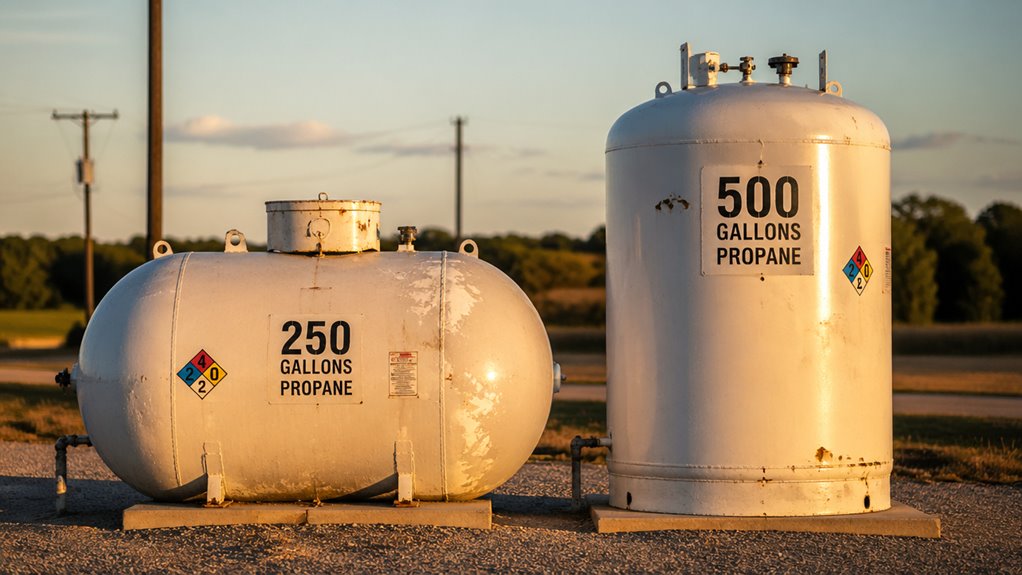
250 vs 500 Gallon Propane Tank: Choosing the Right Capacity
Choosing between a 250- and 500-gallon propane tank depends on your home’s size and appliance needs. A 250-gallon tank offers 200 usable gallons, fitting homes under 2,500 sq ft with a few appliances.
The 500-gallon tank doubles capacity to 400 usable gallons, supporting larger homes and multiple heating systems. Installation options vary, with the larger tank sometimes placed underground for space savings.
Understanding cost, refill frequency, and site requirements will help you make the best choice.
Key Takeaways
- A 250-gallon tank holds 200 usable gallons, while a 500-gallon tank holds 400 usable gallons at the 80% safety fill level.
- The 250-gallon tank suits smaller homes with 2–3 appliances; the 500-gallon supports larger homes with multiple appliances and whole-house systems.
- Physically, the 500-gallon tank is longer and wider, requiring a larger footprint or underground installation for space efficiency.
- Installation options differ: 250-gallon tanks are usually above ground, while 500-gallon tanks can be above or below ground for aesthetics and space.
- A 500-gallon tank costs more upfront but reduces refill frequency and long-term delivery costs compared to the smaller 250-gallon tank.
250 or 500 Gallon Propane Tank: Choosing the Right Capacity
| Feature | 250-Gallon Propane Tank | 500-Gallon Propane Tank |
|---|---|---|
| Usable Propane Capacity | About 200 gallons | About 400 gallons |
| Best For | Small to medium homes | Large homes and high propane usage |
| Recommended Home Size | Under 2,500 sq ft | 2,500–4,500 sq ft |
| Appliance Support | 2–3 appliances | Multiple appliances + whole-house systems |
| Common Uses | Water heaters, fireplaces, dryers | Central heating, generators, multiple systems |
| Tank Dimensions | Approx. 7’10” long × 30″ diameter | Approx. 9’11” long × 37.5″ diameter |
| Installation Type | Usually above ground | Above or underground |
| Space Requirement | Smaller footprint | Requires more installation space |
| Refill Frequency | More frequent refills | Fewer refills needed |
| Initial Cost | Lower upfront cost | Higher upfront investment |
| Long-Term Cost Efficiency | Higher delivery frequency increases cost | Better long-term savings |
| Maintenance Access | Easier to inspect and maintain | Underground tanks may require extra servicing |
| Aesthetic Appeal | Visible above ground | Underground option improves appearance |
| Fuel Availability During Winter | May run out faster | Better for heavy winter demand |
| Best Advantage | Budget-friendly and compact | Greater convenience and fuel reserve |
| Ideal User | Smaller households with moderate usage | Larger families with high propane demand |
Comparing Capacity and Size of 250 vs. 500 Gallon Propane Tanks

When comparing 250-gallon and 500-gallon propane tanks, you’ll find that their usable capacities and physical dimensions differ markedly to accommodate various household needs.
A 250-gallon tank holds 200 gallons at the recommended 80% fill level, while a 500-gallon tank holds 400 gallons, adhering to the same safety standard that prevents propane expansion risks.
Physically, the 250-gallon tank measures approximately 7’10” long with a 30″ diameter, whereas the 500-gallon tank extends nearly 10 feet in length and has a diameter between 36″ and 37.5″.
Both tanks are typically installed horizontally, but the increased diameter of the 500-gallon model requires a larger footprint.
These differences guarantee you select a tank that precisely fits your propane volume needs and installation space.
Additionally, propane’s higher energy density means these tanks can deliver more heat per volume compared to natural gas, making size and capacity key considerations for heating efficiency.
Appliances and Home Sizes That Fit Each Propane Tank
Although both 250-gallon and 500-gallon propane tanks serve a range of household needs, selecting the right size depends largely on the number and type of appliances you use and your home’s square footage.
Choosing the right propane tank size depends on your appliances and home’s square footage.
A 250-gallon tank, holding about 200 gallons usable propane, suits homes with 2-3 appliances such as water heaters, dryers, supplemental heating, and fireplaces. This typically fits modest homes under 2,500 sq ft.
In contrast, a 500-gallon tank, with 400 gallons usable, efficiently supports larger homes from 2,500 to 4,500 sq ft. It powers central heating systems, whole-house generators, and multiple appliances simultaneously.
Your choice should reflect peak winter demand and appliance load to guarantee uninterrupted service while optimizing fuel capacity and refill frequency. Additionally, propane offers portability and easy refilling, making it a convenient fuel option despite the need for regular tank maintenance.
Propane Tank Installation Options and Location Considerations
Because proper installation directly affects safety and efficiency, you must carefully evaluate the location and method for placing your propane tank. A 250-gallon tank is typically installed above ground due to size and accessibility. The 500-gallon tank offers both above and below ground options, with underground placement enhancing aesthetics.
Make certain the site has adequate clearance from buildings, ignition sources, and proper ventilation. Professional assessment is essential to comply with local codes and optimize placement.
It is also important to protect the tank and connections from weather elements by using weather-resistant materials and shielding to prevent corrosion and ensure safety.
| Installation Aspect | 250-Gallon Tank | 500-Gallon Tank | Notes |
|---|---|---|---|
| Placement | Above ground only | Above or below ground | Underground preferred for aesthetics |
| Footprint | Smaller (7’10” x 30″) | Larger (9’11” x 37.5″) | Larger diameter increases space needed |
| Clearance Requirements | Standard NFPA codes | Standard NFPA codes | Maintain safe distances |
| Accessibility | Easy for maintenance | Requires excavation if underground | Consider refill logistics |
Cost Differences and Refill Frequency for 250 and 500 Gallon Tanks
Understanding the installation requirements helps set the stage for evaluating cost differences and refill frequencies between 250- and 500-gallon propane tanks.
The 500-gallon tank costs roughly $1,600 to $1,900 empty, while a 250-gallon tank is less expensive but varies by supplier and location.
You’ll pay about $1,000 to $1,400 for a full 500-gallon refill, with smaller tanks requiring proportionally less but more frequent fills.
Consider these points:
- The 500-gallon tank holds 400 usable gallons at 80% capacity, doubling the 250-gallon’s 200 usable gallons.
- Larger capacity means fewer refills, reducing delivery costs and downtime.
- Upfront costs are higher for the 500-gallon tank but offer long-term savings with less frequent refills.
This balance guides your cost-efficiency based on consumption and budget.
How to Pick the Right Propane Tank Size for Your Home?
Choosing the right propane tank size for your home depends primarily on your household’s peak winter usage and the number of appliances you run.
Smaller households with 2-3 appliances often find a 250-gallon tank sufficient. Larger homes benefit from the 500-gallon’s extended capacity.
Consider refill frequency, installation constraints, and safety fill limits (80%) when deciding. Here’s a quick comparison to guide you:
| Tank Size | Usable Capacity | Typical Use Case |
|---|---|---|
| 250-gallon | 200 gallons | 2-3 appliances, supplemental heat |
| 500-gallon | 400 gallons | Central heating, generators |
| Installation | Above ground | Above or below ground (500-gal) |
Consult a propane professional to tailor your choice precisely to your usage and site conditions.
Frequently Asked Questions
What Maintenance Is Required for 250 vs. 500 Gallon Propane Tanks?
You’ll need to inspect both tanks annually for leaks, rust, and damage.
Check regulators, valves, and gauges regularly.
The 500-gallon tank, often buried, requires corrosion protection and periodic professional inspections due to underground placement.
The 250-gallon tank, usually above ground, needs external surface maintenance like painting to prevent rust.
Always keep the area clear of debris and vegetation.
Professional servicing guarantees safety and peak performance for both sizes.
Are There Differences in Safety Features Between 250 and 500 Gallon Tanks?
Safety features don’t dance differently between the two tanks. They both wear the same protective armor.
You’ll find pressure relief valves, excess flow valves, and sturdy steel construction standard on both sizes. These are designed to prevent leaks and manage pressure safely.
The main difference lies in their size and placement options, not safety specs. So, whether you choose 250 or 500 gallons, you’re getting reliable, code-compliant protection tailored to propane’s demands.
How Long Does Propane Typically Last in Each Tank Size Under Average Use?
Under average household use, a 250-gallon propane tank, holding about 200 gallons usable, typically lasts around one to two months, depending on appliance demand and climate.
A 500-gallon tank, with roughly 400 gallons usable, can last two to four months under similar conditions.
Your actual duration depends on your home’s size, insulation, and heating needs.
Monitoring consumption closely helps plan refills efficiently.
Can 500-Gallon Tanks Be Easily Relocated After Installation?
You might think moving a 500-gallon propane tank is simple, but it’s not that easy once installed.
These tanks are heavy, often buried or securely anchored, requiring specialized equipment and professional handling to relocate safely.
You’ll need to coordinate with certified technicians to disconnect, transport, and reinstall it, following strict safety codes.
What Environmental Impacts Do Larger Propane Tanks Have Compared to Smaller Ones?
Larger propane tanks have a bigger environmental footprint due to their increased material use and manufacturing energy.
You’ll also see a larger land disturbance during installation, especially if placed underground.
However, fewer refills reduce transportation emissions over time.
Smaller tanks use fewer resources upfront but require more frequent deliveries, increasing emissions.
Balancing tank size with your actual energy needs helps minimize environmental impact while ensuring efficiency and safety.
Choose the Propane Tank That Fits Your Home Best
When choosing between a 250 and 500 gallon propane tank, consider that a 500 gallon tank holds twice the fuel, lasting roughly twice as long before a refill.
If your home uses multiple appliances or covers a larger area, the 500 gallon option offers greater convenience and fewer refills.
However, a 250 gallon tank fits smaller spaces and budgets. Assess your appliance load and property size carefully to select the tank that matches your propane needs efficiently.