Curing Salt 1 vs 2: Key Differences Explained
Curing Salt 1 contains 6.25% sodium nitrite for immediate antimicrobial action. This makes it ideal for short-term wet curing of meat or sausages cooked quickly.
Curing Salt 2 adds sodium nitrate, which slowly converts to nitrite. This provides long-term preservation for dry-cured products like salami or prosciutto.
Using the right salt guarantees effective botulism prevention and flavor development. Understanding their composition and application will help you match curing methods to your meat safely and effectively.
Key Takeaways
- Curing Salt 1 contains 6.25% sodium nitrite for immediate antimicrobial action in short-term wet curing.
- Curing Salt 2 combines sodium nitrite and 4% sodium nitrate for slow nitrite release in long-term dry curing.
- Use Curing Salt 1 for quick cures like meat and fresh sausages that require prompt cooking or smoking.
- Use Curing Salt 2 for dry-cured products like salami and prosciutto needing extended preservation over weeks or months.
- Both salts are toxic if consumed directly and dyed pink to prevent misuse and ensure food safety.
Curing Salt 1 or 2: Which One Should You Use?
| Feature | Curing Salt #1 | Curing Salt #2 |
|---|---|---|
| Main Ingredients | Sodium nitrite + salt | Sodium nitrite + sodium nitrate + salt |
| Nitrite Content | 6.25% sodium nitrite | 6.25% sodium nitrite + 4% sodium nitrate |
| Purpose | Short-term curing | Long-term curing |
| Best For | Meat, corned beef, fresh sausages | Salami, prosciutto, pepperoni |
| Curing Method | Wet curing or quick curing | Dry curing and aging |
| Preservation Speed | Immediate antimicrobial action | Slow-release preservation over time |
| Used For Cooked Meats? | Yes | No, mainly uncooked dry-cured meats |
| Protection Against Botulism | Immediate protection | Extended long-term protection |
| Flavor Development | Basic cured flavor | Deeper flavor during aging |
| Curing Duration | Hours to days | Weeks to months |
| Nitrate Presence | No nitrate | Contains sodium nitrate |
| How It Works | Nitrite works instantly | Nitrate slowly converts into nitrite |
| Common Recipes | Smoked meat, ham, hot dogs | Dry sausages, salami, prosciutto |
| Appearance | Pink-colored curing salt | Pink-colored curing salt |
| Can They Be Substituted? | No | No |
| Safety Risk if Misused | Improper preservation for long cures | Unsafe for quick-cooked meats |
| Main Advantage | Fast and effective curing | Long-lasting preservation |
| Ideal Use Case | Meats cooked after curing | Meats aged without cooking |
| Texture Result | Moist cured meats | Firm and dry cured texture |
| Overall Purpose | Quick curing and food safety | Long-term aging and preservation |
What Is Curing Salt 1 and How Does It Work?
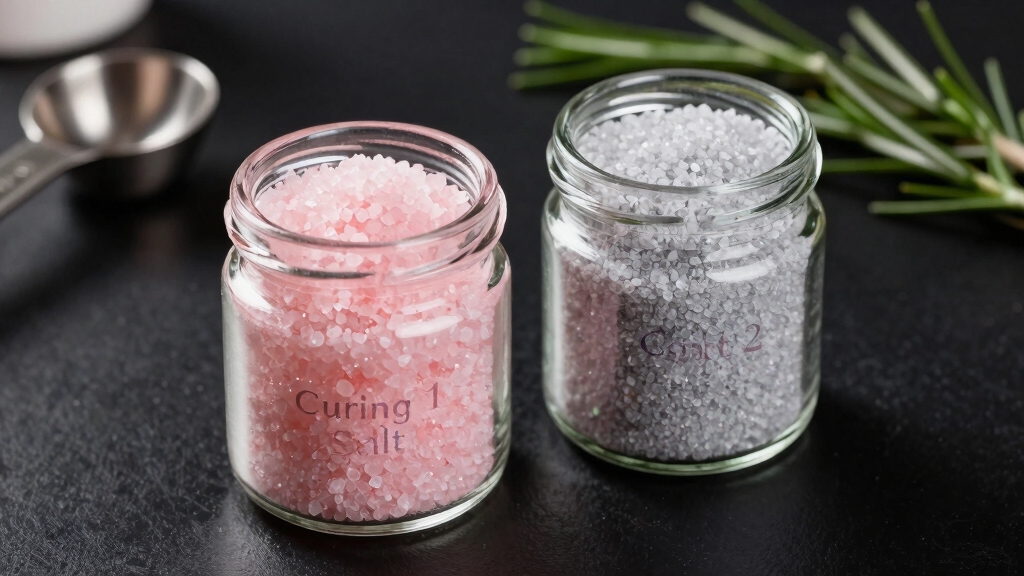
Curing Salt 1, also known as Prague Powder #1, combines sodium chloride and sodium nitrite to preserve meat quickly and effectively.
It contains precisely 6.25% sodium nitrite and 93.75% table salt, per federal regulations. The sodium nitrite delivers immediate antimicrobial action against Clostridium botulinum, preventing botulism during short curing periods.
When you apply Curing Salt 1, the nitrite converts to nitric oxide during cooking or smoking, producing the characteristic pink color and distinct cured flavor.
Its rapid preservation makes it ideal for wet curing methods and meats intended for prompt cooking, such as meat and fresh sausages.
You need to handle it carefully, as it’s not suitable for direct consumption like regular salt due to its concentrated nitrite content.
Curing salts like Prague Powder #1 are typically dyed pink to prevent confusion with pickling salt and ensure safe usage.
What Is Curing Salt 2 and How Is It Different?
How does Curing Salt 2 differ from its counterpart?
Curing Salt 2 combines sodium chloride, sodium nitrite (6.25%), and sodium nitrate (4%), unlike Curing Salt 1, which lacks nitrate.
This nitrate acts as a time-release preservative, gradually converting to nitrite over weeks or months.
It provides extended protection against bacteria like Clostridium botulinum in long-cured meats.
You’ll find Curing Salt 2 ideal for dry-curing processes requiring prolonged preservation, such as salami or prosciutto.
Both salts appear identical, but Curing Salt 2’s nitrate content supports slow curing and flavor development.
Proper curing and preservation techniques are essential to ensure food safety when preparing long-cured meats.
When to Use Curing Salt 1 Vs Curing Salt 2?
You’ll want to use Curing Salt 1 when you’re going for short-term cures and wet curing methods. It’s a great choice, especially for meats that you plan to cook or smoke later on.
On the other hand, if you’re looking at dry curing for a longer time, that’s where Curing Salt 2 comes into play. It’s perfect for air-dried products like salami or prosciutto.
Proper use of curing salts, combined with precise temperature control during smoking, ensures both safety and optimal texture in your meat products, as detailed in temperature handling controls.
Curing Duration Differences
When selecting the appropriate curing salt, you must consider the duration of the curing process. This directly influences which formulation will guarantee effective preservation and safety.
Curing Salt #1 provides immediate nitrite protection for short-term cures lasting hours to days. In contrast, Curing Salt #2 contains nitrate, which converts slowly to nitrite, supporting long-term cures spanning weeks or months.
Proper storage and handling are equally crucial to maintain curing salt efficacy and prevent spoilage, similar to how airtight containers extend shelf life in food preservation.
| Curing Salt Type | Curing Duration | Nitrite Source | Preservation Mechanism | Typical Use Case |
|---|---|---|---|---|
| #1 | Short-term | Sodium nitrite | Immediate bacterial inhibition | Meat, fresh sausages |
| #2 | Long-term | Sodium nitrate | Time-release nitrite conversion | Salami, dry-cured meats |
Choose based on your curing timeline for peak safety and flavor development.
Meat Type Compatibility
Select the correct curing salt based on the type of meat and its intended preparation to guarantee peak preservation and flavor.
Use Curing Salt #1 for meats that require short-term curing and subsequent cooking, smoking, or baking. It’s ideal for meat corned beef, and fresh sausages, providing immediate nitrite protection to inhibit bacterial growth.
Conversely, Curing Salt #2 is formulated for long-term curing of dry-cured, uncooked meats such as salami, prosciutto, pepperoni, and dry sausages. Its sodium nitrate content slowly converts to nitrite over time, ensuring prolonged preservation during extended aging.
Choosing the correct salt aligns with your product’s curing duration and consumption method. This prevents safety risks and optimizes flavor development in your cured meats.
Proper curing also requires maintaining water activity levels to effectively restrict microbial growth and ensure safety.
Wet vs Dry Methods
Determining the appropriate curing salt hinges on whether you’re employing a wet or dry curing method.
Use Curing Salt #1 for wet cures, where immediate nitrite action preserves the meat, typically dissolved in water. For dry curing, choose Curing Salt #2, which contains sodium nitrate that gradually converts to nitrite, supporting long-term preservation without liquid.
| Method | Salt Type | |
|---|---|---|
| Wet Curing | Curing Salt #1 | |
| Dry Curing | Curing Salt #2 | |
| Preservation | Immediate (Nitrite) | Gradual (Nitrate) |
| Application | Meat, Sausage | Salami, Prosciutto |
| Duration | Hours-Days | Weeks-Months |
Selecting the correct curing salt based on curing method guarantees safety and prime meat quality. Including antimicrobial agents such as nitrates and nitrites in the curing step is essential to inhibit bacterial growth and ensure food safety during processing.
How Curing Salt 1 and 2 Preserve Meat and Ensure Safety?
Curing Salt #1 is your go-to for immediate protection against harmful bacteria, like Clostridium botulinum.
It works quickly to preserve your meat, which is super important for safety.
On the other hand, Curing Salt #2 has a different approach.
It uses nitrate as a time-release source of nitrite, giving you extended protection, especially for those long-cured meats.
Understanding how these salts work is really crucial.
If you misapply them, you could face some serious safety risks and even jeopardize the quality of your meat.
Using curing salt also enhances color, flavor, and preservation, making it essential for safe and tasty homemade beef sticks.
Nitrite’s Role In Preservation
The effectiveness of curing salts hinges on nitrite’s critical role in meat preservation and safety.
When you apply Curing Salt #1 or #2, sodium nitrite acts immediately to inhibit Clostridium botulinum and other spoilage bacteria, preventing toxin formation.
Nitrite penetrates the meat, reacting to form nitric oxide, which stabilizes the meat’s color and flavor while halting microbial growth.
This antimicrobial action guarantees the product remains safe during curing and subsequent cooking or drying.
In Curing Salt #2, nitrite derives partly from sodium nitrate’s gradual conversion, but nitrite remains the active agent controlling bacterial hazards.
You must use nitrite-containing curing salts precisely because nitrite’s biochemical interactions are essential for both preservation efficacy and food safety compliance.
Proper use of curing salts also requires strict adherence to temperature control to inhibit bacterial growth and ensure safety during curing.
Nitrate’s Time-Release Mechanism
While nitrite provides immediate antimicrobial protection in cured meats, nitrate plays a critical role in long-term preservation through its slow conversion to nitrite over time.
When you use Curing Salt #2, the sodium nitrate acts as a time-release agent, breaking down gradually to replenish nitrite levels during extended curing periods.
This slow conversion guarantees sustained antimicrobial activity, particularly against Clostridium botulinum, throughout weeks or months of dry curing.
Unlike Curing Salt #1, which delivers immediate nitrite, the nitrate in Curing Salt #2 maintains meat safety and flavor development over prolonged aging.
This mechanism is essential for dry-cured products like salami and prosciutto, where continuous nitrite presence prevents spoilage without immediate nitrite application.
Understanding this time-release process helps you choose the right curing salt for your preservation timeline.
Proper storage conditions, such as maintaining consistent subzero temperatures, are also crucial to preserve the quality and safety of cured meats during long-term storage.
Safety Differences And Risks
Because curing salts contain concentrated levels of nitrite and nitrate, their correct use is critical for both preserving meat and guaranteeing food safety. Curing Salt #1 delivers immediate nitrite protection, preventing Clostridium botulinum growth in short-term curing.
In contrast, Curing Salt #2 contains sodium nitrate, which slowly converts to nitrite, offering sustained antimicrobial action in long-term dry curing. Misusing these salts, such as substituting #2 for #1 in quick cures, can lead to insufficient nitrite levels, increasing botulism risk.
Additionally, both salts must never be consumed directly due to toxicity from high nitrite concentrations. You must precisely follow curing durations, meat types, and application methods to avoid safety hazards and preserve product integrity.
Understanding these differences guarantees effective microbial control and safe, high-quality cured meats. Proper fermentation at 55–60°F and 65–80% humidity is essential to activate starter cultures and ensure safety during curing.
Choosing Wet Vs Dry Cure Methods for Curing Salt 1 and 2
Choosing between wet and dry cure methods hinges on understanding how Curing Salt #1 and #2 interact with meat and moisture.
Deciding on wet or dry curing depends on how Curing Salts #1 and #2 work with meat and moisture.
You’ll use Curing Salt #1 primarily in wet curing, where it dissolves in water to provide immediate nitrite protection. This method suits quick preservation of meats like meat or corned beef, where you immerse or inject the meat with the curing solution.
Conversely, Curing Salt #2 is tailored for dry curing, where sodium nitrate slowly converts to nitrite over time, enabling long-term preservation without liquid.
Dry curing involves rubbing the salt directly on air-dried products like salami or prosciutto.
Selecting the appropriate method guarantees peak nitrite release timing, preservation efficacy, and flavor development. Match your curing salt choice precisely to your wet or dry curing technique.
Why Never Substitute Curing Salt 1 for 2?
If you substitute Curing Salt #1 for #2, you risk compromising both safety and product quality due to their distinct chemical compositions and curing functions.
Curing Salt #1 contains sodium nitrite only, providing immediate bacterial inhibition for short cures.
In contrast, Curing Salt #2 includes sodium nitrate, which slowly converts to nitrite over time, essential for long-term preservation.
Using #1 in place of #2 removes this gradual nitrate release, risking botulism in extended cures.
Additionally, #1’s formulation suits wet curing and quick processing, while #2 is optimized for dry curing and flavor development over weeks or months.
Misapplication alters curing kinetics, texture, and flavor profiles, and may fail to prevent pathogen growth.
Always select the correct salt to ensure safety and achieve intended curing results.
Best Meats and Recipes for Each Curing Salt
Select the appropriate curing salt based on the type of meat and intended recipe to guarantee peak preservation and flavor development.
Use Curing Salt #1 for meats that will be cooked or smoked shortly after curing, such as meat, corned beef, and fresh sausages. Its sodium nitrite content offers immediate bacterial inhibition, ideal for short-term wet curing.
Conversely, Curing Salt #2 suits dry-cured, uncooked products like salami, pepperoni, prosciutto, and dry sausages. It relies on sodium nitrate’s slow conversion to nitrite for extended preservation and flavor maturation over weeks or months.
Applying the correct curing salt guarantees safety against Clostridium botulinum and achieves the desired texture and taste. Always match your curing salt choice precisely to your meat type and curing duration for prime results.
Frequently Asked Questions
Can Curing Salts Be Stored Long-Term Without Losing Effectiveness?
Yes, you can store curing salts long-term without losing effectiveness if you keep them in a cool, dry place, away from moisture and sunlight.
Make sure to seal the containers tightly to prevent contamination or moisture absorption.
Proper storage preserves the sodium nitrite and nitrate’s potency, ensuring they remain effective for meat preservation and safety over time.
Avoid exposure to air and humidity to maintain curing salt stability.
Are Curing Salts Safe for People With Dietary Sodium Restrictions?
Curing salts aren’t safe for people with dietary sodium restrictions because they contain high levels of sodium chloride combined with sodium nitrite or nitrate.
This concentrated sodium content can markedly increase your sodium intake, which may worsen hypertension or cardiovascular conditions.
If you need to limit sodium, avoid using curing salts or consult a healthcare professional for alternatives that fit your dietary needs without compromising food safety or preservation.
How Should Curing Salts Be Disposed of if Expired or Unused?
If you find expired or unused curing salts, don’t just toss them in the trash or pour them down the drain. You’ll risk environmental contamination.
Instead, seal them tightly in a plastic bag to prevent moisture exposure. Then check local hazardous waste disposal guidelines for proper drop-off locations.
Many municipalities treat curing salts like other chemical preservatives. Following these protocols guarantees safety and compliance with environmental regulations.
Do Curing Salts Affect the Texture of Meat Differently?
Yes, curing salts affect meat texture differently.
When you use Curing Salt #1, it acts quickly, firming the meat through immediate nitrite action.
This is ideal for short cures.
Curing Salt #2 slowly releases nitrite via nitrate conversion.
This promotes gradual protein breakdown and moisture loss, resulting in a denser, drier texture typical of long-aged products.
Your choice directly influences the meat’s final texture based on curing duration and method.
Can Curing Salts Be Used for Non-Meat Food Preservation?
You can use curing salts for non-meat food preservation, but it’s uncommon and requires caution.
These salts specifically target bacteria like Clostridium botulinum, which typically threaten meat products.
Applying them to vegetables or fish demands precise dosage and understanding of chemical effects.
Because of their nitrite and nitrate content, misuse risks toxicity or off-flavors.
Always follow tested recipes and safety guidelines when extending curing salt use beyond meat.
Choose the Right Curing Salt for Safe and Flavorful Results
Choosing between curing salt 1 and curing salt 2 depends on your specific curing needs. You might worry that using curing salt 1 for long-term cures could work, but it lacks the nitrate essential for extended preservation.
Using the correct salt secures safety by preventing bacterial growth and preserving meat quality. Always match the curing salt to your recipe and cure type. This precision guarantees both flavor and food safety in your cured meats.