How Long Do You Dehydrate Deer Jerky: Perfect Texture Every Time
You’ll typically dehydrate deer jerky within 3 to 5 hours, depending on whether you use sliced or ground venison.
Start sliced strips at 165°F for about 3 hours, then reduce to 140–145°F to preserve texture.
Ground venison requires a steady 165°F for 4 to 5 hours.
Keep airflow steady and check moisture levels frequently to avoid over-drying.
Achieving that ideal pliable texture requires careful timing and temperature control.
There’s more to optimizing your process for perfect jerky.
Key Takeaways
- Dehydrate sliced deer jerky for 3 to 5 hours, starting at 165°F then lowering to 140–145°F after 3 hours.
- Ground venison jerky requires 4 to 5 hours total, maintaining 165°F throughout and flipping halfway.
- Ensure internal temperature reaches 160°F for food safety before completing dehydration.
- Use airflow and rack spacing to promote even drying and prevent longer dehydration times.
- Check jerky texture after minimum time; it should be pliable but dry, cracking slightly without breaking.
An Overview of Dehydrating Deer Jerky

Although the dehydration time for deer jerky typically ranges from 3 to 5 hours, you’ll need to adjust based on factors like temperature, humidity, and airflow to achieve the ideal texture.
You should start the process at 165°F, then reduce to 140-145°F after about 3 hours. This allows the jerky to dry evenly without becoming brittle.
Keep in mind, ground venison jerky requires a slightly longer total time, typically 4-5 hours, and maintains a steady 165°F throughout.
It’s critical to arrange jerky strips with adequate spacing to promote consistent airflow, which directly impacts drying efficiency.
Regularly inspecting for dryness after the minimum time prevents over-drying, which leads to an undesirable, overly hard texture.
Accurate timing and temperature control guarantee your jerky is pliable yet dry.
For best results, ensure your jerky reaches an internal temperature of 160°F for food safety before completion.
How Long Does Deer Jerky Take to Dehydrate?
Dehydrating deer jerky usually takes about 3 to 5 hours. The exact time can vary a bit based on whether you’re using whole strips or ground venison.
Now, there are a few things to keep in mind that can affect the drying process. Factors like the temperature settings, humidity levels, and airflow in your dehydrator can really play a role. Additionally, it’s important to maintain proper moisture control and avoid repeated freeze-thaw cycles to ensure safe and high-quality jerky.
Typical Dehydration Times
Dehydrating deer jerky typically takes between 3 to 5 hours, depending on factors like meat thickness, temperature settings, and humidity.
You should start by setting your dehydrator to 165°F for the initial 3 hours to guarantee proper bacterial reduction.
After that, lowering the temperature to around 140-145°F helps maintain texture while completing dehydration.
If you’re working with ground venison, expect a total drying time closer to 4 to 5 hours, splitting time between both sides for even drying.
Check your jerky after the 3-hour mark by bending a piece; it should crack but not break.
Over-drying leads to brittle jerky, so precise timing and monitoring are key to achieving the ideal balance between dryness and pliability.
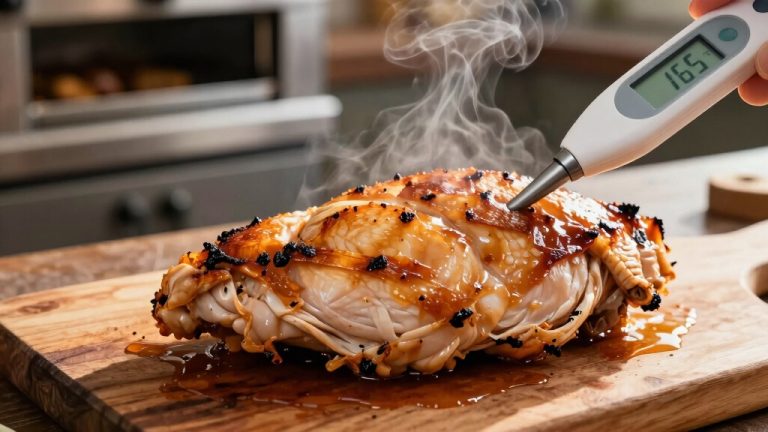
To ensure safety, it is important to verify that the jerky reaches an internal temperature of 160°F using a metal stem thermometer.
Factors Affecting Duration
Since several variables influence dehydration time, you should consider factors like meat thickness, temperature settings, humidity, and airflow when estimating how long deer jerky takes to dry.
Thicker slices require longer drying, as moisture takes more time to evaporate internally.
Maintaining the correct temperature is vital: start at 165°F, then lower to 140-145°F after three hours to avoid over-drying. Ground venison stays at 165°F throughout.
High humidity slows dehydration by reducing evaporation rates, so ensure adequate airflow for consistent drying.
Improper spacing on racks restricts airflow, extending drying time and risking uneven texture.
Regularly checking jerky after three hours helps you adjust timing precisely, preventing brittleness from over-drying and ensuring a pliable, properly dehydrated product.
Additionally, controlling water activity during drying is essential to inhibit microbial growth and ensure jerky safety.
Which Temperature Works Best for Deer Jerky?
When making deer jerky, you’ll want to kick things off at 165°F. This temperature is crucial for ensuring that the meat dries safely and effectively. After a few hours, you can lower the heat to around 140-145°F. This helps maintain that perfect texture we all love.
Now, if you keep the temperature too high for too long, you might end up with jerky that’s just too dry and brittle. And nobody wants that! So, it’s really important to adjust the heat during the drying process. This small tweak can make a big difference in how much moisture is removed and how chewy your final product turns out. Just remember, precise control is the name of the game!
For best results, maintaining the meat just above refrigerator temperature helps promote even drying and prevents thermal shock during the process.
Optimal Temperature Settings
Although temperature control is vital for achieving the perfect texture in deer jerky, many people overlook its nuanced impact on dehydration outcomes.
You need to start dehydrating at 165°F to guarantee safe, effective drying. After about 3 hours, lowering the temperature to 140-145°F helps prevent overcooking and maintains flavor.
For ground venison, keep the temperature steady at 165°F throughout.
Key points to optimize temperature settings:
- Begin at 165°F for initial dehydration to kill bacteria effectively.
- Reduce to 140-145°F after 3 hours for whole muscle jerky.
- Maintain consistent 165°F for ground venison to guarantee thorough dehydration.
- Avoid prolonged high heat to prevent texture degradation and uneven drying.
Mastering these settings guarantees your jerky dries evenly and safely every time. Using a digital meat thermometer ensures accurate monitoring of internal temperatures during dehydration for food safety.
Temperature Impact on Texture
When you control the temperature precisely during dehydration, you directly influence the texture of your deer jerky. Maintaining 165°F initially guarantees rapid moisture removal without overcooking, setting a firm but pliable base texture.
After about three hours, lowering the temperature to 140-145°F prevents excessive drying, preserving chewiness and preventing brittleness. Keeping the temperature constantly at 165°F risks producing overly dry, tough jerky that cracks excessively.
For ground venison jerky, steady 165°F works best due to its different moisture content and thickness. This allows uniform drying without texture compromise. Ideal temperature control balances moisture evaporation and protein denaturation to achieve jerky that bends and cracks slightly without breaking.
This ensures a satisfying chew and extended shelf life.
Additionally, ensuring the internal temperature reaches at least 165°F during processing is crucial to reduce pathogen risk and guarantee safety.
Adjusting Temperature During Drying
Since temperature directly influences moisture removal and texture development, adjusting it thoughtfully during drying is essential for achieving peak deer jerky quality.
Start by setting your dehydrator to 165°F for the first three hours. This initial high heat quickly removes surface moisture.
Afterward, reduce the temperature to 140-145°F to allow gradual drying without overcooking. For ground venison, maintain 165°F throughout to guarantee thorough dehydration.
Monitor texture closely and avoid prolonged high temperatures, which can cause brittleness.
Begin at 165°F to efficiently remove moisture.
Lower to 140-145°F after 3 hours for prime texture.
Keep ground venison jerky at 165°F continuously.
Avoid excessive heat to prevent over-drying and toughness.
Adjusting temperature this way balances drying speed and jerky quality.
Cold smoking meats requires careful temperature control typically between 80°F and 100°F to avoid partial cooking during processing.
Adjust Dehydrator Settings for Deer Jerky
Because temperature control directly influences the texture and safety of your deer jerky, you’ll need to carefully adjust your dehydrator settings throughout the drying process.
Start by setting the dehydrator to 165°F for the first 3 hours to eliminate bacteria. After this phase, reduce the temperature to 140-145°F to avoid over-drying and preserve texture. For ground venison, maintain 165°F throughout.
| Jerky Type | Initial Temp (°F) | Final Temp (°F) |
|---|---|---|
| Sliced Venison | 165 (3 hours) | 140-145 |
| Ground Venison | 165 (entire time) | 165 |
| All Types | Monitor airflow | Adjust as needed |
Precise temperature and airflow adjustments guarantee consistent drying and peak jerky quality. Properly trimmed lean cuts and thin slicing against the grain ensure even drying and tender jerky texture.
How to Check If Deer Jerky Is Done?
Although dehydration times provide general guidance, you should rely on specific physical tests to determine if your deer jerky is done. Simply following the clock risks under- or over-drying, so employ tactile and visual checks after the minimum drying period.
Dehydration times guide you, but physical checks ensure your deer jerky is perfectly dried every time.
To confirm doneness:
- Bend a piece; it should crack slightly but not break apart.
- Feel the texture; jerky must be dry to the touch yet pliable when cooled.
- Inspect the center for any moistness, a sign it needs more drying.
- Perform tests after cooling, as warmth can mask true dryness.
These precise, repeatable checks guarantee your venison jerky achieves peak dryness, flavor, and shelf stability without becoming brittle or under-processed. Proper packaging in airtight containers after drying is essential to preserve quality and prevent moisture reabsorption.
Dehydrating Ground vs. Sliced Venison: Time and Tips
When you dehydrate ground venison, expect a longer total drying time compared to sliced strips due to its denser, uniform texture. Ground venison typically requires about 4-5 hours, beginning with 2 hours at 165°F.
Then, dry for an additional 2-3 hours after flipping, maintaining a consistent temperature throughout.
In contrast, sliced venison strips usually dry faster, around 3-5 hours, with an initial 165°F phase followed by a temperature reduction to 140-145°F to prevent over-drying.
Proper arrangement is vital. Pipe ground venison onto parchment-lined racks with space between strips. Sliced strips need even spacing for airflow.
Monitoring doneness is essential for both. Ground jerky should bend and crack without breaking. Sliced jerky demands careful temperature control to achieve the ideal pliable texture without brittleness.
Using an Oven to Make Deer Jerky
Consider using your oven as a practical alternative to a dehydrator for making deer jerky. Setting your oven to its lowest temperature, ideally around 175°F, mimics the controlled drying environment a dehydrator provides.
You’ll want to keep a close eye on the jerky, checking doneness around the three-hour mark to avoid over-drying or uneven cooking.
Follow these tips for effective oven dehydration:
Arrange jerky strips on baking sheets with adequate spacing for air circulation. Bake for 3 to 4 hours, flipping halfway for even drying.
Monitor texture carefully; finished jerky should bend without breaking. Avoid higher temperatures to preserve texture and prevent toughness.
This method offers a reliable solution if you don’t have a dehydrator, delivering comparable results with attentive temperature control.
Preparing Venison for Jerky Dehydration
Marinating venison properly is essential to achieving consistent dehydration and peak flavor in your jerky.
You should marinate the strips for 6 to 24 hours, shaking the container occasionally to make sure every piece is evenly coated.
After marinating, pat the excess marinade off with paper towels to prevent uneven drying.
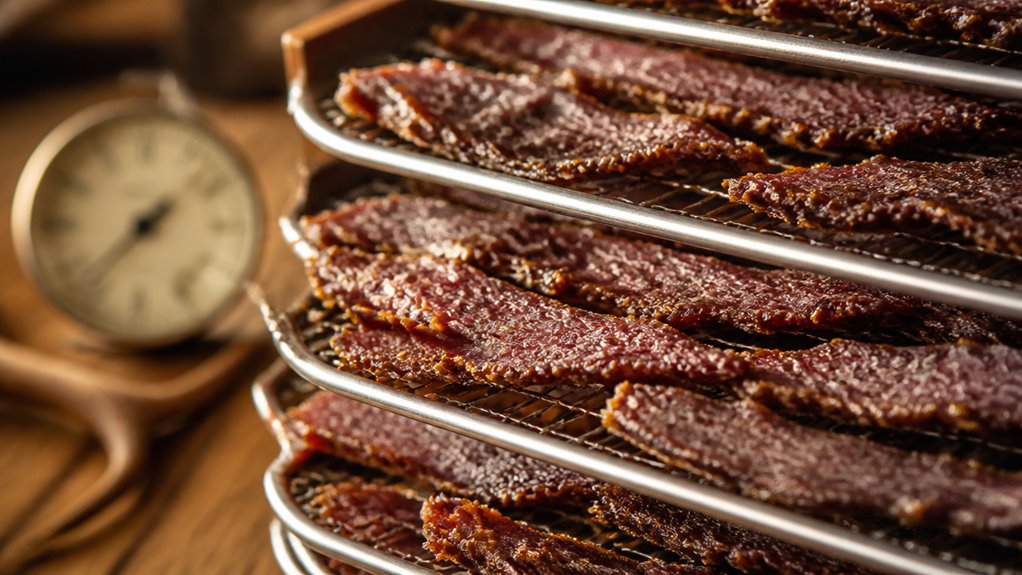
Arrange the strips on dehydrator racks with enough space between them to allow proper airflow.
This spacing is critical for uniform dehydration.
If you’re using ground venison, pipe it onto parchment-lined racks, keeping strips separate.
Precise preparation directly affects dehydration time and texture, so don’t overcrowd or leave marinade residue.
Following these steps makes certain your venison dries evenly, resulting in tender, flavorful jerky with the ideal balance of moisture and chew.
How to Store Deer Jerky and Extend Shelf Life?
To maximize the shelf life of your deer jerky, proper storage conditions are crucial. You want to minimize moisture exposure and temperature fluctuations, as these accelerate spoilage and degrade texture. Use airtight containers or vacuum sealing to reduce oxygen contact and preserve flavor.
Consider these storage tips to extend jerky longevity:
Store jerky in a cool, dark place at room temperature for up to one week.
Refrigerate in sealed containers to maintain quality for several weeks.
Vacuum-seal and keep in a cool, dark space to extend shelf life to about one month.
Freeze vacuum-sealed jerky for up to six months without significant quality loss.
Following these guidelines guarantees your jerky remains safe, flavorful, and pliable for as long as possible.
Frequently Asked Questions
Can I Dehydrate Deer Jerky Without Marinating It First?
Yes, you can dehydrate deer jerky without marinating it first, but skipping marinade affects flavor and texture.
Marinating tenderizes the meat and infuses seasoning, enhancing taste and moisture retention. Without it, your jerky may be tougher and less flavorful.
If you choose to skip marination, make sure you dry thin, evenly sliced strips and monitor drying closely to avoid over-drying or uneven texture.
Raw meat lacks the protective benefits marinade provides.
What Type of Wood Chips Enhance the Smoky Flavor During Dehydration?
Imagine you’re smoking jerky using hickory wood chips, known for its bold, slightly sweet flavor that complements venison perfectly.
Hickory’s robust smoke enhances the jerky’s natural taste without overpowering it. For a subtler, sweeter profile, you might try applewood, which adds a mild fruity aroma.
Choosing wood chips like hickory or applewood lets you control the smoky intensity, tailoring your jerky’s flavor precisely to your liking during dehydration.
Is It Safe to Eat Deer Jerky Immediately After Dehydration?
You shouldn’t eat deer jerky immediately after dehydration because it needs to cool and rest first. Right out of the dehydrator, it might still be too warm and pliable, which can affect texture and safety.
Let it cool to room temperature so moisture redistributes evenly. This guarantees it’s properly dried inside, reducing bacterial risks.
Testing flexibility after cooling confirms it’s safe and ready to eat without compromising quality.
How Does Humidity Affect the Drying Time of Deer Jerky?
Humidity slows down the drying time of your deer jerky by reducing moisture evaporation from the meat’s surface.
When the air is humid, moisture lingers longer, so you’ll need to dehydrate for extra time to achieve proper dryness.
To counteract this, guarantee good airflow in your dehydrator and consider lowering humidity in your drying space.
Always check jerky doneness periodically, especially in high humidity, to avoid under-drying.
Can I Reuse Marinade for Multiple Batches of Venison Jerky?
Imagine dipping a paintbrush repeatedly into the same puddle. It quickly loses its color and picks up unwanted bits.
You shouldn’t reuse marinade for multiple venison jerky batches because it risks bacterial contamination and flavor dilution. Each batch needs fresh marinade to guarantee consistent seasoning and food safety.
While tempting to save time, fresh marinade maintains jerky quality and prevents spoilage. This preserves both taste and health standards effectively.
Perfectly Dehydrated Deer Jerky Starts Here
Now that you know dehydrating deer jerky takes about 4-8 hours at 145°F, you can confidently prepare your venison.
For example, Jake dried his sliced deer meat for 6 hours, achieving perfect texture and flavor. Remember, adjusting time and temperature based on thickness guarantees safe, tasty jerky.
With careful monitoring, you’ll enjoy delicious, long-lasting jerky every time, ideal for camping trips or quick protein snacks.