What Temp to Pull Turkey off Smoker: Resting Temp Matters
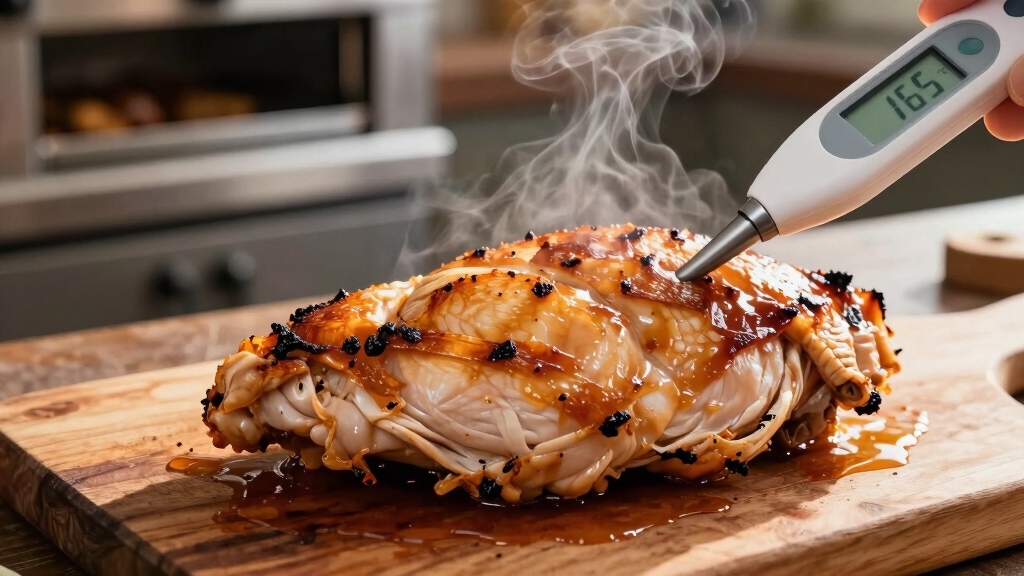
You should pull turkey breasts from the smoker at 158–160°F and thighs at 168–170°F to allow for the 5–7°F carryover temperature rise that secures safe final temps without overcooking.
Maintaining at least 155°F during smoking with proper hold times guarantees pathogen reduction. Continuous probe thermometers help monitor accuracy.
Pulling at these temperatures balances safety and juiciness. Exploring smoker temp strategies and timing will enhance your cooking precision and results.
Key Takeaways
- Pull turkey breasts at 158–160°F to allow a 5–7°F carryover rise to a safe final temperature.
- Pull turkey thighs at 168–170°F to reach the USDA safe temperature after resting.
- Maintain a minimum internal temp of 155°F during smoking to ensure safety with proper resting holds.
- Use continuous probe thermometers to monitor internal temps accurately and avoid overcooking.
- Rest turkey after pulling to let carryover cooking complete and juices redistribute for optimal moisture.
Target Internal Temperatures for Safe, Juicy Turkey

To make certain your turkey is both safe to eat and juicy, you need to target specific internal temperatures for different parts of the bird.
The USDA recommends a minimum final temperature of 165°F for breasts and 170–175°F for thighs.
However, safety can also be achieved at lower temps with proper hold times. Breasts held at 155°F for at least 1.2 minutes or 157°F for 47.9 seconds effectively kill pathogens.
When smoking, pull the turkey 5–7°F below these targets, typically 158–160°F for breasts and 168–170°F for thighs, to allow for carryover cooking, which raises the temperature after removal.
Maintaining a minimum internal temp of 155°F during smoking guarantees safety, with resting periods enabling the meat to reach final safe temperatures without overcooking. This preserves juiciness and texture.
Using a continuous probe thermometer during smoking helps monitor these temperatures accurately to ensure both safety and optimal doneness.
Turkey Safety: Understanding Temperature and Hold Times
Although the USDA sets 165°F as the safe internal temperature for turkey, you can rely on scientifically validated lower temperatures combined with specific hold times to guarantee safety without sacrificing moisture.
For example, breasts held at 155°F for 1.2 minutes or 157°F for 47.9 seconds achieve equivalent bacterial reduction as 165°F instantaneously.
This time-temperature relationship allows you to pull the turkey at slightly lower temperatures, such as 158-160°F for breasts and 168-170°F for thighs, relying on carryover cooking and resting to reach final safe temps.
Maintaining the internal temperature at or above 155°F with appropriate hold times assures pathogen inactivation.
Using precise probes and timing, you can balance safety with peak juiciness, avoiding overcooking while adhering to FSIS guidelines that permit these validated temperature-hold combinations.
For best results, always use a reliable meat thermometer to verify internal temperatures during cooking and resting.
When to Pull Your Turkey Off the Smoker for Best Results?
Consistently monitoring your turkey’s internal temperature is vital for deciding the best moment to pull it from the smoker. Target breasts should read between 158°F and 160°F, while thighs should be between 168°F and 170°F at removal to guarantee safety and optimal texture.
Monitor internal temps closely; pull breasts at 158-160°F and thighs at 168-170°F for perfect safety and texture.
These pull temperatures account for carryover cooking, preventing overcooking while reaching USDA safety standards. Using a reliable probe thermometer, check the thickest parts of both breasts and thighs multiple times.
Avoid relying solely on cooking time or smoker temperature, as variables affect heat transfer. Pulling at these precise temperatures, especially breasts at 157-160°F, guarantees bacterial elimination with minimal moisture loss.
This evidence-based approach balances food safety, texture, and juiciness, assuring your turkey achieves ideal doneness straight from the smoker. Additionally, maintaining smoker temps between 225–250°F during the initial smoking phase helps preserve moisture and supports consistent cooking throughout the process, enhancing overall results and flavor development through temperature control.
How Carryover Cooking Raises Turkey Temperature After Pulling?
Understanding carryover cooking is essential for perfecting your turkey’s final temperature and texture.
After you pull the bird from the smoker at around 158-160°F for breasts and 168-170°F for thighs, residual heat continues to raise the internal temperature by 5-7°F.
This phenomenon guarantees the turkey reaches the USDA-recommended safe temperatures without overcooking during smoking.
You’ll appreciate that:
- Resting allows juices to redistribute, enhancing moisture retention.
- The temperature rise prevents undercooking while avoiding dryness.
- Pulling too early risks safety and chewiness.
- Pulling too late can yield dry, tough meat.
Maintaining a steady smoker temperature between 225–275°F during cooking supports optimal carryover effects and even cooking.
Choosing the Best Smoker Temperature to Cook and Pull Turkey
Select your smoker temperature carefully to balance cooking time, flavor development, and skin texture when preparing turkey.
Smoking at 225-275°F with a water pan optimizes flavor and moisture, but cooking is slower. Expect 20-30 minutes per pound.
At 300°F, you’ll get crisper skin faster, around 2.5 hours to reach 155°F internal, avoiding rubbery texture.
For safety, pull breasts at 158-160°F and thighs at 168-170°F, allowing 5-7°F carryover rise.
USDA recommends a minimum breast temperature of 165°F, but evidence shows 157°F held for 48 seconds achieves equivalent pathogen reduction.
Lower smoker temps require longer hold times for safety.
Choose 225-275°F for traditional smoking and flavor depth. Opt for 300°F if crisp skin and shorter cook times are priorities.
Monitor temperatures precisely to pull turkey at best safety and quality.
Smoking at 300°F reduces cook time markedly compared to lower temperatures, making it ideal when speed and texture are prioritized over intense smoke, as detailed in our smoking guide.
Frequently Asked Questions
How Do Different Turkey Sizes Affect Smoking and Pull Times?
As your turkey size increases, you’ll notice longer smoking and pull times due to greater mass needing heat penetration.
Smaller birds cook faster; for example, a 12-pound turkey takes about 4-5 hours at 225°F, while a 14-pound one requires around 7 hours.
Adjust your pull temperature slightly earlier on smaller birds to allow for carryover cooking, ensuring safe internal temps without overcooking.
Always monitor internal temps for precision.
What Types of Wood Chips Best Complement Turkey Smoking Flavors?
You’ll want to use mild, fruitwood chips like apple or cherry to complement turkey’s delicate flavor without overpowering it.
Hickory and pecan add a stronger, smoky depth but can dominate if overused.
Maple offers subtle sweetness, while mesquite is usually too intense for turkey.
Experiment with blends to balance sweet and smoky notes, maintaining a controlled smoke density for prime flavor infusion during your smoking process.
Can Brining Alter the Ideal Pull Temperature for Turkey?
Yes, brining can alter your ideal pull temperature slightly.
Since brining increases moisture content, it may allow you to pull the turkey at a slightly lower temperature, relying on carryover cooking to reach safe levels.
You can safely pull breasts around 157-158°F instead of the usual 160-165°F, as brined meat retains juiciness better.
Just make sure you rest the bird adequately for carryover heat to finish cooking and kill bacteria.
How to Avoid Dry Skin When Smoking Turkey at Higher Temps?
To keep turkey skin moist at higher smoker temps, start by using a water pan to maintain humidity.
Searing at 300°F crisps skin but risks drying it out, so foil-wrap the bird midway to lock in moisture.
Basting or spritzing every 30 minutes helps too.
Remember, a steady smoker temp around 265-275°F balances skin crispness with juiciness.
Don’t put all your eggs in one basket by pushing temps too high without moisture control.
What Tools Ensure the Most Accurate Internal Temperature Reading?
You should use a high-quality instant-read digital thermometer with a thin, fast-penetrating probe for the most accurate internal temperature reading.
Thermometers with calibration options guarantee precision over time.
Consider wireless or Bluetooth-enabled models for continuous monitoring without opening the smoker.
Avoid dial thermometers; they respond slowly and lack accuracy.
Always insert the probe into the thickest part of the breast or thigh, avoiding bone for reliable readings.
Final Temperature, Perfect Turkey: Finish Strong Every Time
When smoking your turkey, pull it at an internal temperature of 155°F to 160°F to guarantee safety and juiciness.
Remember, carryover cooking will raise the temp by 5 to 10 degrees while resting, reaching the USDA-recommended 165°F. Cooking at 225°F to 275°F balances smoke absorption and even cooking.
Think of it like dialing up a rotary phone; timing and precision matter for a perfectly cooked bird. Follow these guidelines for consistent, delicious results every time.