Pull Brisket at 190: Is It Ready or Should You Keep Cooking?
You can pull your brisket at 190°F if your probe slides in like warm butter, signaling that the connective tissue has broken down.
Temperature alone isn’t enough; some spots might still be firm and need more cooking or resting.
At 190°F, you’ll often need a longer rest to let residual heat finish tenderizing and raise the internal temp to 195°F–205°F.
If you want to master timing, tenderness checks, and how resting affects texture, there’s more to explore.
Key Takeaways
- Pulling brisket at 190°F can be acceptable if probe tenderness confirms connective tissue breakdown.
- Temperature alone at 190°F is less reliable; smooth probe insertion indicates optimal tenderness.
- Residual heat during resting can raise internal temp by 5–10°F, completing collagen breakdown.
- If probe resistance is firm at 190°F, additional cooking or longer rest is needed.
- Rest brisket for at least 30–60 minutes, wrapped and insulated, to maximize tenderness and juiciness.
When Is It Okay to Pull Brisket at 190°F?

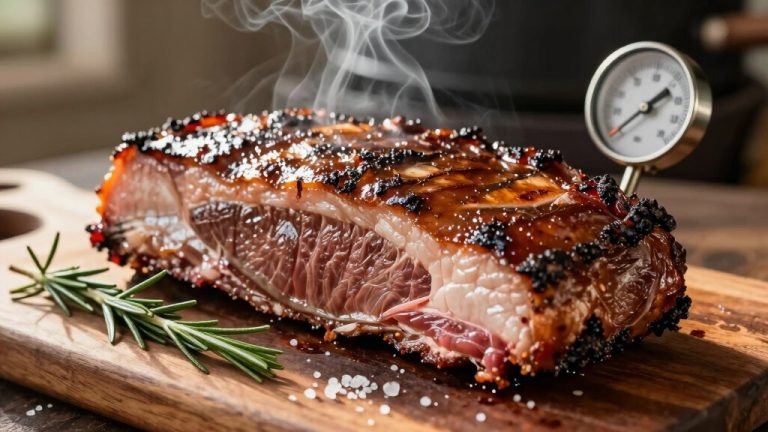
Although many experts recommend pulling brisket at 195°F or higher, you can pull it at 190°F if your probe test confirms tenderness. When the probe slides in smoothly with little resistance, like warm butter, the connective tissues have broken down enough for a tender bite.
This lower temperature pull often works well if you’ve wrapped the brisket during the stall and allowed it to rest properly afterward. Residual heat raises the internal temp by 5–10°F. However, pulling at 190°F without checking tenderness risks a chewy texture since some collagen may remain intact.
Use 190°F as a checkpoint. If the probe resists, keep smoking. If tenderness is there, you’re good to pull early and enjoy a juicy brisket. Keep in mind that collagen breakdown depends on both temperature and time, so probe tenderness is a more reliable indicator than temperature alone.
Why Probe Tenderness Matters More Than Temperature?
Pulling brisket based solely on temperature can lead you astray, especially since every cut cooks a bit differently.
Relying only on temperature for brisket can mislead you; each cut cooks uniquely.
Instead, focus on probe tenderness, the true indicator of doneness.
When the probe slides into the thickest part smoothly, like warm butter, you know the connective tissues have broken down properly.
Temperature alone doesn’t reveal this; a brisket at 190°F might still resist the probe, signaling it needs more time.
Checking tenderness helps you avoid chewy, undercooked meat even if the thermometer reads in the safe range.
Remember, probe tenderness accounts for the brisket’s unique texture and fat distribution, giving you a more reliable gauge than temperature alone.
Trust your probe’s feel to deliver perfectly tender brisket every time.
For best results, insert your probe into the thickest part of the flat muscle to accurately assess internal tenderness and temperature.
Tips for Checking Brisket Tenderness at 190°F
When your brisket hits around 190°F, it’s crucial to test probe tenderness carefully to avoid premature pulling.
Temperature alone won’t guarantee tenderness—you need to rely on how the meat feels. Here’s how to check it effectively:
- Insert your probe into the thickest part of the flat. It should slide in smoothly, like warm butter, with little resistance. If it feels tough or rubbery, the brisket needs more time.
- Check multiple spots since tenderness can vary across the brisket. Don’t rely on just one test point.
- Gently lift or shake the brisket. If it jiggles or bends easily, that’s a good sign the connective tissue is breaking down.
Also, be mindful that spritzing during the cook can affect surface moisture and bark texture, which may influence how the brisket feels when testing for tenderness, so understanding spritzing effects can help in making a better pull decision.
Master these checks to confidently decide if your brisket’s ready to pull at 190°F.
Wrapping Tricks to Hit 190°F Faster
Since the stall can slow your brisket’s temperature climb around 150°F–170°F, wrapping it in butcher paper or foil can help push it past 190°F faster and more evenly.
When you wrap, you trap moisture and heat, reducing evaporation and speeding up the internal temperature rise.
Wrapping traps heat and moisture, cutting evaporation to boost your brisket’s temperature rise.
Foil creates a tighter seal, accelerating the process more than butcher paper, which allows some breathability and helps maintain bark texture.
To wrap effectively, place the brisket in a large sheet, fold tightly, and seal edges well to retain heat.
After wrapping, return it to the smoker and monitor the temperature closely.
This method not only shortens stall time but also promotes more even cooking, helping you reach 190°F with less risk of drying or uneven doneness.
What Happens When You Pull Brisket at 190°F?
Reaching 190°F often feels like a milestone during your cook, especially after wrapping helps push the brisket through the stall.
When you pull brisket at 190°F, you’re stepping into a borderline zone where tenderness isn’t fully guaranteed. Here’s what happens:
- The connective tissue has started breaking down but may not be completely tender, potentially causing a chewier texture.
- The internal temperature will likely rise another 5–10°F during rest, inching closer to the ideal 195°F–205°F range.
- If the meat is probe-tender at this point, pulling can work well, especially if you wrapped it properly to retain moisture and heat.
Always prioritize probe tenderness over temperature alone to make certain your brisket hits that perfect balance.
How Resting Raises Internal Temp After You Pull Brisket at 190°F?
When you pull brisket at 190°F, something pretty interesting happens. The residual heat keeps cooking the meat, and you can actually see the internal temperature rise by about 5 to 10 degrees during the resting period. Cool, right? This is all thanks to the heat from the outer layers moving inward, which helps break down the connective tissue even though the smoker is off.
To really make the most of this effect, it’s a good idea to rest the brisket in a warm, insulated spot. This way, the temperature can climb steadily without drying out the meat. So, find a cozy place for it, and let that juicy goodness just hang out for a bit! Proper temperature control during resting is key to preserving moisture and enhancing tenderness.
Residual Heat Effects
Understanding residual heat is key to mastering brisket pulling at 190°F. When you pull your brisket at this temperature, the internal temperature doesn’t just stop rising.
Instead, residual heat continues to cook the meat during the resting phase, gently increasing the internal temp by 5–10°F. This effect helps you reach a safe and tender range without overcooking.
Here are three important points about residual heat effects:
- Heat Redistribution: The brisket’s hotter outer layers transfer heat inward, finishing the cooking process evenly.
- Carryover Cooking: The internal temperature rises naturally after removal from the smoker, softening connective tissue further.
- Rest Duration: Letting the brisket rest for at least 30–60 minutes maximizes tenderness and juiciness through residual heat.
Mastering this lets you confidently pull early and still achieve great texture. Using a preheated cooler to rest the brisket can help maintain optimal temperatures during this process.
Temperature Rise Mechanics
Although you might pull your brisket at 190°F, the internal temperature doesn’t stop climbing once it’s off the smoker.
This phenomenon, known as carryover cooking, happens because the brisket’s residual heat continues to transfer from the hotter outer layers to the cooler center.
As you rest it, heat redistributes evenly, raising the internal temperature by 5–10°F. This gradual rise helps break down connective tissues further, improving tenderness.
The muscle fibers relax, and moisture redistributes, making the meat juicier.
Your brisket effectively finishes cooking during this phase, so pulling at 190°F isn’t necessarily undercooked if you allow sufficient resting time.
Understanding this temperature rise lets you confidently pull earlier, knowing the internal heat will reach the desired range while resting.
Proper resting techniques also involve wrapping tightly and insulating the brisket to retain heat and moisture for optimal results.
Optimal Resting Conditions
Because brisket continues to cook during its resting phase, setting up the right conditions is essential to maximize tenderness and flavor.
When you pull brisket at 190°F, the internal temperature can rise another 5–10°F. Managing this carryover heat is key.
Follow these steps to optimize resting:
- Wrap tightly in foil or butcher paper to retain moisture and evenly distribute heat.
- Place in a cooler or insulated container without added ice. This maintains a stable warm environment and prevents heat loss.
- Rest for at least 1 hour, allowing collagen to break down further and juices to redistribute.
Maintaining the brisket at an internal temperature between 195°F–205°F during resting ensures optimal tenderness and moisture retention.
Differences Between Pulling at 190°F and 195°F–205°F
When you pull brisket at 190°F, you might find it less consistently tender compared to waiting until it reaches 195°F–205°F, where the connective tissue has more reliably broken down.
At 190°F, tenderness largely depends on probe resistance. If it’s still firm, the meat can be chewy. Pulling early often requires a longer rest to let residual heat finish the breakdown.
Tenderness at 190°F hinges on probe resistance; firm meat may be chewy without a longer rest.
In contrast, pulling at 195°F–205°F usually guarantees a smooth, buttery texture, ideal for slicing or shredding. This higher range assures collagen conversion and moisture retention.
While 190°F can serve as a checkpoint, relying on probe tenderness rather than temperature alone is key.
Ultimately, patience pays off by delivering consistent, melt-in-your-mouth brisket at the higher pull range.
Managing the internal temperature through collagen conversion is essential for achieving optimal tenderness and juiciness.
Frequently Asked Questions
What Type of Thermometer Is Best for Checking Brisket Tenderness?
You’ll want to use a thin, sharp probe thermometer designed specifically for meat tenderness testing.
Look for a long, narrow probe that slides in smoothly without tearing the brisket.
Instant-read digital thermometers with a slender probe work great, letting you check multiple spots easily.
Avoid bulky probes; they can damage the meat and give inconsistent readings.
The key is feeling how easily the probe inserts; that tells you tenderness better than just temperature.
How Long Should Brisket Rest After Pulling at 190°F?
You should let your brisket rest for at least 1 to 2 hours after pulling it. This resting period lets the juices redistribute and the internal temperature rise by 5 to 10 degrees, improving tenderness.
Wrap it tightly in foil or butcher paper, then place it in a cooler or warm environment to hold heat. Don’t rush; proper resting guarantees your brisket reaches peak softness and flavor before slicing or serving.
Can Smoking Wood Type Affect Tenderness at 190°F?
Yes, the smoking wood type can subtly influence tenderness even at 190°F.
Different woods release varied compounds that affect meat’s flavor and moisture retention.
For example, fruitwoods like apple or cherry add mild sweetness and help keep brisket moist, aiding tenderness.
Hardwoods like hickory or oak impart stronger flavors but can dry meat faster if overused.
Is 190°F Pull Temperature Safe for Foodborne Pathogens?
Imagine you pulled your brisket at 190°F but made certain it was probe-tender after resting.
That’s safe because the internal temperature often rises by 5–10°F during the resting phase, pushing it past the 195°F minimum needed to kill harmful bacteria.
While 190°F alone isn’t always enough to guarantee safety, combining it with tenderness checks and proper resting guarantees you avoid foodborne pathogens effectively.
How Does Altitude Impact Brisket Cooking Temperature and Time?
Altitude lowers the boiling point of water, so you’ll find brisket cooks at a slightly lower temperature and takes longer.
You can expect extended cooking times because moisture evaporates faster, and heat transfers differently.
You’ll want to monitor probe tenderness carefully rather than relying solely on temperature.
Wrapping helps retain moisture and heat, ensuring even cooking.
Adjust your smoke time and be patient to get that perfect tender brisket at high altitudes.
Brisket at 190°F: What to Expect for Tenderness and Texture
When you pull brisket at 190°F, imagine slicing into tender, juicy meat that melts effortlessly on your tongue.
Trust your probe’s gentle resistance over numbers alone and use wrapping tricks to speed up the process without sacrificing flavor.
As you let it rest, watch the internal temp rise, sealing in those rich smoky juices.
Pulling at 190°F offers a delicate balance—slightly less soft than higher temps but perfectly satisfying for a brisket that’s ready to impress.