10 Lb Brisket Smoke Time: Step-by-Step Smoking Guide
You’ll smoke a 10 lb brisket at 225°F for about 6 to 9 hours, depending on fat content and thickness.
Plan roughly 1 to 1.25 hours per pound, aiming for an internal temp near 203°F for peak tenderness.
Wrapping at 160–165°F helps retain moisture and speed the cook. Maintaining consistent temperature between 225°F and 250°F is key.
Adjust timing for higher temps and thickness to avoid drying out. Keep going to fine-tune wrapping, resting, and slicing techniques for the best results.
Key Takeaways
- A 10 lb brisket smoked at 225°F typically takes 6 to 9 hours to cook fully.
- Plan for about 1 to 1.25 hours per pound at 225°F for accurate timing.
- At 250°F, expect the total smoke time to reduce to around 6–7 hours.
- Wrapping the brisket around 160–165°F helps retain moisture and speeds cooking.
- Pull the brisket at 195–203°F internal temperature for optimal tenderness and juiciness.
How Long to Smoke a 10 Lb Brisket at 225°F?

When you smoke a 10 lb brisket at 225°F, you can generally expect the process to take between 6 and 9 hours.
Some pitmasters extend this to 10–12 hours depending on the meat’s fat content and smoker consistency.
A solid rule of thumb is about 1 to 1.25 hours per pound at this temperature.
Maintaining a consistent 225°F is vital for even cooking and smoke absorption.
You’ll want to monitor internal temperature, aiming for around 195°F to 203°F for peak tenderness.
Using a reliable thermometer and planning for occasional temperature adjustments helps you avoid under- or overcooking.
Remember, resting the brisket after smoking is essential to let juices redistribute, enhancing flavor and texture.
This timeframe balances patience with expert precision.
For best results, plan to pull the brisket at about 203°F to achieve optimal collagen breakdown and juiciness.
How Fat Content and Thickness Affect Smoke Time?
You might’ve noticed that briskets with higher fat content tend to take a bit longer to smoke. That’s because the fat acts like insulation, slowing down how quickly the heat gets in. Pretty interesting, right?
Now, when it comes to thickness, thicker cuts definitely need more time to reach that perfect internal temperature. This is especially true for the flat, which is leaner and can be a bit more challenging.
Managing the stall phase properly is crucial during the cook, as it can significantly affect the overall smoke time and tenderness.
Fat Content Impact
Although fat content and thickness might seem like minor details, they markedly influence your 10-lb brisket’s smoke time and overall cooking process.
Fat acts as natural insulation, slowing heat penetration and extending cook time. Higher fat content means slower cooking but better moisture retention and flavor development.
When planning your smoke time, consider these points:
- Thicker fat cap: Adds 10–20% more cook time due to slower heat transfer.
- Marbling level: Fat within the muscle melts during smoking, keeping the meat tender and juicy, but can slightly increase cook time.
- Trimming decisions: Removing excess fat speeds up cooking but risks drying the brisket if done excessively.
Adjust your smoking schedule accordingly to balance tenderness and efficient cooking. Proper temperature control and airflow are more critical than fat orientation for the final result.
Thickness And Smoke
Because thickness directly influences how heat penetrates the brisket, it plays a crucial role in determining your smoke time. Thicker cuts take longer to reach the target internal temperature, while thinner ones cook faster but can dry out if overexposed to smoke.
Fat content also affects heat retention. More fat insulates the meat, extending cook time but adding juiciness.
| Thickness (inches) | Estimated Smoke Time (hrs) | Emotional Impact |
|---|---|---|
| 1.5–2 | 6–8 | Quick satisfaction |
| 2.5–3 | 8–10 | Balanced anticipation |
| 3.5+ | 10–12 | Deep, rewarding patience |
Adjust your smoke time according to thickness and fat for the best brisket texture and flavor. For the most accurate doneness, always insert your temperature probe into the thickest part of the flat muscle to monitor internal temperature effectively.
Adjusting Smoke Time for 250°F and 275°F
When raising the smoker temperature to 250°F or 275°F, expect a notable reduction in your 10-lb brisket’s cook time compared to 225°F. At these higher temps, the brisket cooks faster but requires attentive monitoring to avoid drying out.
Increasing smoker temperature to 250°F or 275°F speeds up cooking but demands careful moisture monitoring.
Here’s how to adjust your timing:
- At 250°F, plan for about 6–7 hours total, roughly 0.75 to 1 hour per pound. This balances speed with tenderness, especially if your brisket has moderate fat.
- For 275°F, target 5–6 hours total, around 60–70 minutes per pound. This higher heat accelerates browning and evaporation, so keep a close eye on moisture.
- Use a consistent temperature and consider brisket thickness to fine-tune the cook time within these ranges for best results.
To preserve juiciness during faster cooks at these temperatures, it’s important to wrap the brisket at the stall to lock in moisture and maintain tenderness.
Internal Temperature Goals When Smoking a 10 Lb Brisket
When you’re smoking a 10 lb brisket, you want to aim for an internal temperature of about 195°F. This is the sweet spot where the fat starts to soften, giving you that lovely buttery texture.
Once you hit that mark, it’s a good idea to push it a bit further—up to 203–206°F. Trust me, this will ensure perfect tenderness.
Oh, and don’t forget to wrap the brisket when it reaches around 160°F to 165°F. This helps lock in moisture and speeds up the cooking process, all while keeping that delicious bark intact.
If you hit these temperature milestones just right, you’re guaranteed to end up with a juicy, flavorful brisket every time. Enjoy the process!
Maintaining a consistent smoker temperature between 225°F and 250°F is crucial for even cooking and best results with your internal temperature targets.
Target Internal Temperatures
Achieving the right internal temperature is essential for smoking a 10 lb brisket to perfection. You want to balance tenderness and moisture without drying out the meat.
Focus on these target temps for best results:
- 160°F – The ideal point to wrap your brisket in butcher paper or foil, helping retain moisture and speed cooking.
- 195°F – At this stage, the fat softens, creating a buttery texture that enhances flavor and juiciness.
- 203–206°F – This final temperature range guarantees the brisket is tender and fully rendered, perfect for slicing.
Monitor the thickest part of the brisket carefully. Pulling it at the right temp and allowing a proper rest will give you that classic, melt-in-your-mouth brisket every time.
Remember to allow at least a one-hour resting period after cooking to let the juices redistribute evenly throughout the meat.
Wrapping Temperature Milestones
Knowing the right internal temperatures sets the stage for wrapping your brisket at key milestones that lock in moisture and speed up cooking.
When your 10 lb brisket hits about 160°F, it’s time to contemplate wrapping it in butcher paper or foil, a technique known as the Texas crutch.
Wrapping here prevents drying out while pushing through the stall. Aim to unwrap or finish cooking when the internal temp reaches the 200–205°F range, ensuring tender, juicy meat.
Choosing between foil and butcher paper allows you to dial in the balance between bark texture and moisture retention.
| Temperature (°F) | Action |
|---|---|
| 160 | Wrap brisket (Texas crutch) |
| 195 | Fat softens, texture improves |
| 202–205 | Final cook, brisket done |
Watch these milestones closely for a perfectly smoked brisket.
When and How to Wrap Your Brisket During Smoking?
Although wrapping your brisket isn’t mandatory, it’s an essential step that can dramatically influence moisture retention and tenderness during smoking.
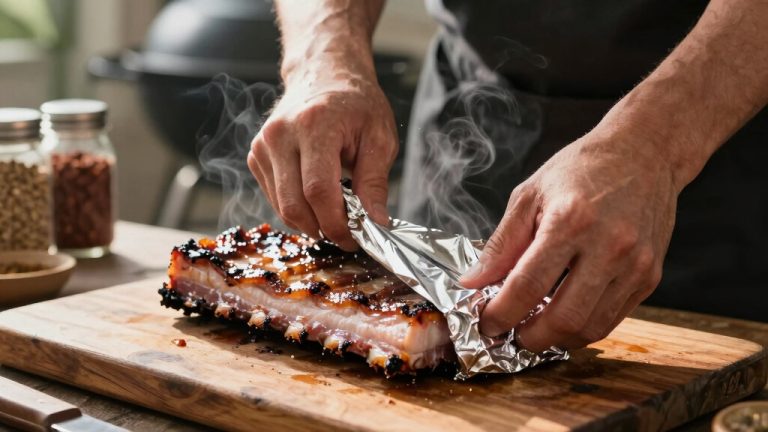
You’ll generally want to wrap once the internal temperature hits around 160°F, when the brisket enters the stall phase and evaporation slows cooking. Wrapping traps moisture and heat, accelerating tenderization.
Here’s how to wrap your brisket during smoking:
- Choose butcher paper for a firmer bark or foil for faster cooking and softer bark.
- Wrap tightly but don’t crush the brisket to maintain shape and moisture.
- Return the wrapped brisket to the smoker, continuing until it reaches 195–203°F internal temperature.
This method optimizes tenderness and juiciness, preventing excessive drying while preserving flavor and texture. Wrapping also helps push the brisket through the stall phase more quickly, reducing overall cooking time.
Resting Techniques for a Perfect 10 Lb Brisket
Once your brisket hits 203°F and you’ve wrapped it for resting, the next step is to secure that perfect tenderness and juiciness by letting it rest properly.
You want to keep it wrapped tightly in foil or butcher paper to trap heat and moisture. Place the brisket in a cooler or insulated container for at least one hour, ideally up to two hours for a 10 lb cut.
This resting period allows the juices to redistribute evenly throughout the meat, preventing them from spilling out when you slice. Avoid cutting too soon; slicing while hot causes dryness.
When you’re ready, unwrap carefully and slice the point and flat against the grain with a sharp knife to maximize tenderness and presentation. This technique guarantees a juicy, flavorful brisket every time.
For optimal results, use a preheated cooler and insulate the brisket with towels to maintain a safe and consistent temperature above 140°F during the rest.
Expert Tips for Smoking a 10 Lb Brisket
Mastering the smoke on a 10 lb brisket requires precise temperature control and patience to guarantee even cooking and tender results.
Start by maintaining a steady smoker temperature between 225°F and 250°F to balance smoke flavor with cooking time.
Use a reliable meat thermometer to monitor internal temperature, aiming for 203°F for peak tenderness.
Finally, don’t rush the resting phase; let the brisket rest wrapped for at least an hour to redistribute juices.
- Trim excess fat carefully, leaving a thin layer to protect the meat during the long smoke.
- Use a consistent wood source like oak or hickory to complement the brisket without overpowering.
- Consider wrapping the brisket in butcher paper at 160°F to speed cooking while preserving bark texture.
Following these tips guarantees a flavorful, tender 10 lb brisket every time.
Common 10 Lb Brisket Smoking Mistakes to Avoid
When smoking a 10 lb brisket, overlooking temperature consistency is one of the most critical mistakes you can make. Fluctuating smoker temps can prolong cooking, dry out the meat, or prevent proper fat rendering.
Avoid rushing by cranking the heat above 275°F; this risks a tough bark and uneven cook. Don’t neglect the probe placement; insert it into the thickest part to accurately monitor internal temp, aiming for 195–203°F for perfect tenderness.
Skipping the wrap phase or wrapping too early can stall bark development or cause steaming instead of smoking. Finally, resist opening the smoker too often; every peek drops heat and extends cook time.
Staying patient and vigilant with these details guarantees a juicy, flavorful brisket every time.
Final Slicing and Serving Tips for Your Smoked Brisket
Although the brisket has rested and reached its ideal internal temperature, how you slice it directly affects the eating experience. To serve your smoked brisket perfectly, follow these expert tips:
- Slice Against the Grain: Identify the grain direction on both the flat and point sections. Slice perpendicular to the grain for maximum tenderness.
- Use a Sharp Knife: A long, sharp slicing knife guarantees clean cuts without tearing the meat, preserving juices and texture.
- Maintain Even Thickness: Aim for 1/4-inch slices to balance tenderness and bite, enhancing the brisket’s buttery texture.
After slicing, arrange the pieces neatly on a warm platter and serve immediately to enjoy the full flavor and juiciness. Proper slicing not only showcases your smoking skills but also maximizes enjoyment with every bite.
Frequently Asked Questions
What Type of Wood Pairs Best With Brisket for Smoking?
You’ll want to choose wood that complements brisket’s rich, beefy flavor. Oak is a classic choice, offering a medium smoke intensity that won’t overpower.
Hickory provides a stronger, bacon-like smokiness, but use it sparingly to avoid bitterness. Mesquite adds bold, earthy notes but can be intense, so blend it with milder woods.
Fruitwoods like apple or cherry give subtle sweetness and a beautiful color. Mix woods to balance flavor and smoke intensity perfectly.
How Should I Prepare the Brisket Before Smoking?
You’ve got to treat your brisket like royalty before smoking it.
Trim the fat cap down to about 1/4 inch to let smoke flavor shine through without drying it out.
Pat it dry, then apply a generous coat of your dry rub, making sure to cover every nook and cranny.
Let it rest uncovered in the fridge overnight to develop a flavorful bark.
This prep guarantees your brisket smokes to tender, mouthwatering perfection.
Can I Smoke a Brisket Overnight Safely?
Yes, you can smoke a brisket overnight safely if you maintain a consistent smoker temperature between 225°F and 275°F.
Use a reliable thermometer to monitor both the brisket’s internal temperature and the smoker’s heat.
Make sure good airflow and avoid opening the smoker frequently.
Consider wrapping the brisket once it hits about 160–165°F to retain moisture.
Then rest it properly after cooking to achieve tender, flavorful results.
What Equipment Is Essential for Smoking a Brisket?
You need a reliable smoker, whether it’s offset, pellet, or electric, that maintains steady temps around 225–275°F.
A good meat thermometer, preferably wireless or instant-read, is essential to track internal temperature accurately.
Grab quality charcoal or wood chunks for consistent smoke.
Heat-resistant gloves, a sharp slicing knife, and butcher paper or foil for wrapping help with prep and resting.
Finally, a sturdy cutting board and a spray bottle for moisture keep your brisket perfect.
How Do Weather Conditions Affect Brisket Smoking Times?
Weather directly impacts your brisket smoking times by influencing your smoker’s temperature stability.
Cold, windy, or humid conditions cause heat loss, making your smoker work harder and slow the cooking.
You’ll need to monitor and adjust fuel or airflow to maintain consistent temps.
Conversely, hot weather can speed things up.
Always use a reliable thermometer and expect possible time variations.
Plan extra time for unpredictable weather to make sure your brisket cooks perfectly.
The Secret to Tender, Juicy Smoked Brisket
Smoking a 10 lb brisket takes time, technique, and tender care. Tailor your timing to thickness and temperature, trust internal temps, and tactfully tuck in your wrap.
Resting rewards you with rich, juicy results. Remember, rushing risks ruining your roast; patience perfects your plate.
With these expert essentials, you’ll slice succulent, smoky servings that satisfy every bite. Stay steady, stay savvy, and savor the smoky success of your splendidly smoked brisket!