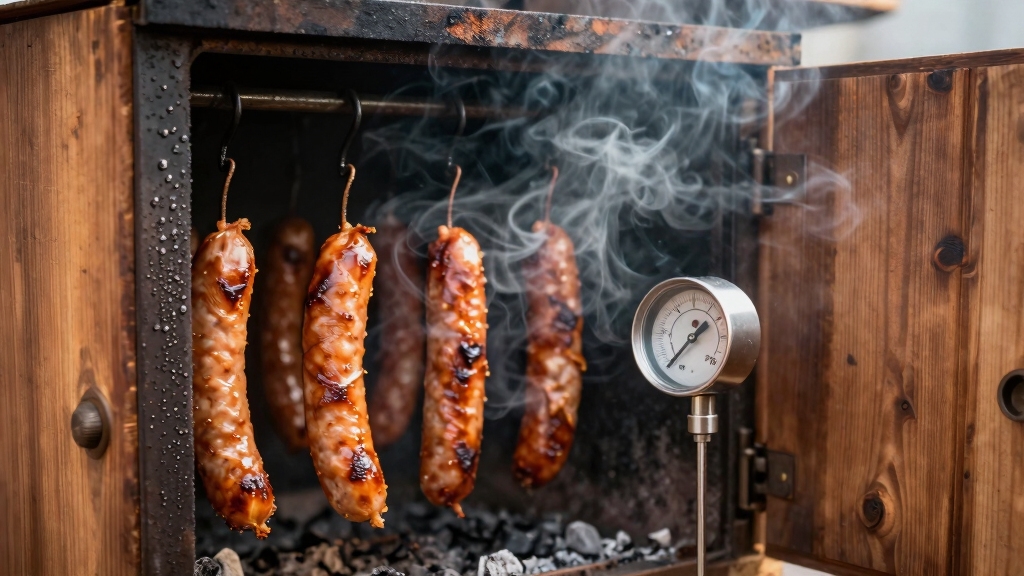
What Temp to Smoke Sausage: Expert Tips for Perfect Flavor
You should maintain your smoker between 225°F and 240°F for steady, even cooking and optimal smoke absorption.
Start smoking at this range, then reduce to 200°F–225°F once your sausage’s internal temperature nears 155°F.
Use a reliable digital thermometer inserted into the center for accurate monitoring, aiming for a final internal temp of 160°F or higher for safety.
Managing airflow and humidity helps prevent drying and guarantees flavor. Understanding timing and wood choices further enhances results.
Key Takeaways
- Maintain smoker temperature between 225°F and 240°F for steady, even sausage smoking and cooking.
- Keep smoker above 200°F when smoking uncured sausage to prevent bacterial growth.
- Lower smoker to 200°F–225°F after initial smoke phase once sausage reaches 155°F internal.
- For specific recipes like summer sausage, smoking around 170°F is possible but less common.
- Aim for internal sausage temperature of 160°F–165°F to ensure safety and proper cooking.
What Smoker Temperature Should You Use for Sausage?

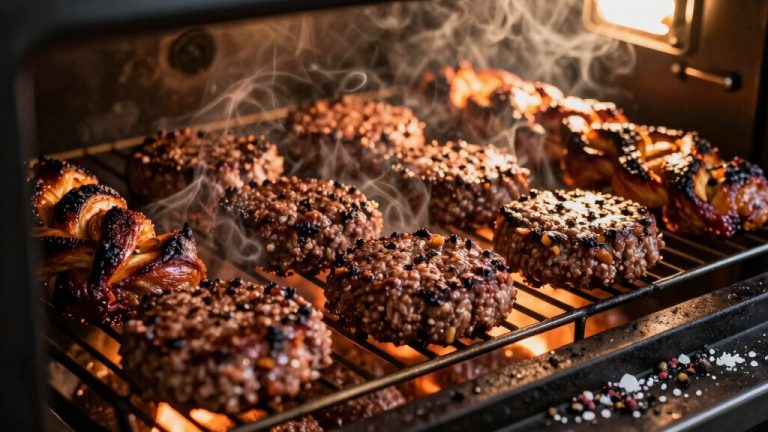
When smoking sausage, you typically want to maintain your smoker temperature between 225°F and 240°F for steady, even cooking. This range suits charcoal or wood smokers well, ensuring consistent heat without overheating.
Maintain your smoker between 225°F and 240°F for consistent, even sausage cooking.
If you’re smoking uncured sausage, keep the temperature at or above 200°F to prevent bacterial growth. After the initial smoking phase, you can lower the temperature to between 200°F and 225°F to finish cooking gently.
Some recipes, like summer sausage, call for smoking at around 170°F, but that’s less common. Always monitor your smoker’s internal temperature with a reliable thermometer placed away from direct heat to maintain accuracy.
Sticking within these temperature guidelines helps you cook sausage safely and evenly without drying or undercooking it. Maintaining steady smoker temperature near 225°F also promotes optimal smoke absorption for the best flavor and texture.
Best Wood and Preparation Tips for Smoking Sausage
Maintaining the right smoker temperature is only part of smoking sausage effectively; selecting the appropriate wood and preparing your sausage correctly markedly impact flavor and texture.
Start by choosing wood that complements your sausage: hickory delivers a strong, smoky profile, apple wood offers a fruity, bold accent, and pecan provides a milder, nutty flavor.
Next, preheat your smoker with a water pan for 20 minutes to stabilize temperature and humidity.
Finally, arrange sausages on the grate without touching to guarantee even smoke penetration and heat distribution.
Consider briefly ice-bathing sausages at 155°F and drying them before resuming smoking to improve casing texture.
Follow these steps:
- Select wood based on desired smoke intensity.
- Preheat smoker with water pan for consistent heat.
- Space sausages properly for uniform cooking and smoke.
For best results, ensure sausages are fully thawed before smoking to promote even cooking and food safety, as proper preparation is key to flavor and texture.
How to Accurately Measure Sausage Internal Temperature?
To get an accurate reading of your sausage’s internal temperature, you’ll want to insert the thermometer probe through the end and push it right to the center.
This way, you can ensure you’re getting the most precise measurement.
Using an instant-read thermometer or a digital probe is a great choice for this. It allows you to keep an eye on the temperature as you smoke the sausage.
Plus, making regular checks helps you hit that target temperature safely, without the risk of overcooking. So, don’t skip those checks! They’re key to juicy, perfectly cooked sausage.
For best results, ensure the probe is inserted past the safety notch and placed in the thickest part of the sausage to avoid skewed temperature readings.
Proper Thermometer Placement
Insert your thermometer probe through the end of the sausage to reach the geometric center for the most accurate internal temperature reading.
Avoid measuring near the casing or edges, as these areas heat unevenly and can give misleading results. You want the probe tip positioned in the thickest part without touching the smoker grate or any filling.
Follow these key steps for precise placement:
- Insert the probe lengthwise, aiming for the sausage’s core to capture true internal temperature.
- Make certain the probe doesn’t pierce through the casing to prevent juices from escaping and affecting accuracy.
- Hold the sausage steady or rest it on a clean surface while measuring to avoid probe movement that can distort readings.
Accurate probe placement is critical for safety and peak smoking results. Insert the probe horizontally into the thickest part to ensure stable and representative temperature readings.
Using Instant Read Thermometers
To get an accurate internal temperature reading for your sausage, always use an instant read thermometer designed for quick, precise measurements.
Insert the probe through the end of the sausage, aiming for the geometric center to avoid false readings from casing or fat.
Hold the thermometer steady until the reading stabilizes, typically within a few seconds.
Check the internal temperature once the sausage reaches approximately two-thirds of the expected cooking time to monitor progress.
Avoid inserting the probe near the smoker’s heat source or the casing’s surface, as these can distort the measurement.
Accurate temperature readings ensure you hit the USDA-recommended 160°F for safety without overcooking, maintaining sausage quality and food safety effectively.
For smoked chicken sausage, aim for an internal temperature of 165°F to ensure all harmful bacteria are eliminated and the sausage retains its moisture and tenderness.
Monitoring Temperature During Smoking
Accurately monitoring the internal temperature during smoking guarantees your sausage reaches safe doneness without overcooking. Use a reliable digital probe or instant-read thermometer, inserting it through the end to the center for an accurate core reading. Avoid surface checks; they misrepresent doneness.
Follow these steps for precision:
- Check the internal temperature after 2-3 hours or when the smoker stabilizes around 225°F.
- Pull the sausage at 152°-154°F, allowing residual heat to increase it to the target 160°F-165°F.
- Confirm smoker temperature away from the firebox to maintain consistent heat, ideally between 200°F and 225°F.
This method guarantees both safety and peak texture while preventing under- or over-smoking. Maintaining consistent airflow during smoking is also crucial to ensure even cooking and optimal smoke absorption.
What Internal Temperatures Make Sausage Safe and Juicy?
When you smoke sausage, reaching the right internal temperature is essential for both safety and juiciness. You need to hit at least 160°F to eliminate harmful bacteria, per USDA guidelines.
Pulling the sausage at 152°-154°F and letting residual heat raise it to 160°F guarantees thorough cooking without drying. For cured sausages, aim for a minimum of 150°F-154°F internal temperature.
Use an instant-read thermometer inserted into the center for accuracy. Avoid undercooking below 145°F, which won’t kill pathogens effectively.
Maintaining steady smoker temps between 200°F and 225°F helps achieve this internal target while retaining moisture. Proper temperature control guarantees a safe, juicy sausage every time without compromising flavor or texture.
For optimal results, smoking should be done gradually by starting at lower temperatures like 100°F and increasing to 170°F to ensure even cooking and prevent fat rendering, as recommended in temperature control techniques.
How Long Should You Smoke Sausage at Different Temperatures?
Smoking sausage is a bit of an art, and you’ll notice that the smoking times can really vary based on the temperature you choose.
Generally, you’re looking at anywhere from 2 to 5 hours, but it all comes down to your heat setting and the size of the sausage.
When you go for lower temperatures, the cooking process slows down quite a bit.
This means you’ll need to keep a close eye on things to make sure you don’t end up with undercooked sausage.
A good tip? Use a reliable thermometer to check the internal temperature.
It’s definitely more accurate than just watching the clock, and it helps ensure that you get both safety and that perfect texture you’re after.
Choosing the right casing size can also impact cooking uniformity and texture during smoking.
Smoking Time Variations
Although smoking temperature primarily dictates cooking speed, the time you should smoke sausage varies markedly based on the exact temperature maintained.
For example, at 225°F, expect a consistent 2-3 hour smoke to reach a safe internal temperature around 160-165°F.
Lower temps near 170°F extend smoking beyond 3 hours, requiring patience to reach doneness safely.
Higher temps in the 240°F range shorten cooking to roughly 1.5-2 hours but demand close monitoring to avoid drying out.
Consider these time variations:
- 170°F smoking: 3-5 hours, slow and steady.
- 225°F smoking: 2-3 hours, balanced heat.
- 240°F smoking: 1.5-2 hours, faster cook.
Adjust your timing precisely by monitoring internal temperatures instead of relying solely on time.
Temperature Impact On Duration
At varying smoker temperatures, the duration required to safely cook sausage changes markedly. This directly affects texture and flavor development.
When you smoke at lower temps like 170°F, expect longer cook times, often 4-5 hours. This allows gradual smoke absorption but can risk uneven cooking.
At 200-225°F, most sausages finish in 2-3 hours. This balances smoke flavor and safe internal temperature reach.
Above 225°F, cooking accelerates but may reduce smoke penetration and cause casing split.
| Smoker Temp (°F) | Approx. Duration | Notes |
|---|---|---|
| 170 | 4-5 hours | Slow smoke, delicate texture |
| 200-225 | 2-3 hours | Best balance, safe & tasty |
| 225+ | 1.5-2 hours | Faster cook, lighter smoke |
Adjust time precisely to hit 160-165°F internal for safety. Maintaining a steady temperature and avoiding frequent lid openings is essential for consistent results and smoke flavor development, as demonstrated in temperature control techniques.
Monitoring Internal Progress
Monitoring the internal temperature during smoking is essential for ensuring sausage safety and quality. You’ll need to track progress closely, as smoking times vary with temperature and sausage size. Use a reliable digital probe thermometer inserted through the end to the center.
Follow these key points to monitor internal progress effectively:
- Smoke at 225°F to 240°F for 2-3 hours, aiming for an internal temperature of 160°F to meet USDA safety guidelines.
- At lower temps (around 170°F), plan for longer durations, often 3-5 hours, ensuring the internal temp reaches at least 155°F before finishing.
- Pull sausages at 152°-154°F and allow residual heat to raise the temperature to a safe 158°-165°F.
This method guarantees safe, evenly cooked sausage without over-smoking. Using a water pan during smoking helps maintain humidity and prevents the casing from drying out, enhancing sausage texture and juiciness.
How to Adjust Smoker Temperature While Smoking Sausage?
When you start smoking sausage, maintaining a consistent temperature around 225°F is crucial for even cooking. You’ll need to adjust the smoker temperature as the process progresses.
Begin by setting your smoker between 225° and 240°F if using charcoal or wood, guaranteeing steady heat. Monitor the internal sausage temperature with a probe; once it reaches about 155°F, reduce the smoker temperature to 200-225°F to finish cooking gently and avoid drying out the meat.
Start smoking sausages at 225°-240°F, then lower to 200°-225°F once internal temp hits 155°F.
If the temperature spikes above 240°F, lower the vents or add less fuel to regain control. Conversely, increase airflow or add fuel if the temperature falls below 200°F.
Precise adjustments guarantee safe cooking to at least 160°F internal while preserving texture and flavor.
Frequently Asked Questions
Can I Smoke Sausage Without a Water Pan?
Yes, you can smoke sausage without a water pan, but it requires careful temperature control to prevent drying out.
Without the pan’s moisture, you’ll need to monitor the smoker closely and maintain steady heat, ideally around 225°F.
Keep the sausages spaced apart to promote even airflow.
Using a digital probe helps track internal temps accurately, ensuring you hit safe doneness without overcooking or drying the meat during the smoke.
How Do Weather Conditions Affect Smoking Sausage Temperature?
Cold weather cools your smoker, forcing you to increase fuel and monitor temperatures closely.
Windy conditions cause heat loss, so you’ll need to shield your smoker and adjust vents.
Humid air slows smoke absorption, requiring longer cooking times.
Dry weather speeds up moisture loss, so you must maintain steady temps and use water pans.
Is It Safe to Smoke Sausage Overnight at Low Temperatures?
No, you shouldn’t smoke sausage overnight at low temperatures below 200°F.
Keeping the smoker at 170°F or less for extended periods risks bacterial growth since it’s below USDA’s recommended 160°F internal temperature for safety.
If you want to cold smoke, you must cure the meat first and maintain temps above 180°F to avoid pathogens.
Always monitor internal temps with a probe to guarantee safe cooking throughout.
What Are Signs of Over-Smoked or Dry Sausage?
You’ll notice over-smoked or dry sausage by a tough, overly firm texture and a cracked or brittle casing.
The flavor turns bitter or harsh, often overpowering the meat’s natural taste.
The interior may feel crumbly instead of juicy, indicating moisture loss.
If the sausage shrinks excessively or develops a grayish color inside, you’ve likely smoked it too long or at too high a temperature, compromising quality and palatability.
Can I Freeze Smoked Sausage and How Does It Affect Flavor?
Yes, you can freeze smoked sausage to extend its shelf life.
Freezing preserves safety and flavor but may slightly affect texture, making it a bit drier after thawing.
To minimize flavor loss, wrap sausages tightly in airtight packaging and freeze promptly.
Thaw them slowly in the refrigerator to retain moisture.
Proper freezing maintains your sausage’s smoky taste while preventing spoilage, though some subtle changes in juiciness are normal.
Smoke Smart, Savor Better: Your Final Step to Perfection
Smoking sausage is a delicate dance of heat and time. Keep your smoker steady between 225°F and 250°F to reveal smoky perfection without drying out your links.
Use a reliable meat thermometer to hit that sweet spot: 160°F for meat, 165°F for poultry, ensuring safety and juiciness.
Adjust temps carefully, like tuning an instrument, to maintain control. Master these technical steps, and your sausage will sing with flavor every time.