What Temp to Pull Brisket and Put in Cooler? Juicy Results
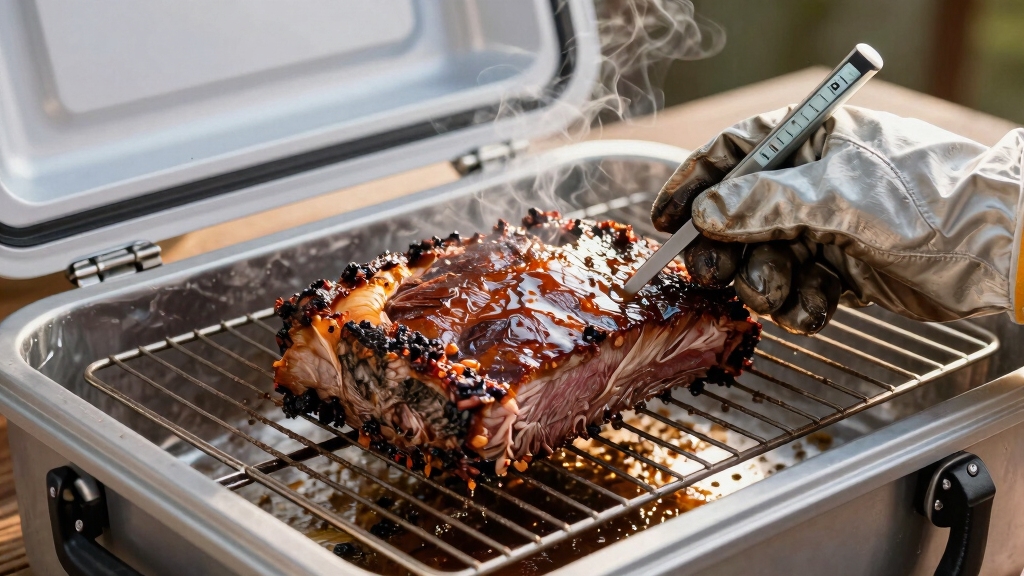
You should pull your brisket when it reaches about 203°F and feels probe-tender, gliding like room-temperature butter. This indicates optimal collagen breakdown and melt-in-mouth texture.
Before transferring it to a preheated, well-insulated cooler lined with towels and elevated off the bottom, wrap it tightly in foil or butcher paper. This locks in moisture without sacrificing bark.
Holding the brisket around this temp helps balance tenderness, juiciness, and bark integrity. There’s more to mastering cooler rest and bark care to guarantee perfect results.
Key Takeaways
- Pull brisket at an internal temperature around 200–205°F when probe tenderness feels like room-temperature butter.
- Aim for about 203°F to ensure optimal collagen breakdown and consistent tenderness before resting.
- Briefly cool brisket to 180–190°F before transferring to the cooler to minimize carryover cooking.
- Wrap brisket tightly in foil or butcher paper and place fat side up on a dry towel inside the cooler.
- Use a well-insulated cooler preheated with hot water and keep brisket above 140°F to maintain safe holding temperatures.
When to Pull Brisket: Ideal Internal Temperature for Tenderness?
While temperature isn’t the only sign of doneness, you should start checking your brisket’s tenderness once it hits between 185°F and 195°F. Wrapping the brisket during the stall phase, typically between 150°F and 170°F, can significantly affect the cook time and tenderness by accelerating collagen breakdown through trapped moisture and heat (stall phase).
Begin testing your brisket’s tenderness when it reaches 185°F to 195°F for optimal results.
Most briskets reach peak tenderness between 200°F and 208°F, but the critical zone for connective tissue rendering lies between 195°F and 203°F.
Since brisket size, fat content, and cooking conditions vary, you’ll find some briskets tender closer to 195°F, while others require up to 210°F.
Because brisket cooks unevenly, it’s important to check probe tenderness in multiple areas, including both the flat and the point, to ensure consistent tenderness throughout.
Use temperature as a reference point, not a strict rule.
Pulling too early risks toughness, while waiting too long can dry the meat.
Starting tenderness checks in that range helps you gauge progress and decide when to pull for the best texture and juiciness.
This approach guarantees you hit the sweet spot for your specific brisket.
How to Check Brisket Doneness Beyond Internal Temperature?
Don’t rely solely on internal temperature to judge brisket doneness. You’ll want to check texture and appearance to nail the perfect pull time.
Use a thin probe or toothpick to test tenderness; it should slide in and out with resistance like room-temperature butter.
Check multiple spots—flat, point, and junction—to make certain of uniform softness. Remember that cooking time can vary depending on the brisket’s size and cooking method, so relying on time alone is not advisable.
Monitoring internal temperature alongside these tests helps ensure the brisket reaches the ideal 195°F to 205°F range for tenderness.
Examine the bark; it should be dark mahogany, dry, and slightly crusty with rendered, translucent fat. Lift the brisket to assess jiggle and bend; it should droop naturally and jiggle loosely, signaling properly converted collagen.
Pressing the flat gently should leave a slow-recovering indentation. After resting, slices should cut cleanly, stretch slightly without tearing, and glisten with moisture.
Combining these tactile and visual cues ensures you pull at peak tenderness beyond just temperature.
Why 203°F Is the Ideal Pull Temperature?
When it comes to pulling your brisket, aiming for around 203°F is key. Why, you ask? Well, that’s the sweet spot where collagen fully breaks down into gelatin, giving you that melt-in-your-mouth tenderness we all crave.
It’s like hitting the jackpot in the world of barbecue! Achieving this temperature also allows for optimal moisture retention during the resting phase.
Now, this temperature isn’t just a random number; it serves as a reliable benchmark. It strikes the perfect balance between juiciness and doneness.
You want to avoid the undercooked toughness you get when it’s too low or the overcooked dryness that happens when it goes too high.
Sticking close to that 203°F mark is your ticket to consistent results, no matter the size or quality of the brisket you’re working with. Trust me, your taste buds will thank you!
Reaching this temperature ensures the proper collagen breakdown, transforming the connective tissue into luscious gelatin that keeps the meat moist and tender.
Collagen Breakdown Temperature
Because collagen breakdown depends on both temperature and time, hitting an internal brisket temperature around 203°F gives you the best balance between thorough connective tissue conversion and maintaining moisture.
This temperature also aligns with optimal spritzing intervals that help maintain the surface moisture without compromising cooking progress.
Collagen begins to denature around 122–140°F but requires sustained heat above 160°F to fully dissolve into gelatin, transforming toughness into tenderness.
This process follows first-order kinetics, meaning the rate of collagen conversion accelerates exponentially with temperature increases.
At typical smoker temperatures near 250°F, reaching 203°F guarantees collagen has spent ample time in this optimal range, accelerating breakdown without drying out the meat.
While lower temps can convert collagen with extended cooking times, 203°F fits practical barbecue timelines perfectly.
This temperature range maximizes collagen solubilization, yielding tender brisket with retained juiciness, making 203°F the sweet spot for pulling your brisket and locking in prime texture and moisture.
Optimal Tenderness Benchmark
Reaching around 203°F internal temperature aligns perfectly with the point where brisket achieves peak tenderness, balancing fully rendered connective tissues and properly cooked muscle fibers.
Maintaining the brisket at this temperature range for a sufficient resting period is critical to allow collagen breakdown and moisture redistribution, which enhances overall texture and juiciness.
This temperature has become the practical benchmark because it guarantees collagen breaks down sufficiently while the meat stays moist and sliceable.
Many experienced pitmasters emphasize that the ultimate doneness is best determined by probe-tender feel rather than temperature alone.
However, hitting 203°F momentarily isn’t enough; you need to hold the brisket in the 195–203°F range for 30 minutes to two hours, allowing gradual tenderization throughout.
During this resting or holding phase, it is important to monitor internal temperature closely to ensure the brisket remains safe and maintains optimal tenderness.
You’ll also want to confirm tenderness by probing the meat; it should feel like “butter” or “jelly” with minimal resistance.
Since brisket size, grade, and fat content vary, 203°F serves as a reliable average target.
Always combine temperature with tactile testing to assure optimal tenderness before pulling your brisket.
Consistent Cooking Results
When aiming for consistent brisket results, pulling at 203°F guarantees peak collagen breakdown and gelatin conversion, which are critical for juiciness and tenderness.
This temperature sits at the upper end of the ideal finish range, maximizing connective tissue rendering while minimizing moisture loss. Proper temperature control during both cooking and resting phases ensures the brisket remains safe and flavorful.
Holding your brisket near 203°F for 30 to 120 minutes guarantees uniform gelatinization across both the flat and point, delivering consistent tenderness regardless of brisket size or grade.
Using 203°F as your pull target also accommodates variations in marbling and muscle thickness better than lower temps.
Because every brisket varies in toughness and muscle development, ensuring a sufficient hold time in the target temperature zone is essential for optimal results.
Combining accurate thermometer placement in the flat with a reliable 203°F pull temp reduces variability between cooks.
This makes it a practical, repeatable guideline that helps you avoid undercooked, chewy briskets and achieve professional-level consistency every time.
When and How to Transfer Brisket to the Cooler?
Although the exact moment to transfer brisket to the cooler can vary, you’ll generally want to move it once it hits that tender “probe like butter” stage around 200–205°F internal temperature.
Transfer the brisket to the cooler when it reaches that perfect “probe like butter” tenderness at 200–205°F.
Before transferring, allow the brisket to cool slightly to about 180–190°F to minimize carryover cooking and protect the bark. Wrapping tightly in foil or butcher paper is essential to prevent moisture loss during resting.
Using foil vs. butcher paper affects moisture retention and bark texture during this phase.
Keep it tightly wrapped in foil or butcher paper to retain moisture. Set the brisket fat side up on a dry towel or pan to catch juices and avoid direct cooler contact.
Once placed in the cooler, leave it undisturbed with the lid closed to maintain stable temperatures above 140°F during the 2–6 hour rest.
- Confirm probe tenderness at 200–205°F
- Briefly cool to 180–190°F before transfer
- Maintain tight, secure wrapping
- Position fat side up on absorbent surface
- Minimize cooler lid openings during rest
How to Set Up Your Cooler for Brisket Heat Retention?
To maximize heat retention during your brisket’s resting phase, start by selecting a high-quality hard-sided cooler with thick insulation and a tight-fitting lid. Ensuring the cooler has a tight seal is crucial to maintaining consistent heat inside.
Match the cooler’s capacity closely to your brisket’s size to minimize air space, reducing heat loss.
Preheat the cooler by filling it with near-boiling water for 15–30 minutes, then empty and thoroughly dry it to avoid steam. Line the bottom with a folded towel or cooling rack to prevent direct contact with cold plastic.
Wrap your brisket tightly in butcher paper or foil, then add a clean towel for insulation and moisture absorption. Fill any gaps with towels or crumpled paper to limit convection.
Keep the brisket centered, use a leave-in probe thermometer, and minimize lid openings to preserve heat efficiently.
How Long You Can Safely Hold Brisket in a Cooler?
After setting up your cooler properly for heat retention, the next step is understanding how long you can safely hold your brisket inside it.
Generally, you can keep your brisket safe and warm for several hours if you maintain the right conditions. Using insulated containers and monitoring temperature regularly helps prevent bacterial growth during holding.
Most backyard coolers hold brisket safely for 2–6 hours. Premium coolers with hot water can extend safe holding to around 10 hours. High-end coolers properly maintained may keep it safe for 18+ hours.
It is important to remember that a short resting period of 1–3 hours immediately after smoking is always required before holding.
Always monitor internal temperature; keep brisket above 140°F to avoid the danger zone. If temperature dips below safe levels, serve immediately or move brisket to a warming oven.
Consistent temperature checks and proper insulation are key to maximizing safe holding time in your cooler.
Managing Rest Time and Bark Texture During Cooler Holds
When managing rest time during cooler holds, you’ll want to focus on maintaining bark texture while preserving internal juiciness. Pull your brisket around 195–198°F to keep bark firmer, minimizing softening during the rest.
Before placing it in the cooler, rest unwrapped at room temperature for 20–60 minutes to reduce surface steam and dry the bark slightly.
This initial resting period allows the natural juices to redistribute within the meat, enhancing moisture retention.
Wrapping loosely in butcher paper also helps to apply a balanced dry rub flavor during the resting phase, preventing sogginess without sacrificing heat retention.
Elevate the brisket inside the cooler to avoid pooling juices dissolving the crust. Use towels strategically—too many trap moisture, softening bark; too few accelerate cooling.
Consider cooler preheating and venting to balance humidity. Finally, limit cooler lid openings to firm bark slightly without excessive heat loss, ensuring your brisket’s bark stays intact throughout the extended rest.
Frequently Asked Questions
Can I Use a Digital Thermometer or Should I Use an Instant-Read Thermometer?
You should use a digital probe thermometer for continuous monitoring throughout the cook and cooler hold. It tracks temperature without opening the cooker or cooler, preserving heat and safety.
Use an instant-read thermometer for quick spot checks near the end to verify tenderness and even doneness.
Combining both gives you precise control: digital for steady tracking and instant-read for confirmation. This ensures you pull the brisket right around 200–205°F and hold it safely above 140°F.
How Does Altitude Affect Brisket Cooking and Pull Temperature?
Like a knight adjusting armor for different battles, you need to tweak brisket cooking at altitude.
Lower boiling points cause faster moisture loss, so pull your brisket earlier, around 190–195°F at 5,000 ft instead of the usual 203°F.
Increase pit temps slightly to 250–265°F to maintain bark and cook times.
Focus on tenderness over strict temps, and use water pans or wrapping to prevent drying.
What’s the Best Way to Reheat Brisket After Cooler Holding?
To reheat brisket after cooler holding, use a low-temperature oven set around 150°F to gently warm it without drying out.
Keep the brisket wrapped in butcher paper or foil to retain moisture. Alternatively, a Traeger grill’s “Keep Warm” function at 165°F works well.
Avoid high heat, which toughens the meat. Reheat slowly until the internal temp reaches 140°F, ensuring safe serving temperature while preserving tenderness and juiciness.
Can Brisket Be Safely Held Overnight in a Cooler Without Refrigeration?
You shouldn’t hold brisket overnight in a cooler without refrigeration unless you can guarantee it stays above 140°F the entire time.
Most standard coolers can’t maintain that temperature safely beyond 8–10 hours, risking bacterial growth once it dips into the danger zone.
For overnight holds, use an electric holding oven or hot box to keep it hot.
If you rely on a cooler, limit holding to just a few hours to assure safety.
How Do Different Types of Wraps Affect Brisket Moisture During Resting?
You’ll find foil traps moisture best during resting, keeping brisket juicy but softening the bark due to steam buildup.
Butcher paper lets some steam escape, preserving a firmer bark while balancing tenderness and moisture.
Resting unwrapped increases evaporative cooling, drying the surface and firming bark but losing more juices.
Choosing your wrap depends on whether you prioritize bark texture or maximum moisture retention during rest.
Master Brisket Resting Temperature for Tender, Slice-Ready Meat
Pulling your brisket at around 203°F guarantees you hit that perfect tenderness, as expert pitmasters agree this temp maximizes collagen breakdown. Did you know resting brisket in a cooler can retain heat for up to 4 hours without losing quality?
Setting up your cooler right lets you manage rest time effectively, preserving moisture and bark texture. Trust this method to serve juicy, flavorful brisket every time you smoke.