Traeger Ironwood Vs Timberline: Features, Cooking Space & Value
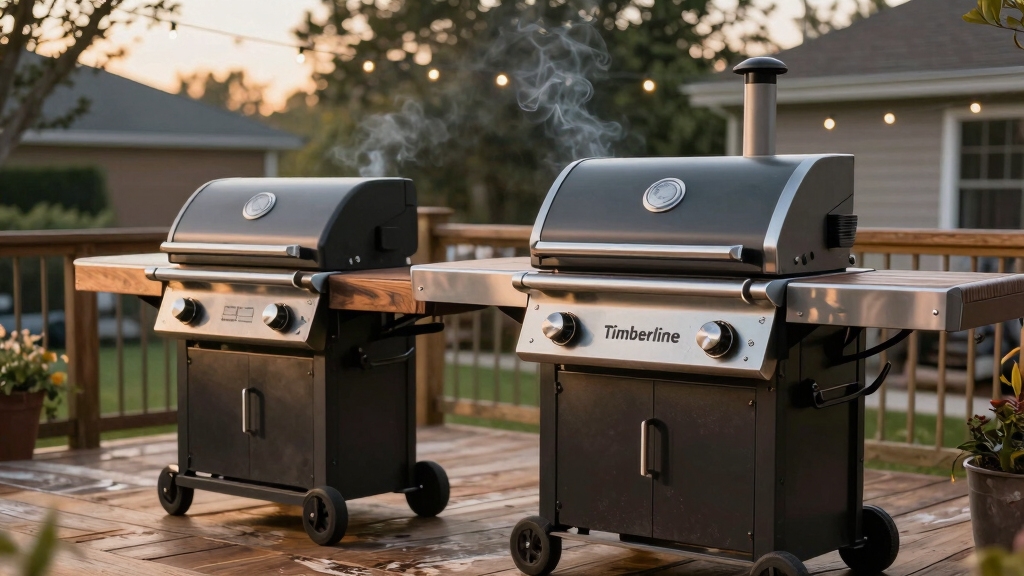
If you need larger cooking space with premium stainless steel grates and superior insulation, the Timberline’s 1,320 sq in area and triple racks suit heavy grilling and outdoor kitchen setups.
For easier portability, lighter weight, and budget-friendly price, the Ironwood’s compact design with porcelain-coated grates and dual racks is ideal.
Both share advanced temperature controls and smart features, but Timberline includes more meat probes and accessories. Explore further to see which grill truly matches your cooking style and needs.
Key Takeaways
- Timberline offers larger cooking space (1,320 sq in) with three racks versus Ironwood’s smaller area (up to 885 sq in) and two racks.
- Timberline uses durable 304 stainless steel grates; Ironwood has porcelain-coated steel grates requiring gentler cleaning.
- Timberline features superior insulation with double-lined hood and gasket, while Ironwood has dual-wall construction and lighter weight.
- Both models have WiFIRE smart controls, D2 Direct Drive, and similar temperature range, but Timberline includes four meat probes versus Ironwood’s one.
- Timberline is heavier (243 lbs) with limited mobility, suited for outdoor kitchens; Ironwood is lighter (199 lbs) with wheels for easier repositioning.
Ironwood or Timberline? A Quick Comparison of Cooking Space, Features & Value
| Feature | Traeger Ironwood | Traeger Timberline |
|---|---|---|
| Cooking Space | Up to 885 sq in | 1,320 sq in (significantly larger) |
| Rack Configuration | 2 racks (top mainly used as warming shelf) | 3 full racks for multi-level cooking |
| Grate Material | Porcelain-coated steel | 304 stainless steel |
| Durability of Grates | Moderate durability, may chip with heavy use | Highly durable and resistant to wear |
| Cleaning Ease | Requires gentle cleaning with soft brush | Can handle aggressive cleaning with any grill brush |
| Insulation & Hood Design | Dual-wall construction with standard gasket | Full double-lined hood + commercial gasket for better heat retention |
| Weight | 199 lbs (lighter) | 243 lbs (heavier and more stable) |
| Mobility | Easier to move with wheels | Limited mobility; better for fixed outdoor kitchen setups |
| Temperature Range | Up to 500°F | Up to 500°F |
| Smart Technology | WiFIRE controller, app integration, pellet sensor | WiFIRE controller, app integration |
| Drive System | D2 Direct Drive | D2 Direct Drive |
| Meat Probes Included | 1 wired probe | 4 probes (2 MEATER wireless + 2 wired) |
| Extra Accessories | Pellet sensor via app | Magnetic bamboo cutting board included |
| Best For | Budget-friendly, portable grilling | Large gatherings and premium grilling setups |
| Overall Value | Great value for moderate users | Premium build and capacity for serious grillers |
Cooking Space and Rack Options on Ironwood vs Timberline

When comparing cooking space and rack options, you’ll find the Timberline XL offers twice the total grilling area of the Ironwood 885 and more than double that of the Ironwood 650. It provides 1,320 square inches versus 885 and 650 respectively.
You’ll also notice that the Timberline features three racks, providing ample vertical cooking room for larger batches or multi-level cooking. In contrast, the Ironwood models come with two racks, where the second functions primarily as a warming shelf rather than extra cooking space.
This difference means you can cook more diverse items simultaneously on the Timberline XL, making it better suited for heavy use or larger gatherings.
The Ironwood series, while more compact, still offers solid capacity but doesn’t match the Timberline’s expansive grilling footprint or versatile rack configuration.
To maintain optimal cooking performance on these grills, it’s important to properly position the smoker outdoors in a well-ventilated area during operation.
Ironwood vs Timberline Grate Materials: Durability and Cleaning
When you’re looking at different grate materials, it’s interesting to note that the Timberline uses solid 304 stainless steel.
On the flip side, the Ironwood opts for porcelain-coated steel.
Now, here’s where it gets a bit interesting: those stainless steel grates on the Timberline are pretty tough. They resist wear really well and you can clean them easily with just about any brush.
In contrast, the Ironwood’s porcelain coating isn’t quite as durable.
It actually requires a bit more TLC when it comes to cleaning. To prevent surface corrosion, it’s important to dry grates thoroughly after cleaning, especially with porcelain-coated steel.
Stainless Steel Versus Porcelain
Grate material plays a crucial role in both durability and ease of cleaning for pellet grills. Traeger’s Ironwood and Timberline models take distinctly different approaches.
The Timberline features solid 304 stainless steel grates, offering superior durability and resistance to wear. You’ll find these grates stand up well to frequent use and clean easily with any brush, making maintenance straightforward.
In contrast, the Ironwood uses porcelain-coated steel grates. While these provide a smoother cooking surface that some cooks prefer, they’re less durable and prone to chipping or cracking over time.
Porcelain’s coating can degrade, especially with heavy use, which may affect longevity. If you prioritize lasting durability and robust construction, the Timberline’s stainless steel grates clearly have the edge over the Ironwood’s porcelain-coated option.
To maintain their longevity, it’s important to prevent moisture buildup by thoroughly drying and lightly oiling grates after cleaning before storage.
Cleaning Ease Comparison
Understanding the differences in material durability between the Ironwood’s porcelain-coated steel and the Timberline’s stainless steel helps clarify how each grill performs in cleaning ease.
You’ll find Timberline’s 304 stainless steel grates clean effortlessly with any brush, resisting residue buildup and chipping.
Ironwood’s porcelain-coated steel, while offering a smooth surface, requires gentler cleaning to avoid damage and is more prone to staining.
This affects how often and how thoroughly you can clean without risking grate wear.
Regular maintenance including the use of stainless steel grill brushes can significantly enhance the cleaning process and prolong grate lifespan.
| Feature | Ironwood (Porcelain-Coated Steel) | Timberline (Stainless Steel) |
|---|---|---|
| Cleaning Method | Soft brush, careful scrubbing | Any brush, aggressive scrubbing |
| Stain Resistance | Moderate | High |
| Residue Buildup | More frequent | Less frequent |
| Cleaning Frequency | Regular to avoid damage | Less frequent needed |
| Maintenance Effort | Moderate | Low |
Durability And Wear Resistance
Durability plays a critical role in how well your grill performs over time, especially under frequent use.
The Timberline features solid 304 stainless steel grates, which resist wear and clean easily with any brush. This makes them ideal if you grill often or want minimal maintenance.
In contrast, the Ironwood uses porcelain-coated steel grates, which aren’t quite as durable. They’re more prone to chipping and wear, especially with heavy use or abrasive cleaning.
While the Ironwood’s dual-wall construction offers good temperature consistency, its grates require gentler care to maintain their finish.
If longevity and wear resistance are your priorities, Timberline’s stainless steel grates provide a clear advantage, delivering better durability and easier cleaning over time compared to Ironwood’s porcelain-coated alternatives.
Additionally, using materials with high heat resistance can help extend the lifespan of grill components by preventing damage from frequent temperature changes.
Insulation and Build: Performance and Portability Compared
When you take a closer look at insulation and build, it’s pretty clear that the Timberline really shines with its full double-lined hood and commercial-grade gasket. These features help keep the heat in much better than the Ironwood’s dual-wall construction. However, there’s a trade-off: the Timberline weighs in at 243 pounds, making it a bit cumbersome and less portable compared to the Ironwood, which is a lighter 199 pounds. This lighter weight makes the Ironwood easier to move around, which is great if you need that flexibility.
Now, if you’re thinking about setting up your grill in an outdoor kitchen, the Timberline does have some advantages. Its sliding cart design offers better stability, which can be a big plus when you’re cooking up a storm. On the other hand, the Ironwood is all about mobility, making it a more practical choice if you plan to move it around often. So, it really depends on your needs—do you prioritize stability or portability? Adding fire-resistant insulation like welding blankets or custom jackets can further improve heat retention and fuel efficiency in colder conditions.
Hood Construction Quality
Although both the Traeger Ironwood and Timberline prioritize insulation to maintain consistent cooking temperatures, the Timberline’s full double-lined hood with a commercial-grade gasket offers superior heat retention and durability compared to the Ironwood’s dual-wall construction.
When you use the Timberline, you’ll notice less heat loss during longer cooks, thanks to this enhanced sealing. The Ironwood’s hood, while effective, relies on a simpler dual-wall design paired with standard gaskets, which provides good insulation but not quite the same level of thermal efficiency.
You’ll also find the Timberline’s hood built to withstand heavier use and outdoor kitchen integration, reflecting its premium positioning. Both models include insulated sides and solid build quality, but if hood construction is a priority for you, the Timberline clearly edges ahead in performance and longevity.
Proper maintenance, including regular cleaning and seasoning with high-smoke-point oils, can further protect and extend the life of the hood’s materials.
Weight And Mobility
Since both the Traeger Ironwood and Timberline prioritize sturdy construction, their weight and mobility reveal key differences that affect how you handle and position them.
The Timberline weighs 243 lbs, making it heavier than the Ironwood’s 199 lbs. This extra weight reflects its full double-lined hood and commercial-grade gasket, enhancing insulation and temperature consistency but reducing portability.
The Ironwood’s dual-wall construction balances durability with lighter weight, allowing easier repositioning.
Timberline features a sliding cart designed for outdoor kitchen setups, limiting casual mobility.
Ironwood’s lighter frame and dual wheels improve maneuverability on varied surfaces.
Both have double-insulated sides and hood gaskets, supporting thermal efficiency.
Timberline’s weight demands more effort or assistance when relocating outdoors.
You’ll find Ironwood more convenient if portability matters, while Timberline excels in stability and integration.
For maintaining consistent cooking results, proper temperature probe placement and monitoring are crucial regardless of the grill’s portability.
Temperature Controls and Smart Features on Ironwood and Timberline
Because both the Ironwood and Timberline reach a maximum temperature of 500°F, they offer powerful heat control for various cooking styles.
Both feature the advanced WiFIRE controller with smartphone app integration, allowing you to monitor and adjust cooking remotely.
The D2 Direct Drive drivetrain guarantees precise temperature regulation and consistent heat.
The Ironwood stands out with an intuitive touchscreen display, making manual adjustments straightforward.
Both models support Super Smoke mode for enhanced smoke flavor, and each includes a hopper clean-out for easy pellet switching.
The Ironwood also integrates a pellet sensor via the Traeger app, keeping you informed about pellet levels.
While the Timberline shares these smart features, it complements them with a more robust design suited for heavy use.
Both provide excellent digital temperature control and smart functionality.
For optimal smoke flavor, it is important to maintain steady airflow around the grill and avoid wind that can disrupt the smoke consistency.
Included Accessories: What Comes With Each Model?
When you look at what each model includes, the Timberline clearly steps up with a more all-encompassing accessory package.
You get four meat probes, two MEATER wireless and two wired, versus just one wired probe with the Ironwood. Timberline also comes standard with a magnetic bamboo cutting board, adding convenience right out of the box.
Both have similar hopper capacities, but Ironwood adds an integrated pellet sensor accessed via the Traeger app.
Here’s a quick comparison of what you receive:
- Timberline: 4 meat probes (2 MEATER, 2 wired)
- Ironwood: 1 wired meat probe
- Timberline: Magnetic bamboo cutting board included
- Ironwood: Integrated pellet sensor via app
This difference highlights Timberline’s focus on a wide-ranging grilling experience. Using pellets in wood chip smokers requires careful monitoring and proper airflow management to ensure optimal temperature and smoke control.
Ironwood vs Timberline: Which Offers Better Value for You?
Although both the Ironwood and Timberline deliver exceptional grilling performance, your choice hinges on how much you value advanced features, build quality, and cooking capacity relative to their price differences.
Choosing between Ironwood and Timberline depends on your priorities for features, durability, and cooking space.
The Timberline boasts a larger 1320 sq. in. cooking area with three racks and durable 304 stainless steel grates, ideal if you grill frequently or entertain large groups. Its superior insulation and commercial-grade gasket guarantee consistent temperatures, complementing the premium price.
The Ironwood, with up to 885 sq. in. and porcelain-coated grates, suits moderate users seeking good functionality without the Timberline’s cost. While the Timberline includes four meat probes and extra accessories, the Ironwood offers smart features like an integrated pellet sensor.
Ultimately, Timberline delivers higher durability and capacity, but Ironwood provides solid value for less frequent grilling and budget-conscious buyers.
Frequently Asked Questions
How Noisy Are the Pellet Grills During Operation?
You’ll find pellet grills generally produce a moderate humming noise from the auger and fan during operation.
The Timberline tends to run a bit quieter thanks to its more robust insulation and double-lined hood, which dampens sound effectively.
In contrast, the Ironwood’s dual-wall construction offers good but slightly less noise reduction.
Neither grill is disruptive, but if you’re sensitive to noise, Timberline’s design helps keep operation more peaceful.
Can I Use Third-Party Pellets With These Models?
Yes, you can use third-party pellets with both models, but quality matters.
Traeger grills, including Ironwood and Timberline, perform best with premium hardwood pellets to maintain temperature and flavor consistency.
Lower-quality pellets may cause more ash buildup, affecting performance and requiring frequent cleaning.
While both grills handle third-party pellets, sticking to Traeger’s recommended pellets guarantees optimized results.
This is especially important if you want to protect your investment and enjoy reliable cooking every time.
Are There Specific Cleaning Tools Recommended for Each Grill?
Think of cleaning your grill like tuning a guitar. Each tool fine-tunes the flavor.
For the Timberline’s stainless steel grates, you’ll want a sturdy wire brush to effortlessly clear residue without damage. The Ironwood’s porcelain-coated grates need a gentler nylon brush to avoid scratching.
Both benefit from the included hopper clean-out tool for pellet residue. Using the right brushes protects your grill’s surface and keeps your cooking consistent every time.
How Do the Grills Perform in Extreme Cold or Hot Weather?
You’ll find both grills perform well in extreme cold and hot weather, thanks to insulated hoods and double-walled construction.
However, the Timberline’s full double-lined hood with commercial-grade gasket offers superior temperature retention in harsh conditions.
The Ironwood’s dual-wall build also maintains heat effectively but may struggle more in freezing temps.
If you grill frequently in extreme climates, the Timberline gives you greater consistency and reliability for peak cooking results.
Two Premium Traeger Grills, One Perfect Pick
When choosing between Traeger’s Ironwood and Timberline, consider your cooking cravings carefully. The Ironwood impresses with its innovative insulation and intuitive controls, while the Timberline triumphs in cooking space and top-tier grates.
Both boast brilliant build quality and smart features, but your ideal pick depends on desired durability, portability, and budget balance.
By weighing these well-crafted wonders, you’ll confidently cook up countless culinary creations tailored to your tastes and needs.