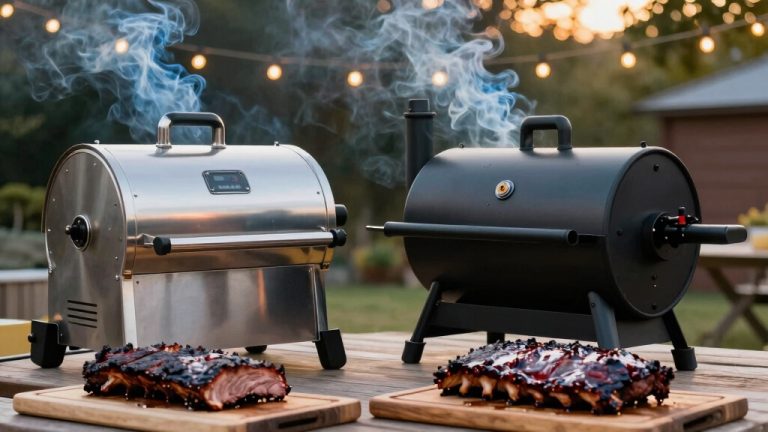
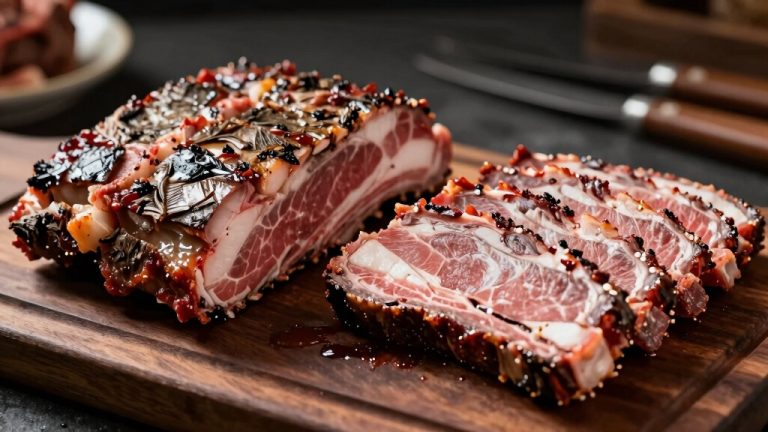
Schwank Grill vs Otto: Heat & Performance Test
If you want intense, steakhouse-quality searing with moisture retention, Schwank’s infrared burner excels by reaching about 1500°F quickly. It offers easy push-button ignition plus stainless steel grates for simpler upkeep.
Otto Wilde Grill Pro provides dual burners for even heat distribution, a higher peak temperature near 1634°F, and cast iron grates favored for superior searing but requiring seasoning.
Otto costs less but lacks carrying handles Schwank includes. Explore deeper to see which matches your grilling style and priorities perfectly.
Key Takeaways
- Schwank offers focused infrared radiant heat for fast, steakhouse-quality searing, while Otto provides dual burners for even, adjustable heat distribution.
- Schwank uses electronic push-button ignition requiring power; Otto features mechanical piezo ignition needing no batteries for reliable, power-free starts.
- Schwank grates are stainless steel for easy cleaning and rust resistance; Otto uses cast iron grates that deliver superior heat retention and sear marks.
- Schwank includes integrated carrying handles for portability; Otto lacks handles, favoring a minimalist design with similar compact storage size.
- Schwank costs about $1,250 with USA manufacturing; Otto is priced lower at $1,099, featuring German engineering and an award-winning design.
Schwank vs Otto Grill: Feature Comparison
| Feature | Schwank Grill | Otto Wilde Grill Pro |
|---|---|---|
| Heating System | Proprietary Infrared Burner | Dual independent gas burners |
| Maximum Temperature | Up to 1500°F | Up to 1634°F (thermal peak) |
| Heat Style | Intense, focused radiant heat | Even, balanced flame distribution |
| Grill Grates | Stainless steel (easy maintenance) | Cast iron (superior heat retention) |
| Ignition System | Electronic push-button ignition | Mechanical piezo ignition |
| Portability | Integrated side carrying handles | No built-in handles |
| Build Origin | USA-made craftsmanship | German-engineered design |
| Price Range | Higher premium pricing | Slightly more budget-friendly |
| Best For | Fast steakhouse-style searing | Consistent heat control & versatility |
Which Grill Is Right for Your Steak Grilling Needs?

When choosing between the Schwank Grill and the Otto Wilde Grill Pro for your steak grilling needs, you’ll want to take into account how each model’s features align with your cooking style and priorities.
The Schwank offers proprietary Infrared Burner technology, ideal if you value restaurant-quality searing with moisture retention. It heats up quickly and fits 2-3 steaks comfortably, making it suited for intimate gatherings.
Meanwhile, the Otto Wilde Grill Pro reaches high temperatures consistently across its dual independent burners, providing even heat distribution. Its cast iron grates enhance searing, although it lacks carrying handles.
Consider whether you prefer Schwank’s portability and electronic ignition or Otto’s mechanical piezo ignition and German-engineered design. Both excel in premium steak preparation but cater to slightly different user preferences.
For optimal grilling results, it is important to manage flame adjustment and combustion control by ensuring a steady blue flame and proper air shutter setting, which enhances cooking efficiency and flavor flame adjustment and combustion control.
Schwank vs Otto: Price and Financing Options
Hey there! So, let’s talk about the prices of these two grills. The Otto Wilde Grill Pro is priced at $1,099, which is actually $151 less than the Schwank Grill, coming in at $1,250. Pretty interesting, right?
Both grills come with financing options too, which is great because it lets you manage the cost based on what fits your budget. When you’re trying to decide between them, it’s worth thinking about the value versus the cost. Schwank boasts USA manufacturing and has that Infrared Burner technology, while Otto offers a more competitive price along with some cool design features. What do you think?
Also, properly maintaining and seasoning your grill using high-smoke-point oils can significantly extend its lifespan and enhance performance.
Price Comparison Overview
Diving into the price comparison between the Schwank Grill and the Otto Wilde Grill Pro reveals a clear cost difference that may influence your decision.
The Schwank Grill is priced at $1,250, while the Otto Wilde Grill Pro costs $1,099, making Otto $151 less expensive.
This gap reflects Schwank’s USA manufacturing and proprietary Infrared Burner technology, which might justify the higher price for some buyers.
Both grills offer financing options, but the upfront cost difference is a straightforward factor to ponder.
If you prioritize domestic production and specialized burner tech, Schwank’s price aligns with those features.
Conversely, if you’re cost-conscious and seek quality with a lower entry price, Otto presents a compelling value.
Understanding these price points helps you weigh your priorities effectively.
Additionally, considering the higher heat output of propane-fueled grills like Schwank’s can influence cooking performance and efficiency.
Financing Availability Options
Although the upfront price difference between the Schwank Grill and Otto Wilde Grill Pro is notable, both brands address affordability by offering financing options that can make the purchase more manageable.
You’ll find that Schwank provides flexible payment plans through select partners, often allowing you to spread the cost over several months with low or zero interest, depending on credit approval.
Otto Wilde also offers financing solutions, typically through third-party services, enabling you to invest in premium German engineering without a large initial outlay.
Both options aim to reduce financial strain while maintaining access to high-quality grills.
When considering financing, you should review terms carefully, including interest rates, repayment periods, and any fees, ensuring the chosen plan aligns with your budget and long-term financial goals.
Value Versus Cost
Financing options certainly ease the initial investment, but understanding the true value of each grill requires looking beyond price tags.
The Schwank Grill costs $1,250, about $151 more than the Otto Wilde Grill Pro at $1,099. While Otto’s lower price might catch your eye, Schwank’s cost reflects its USA manufacturing and proprietary Infrared Burner technology, which promises steakhouse-quality results.
Both grills reach high temperatures and offer reliable ignition systems.
Yet Schwank’s stainless steel construction and side handles add convenience and durability. Otto impresses with German engineering and a design award but lacks portability features.
When deciding, weigh your priorities: whether you value domestic build and unique tech or prefer a slightly lower price with acclaimed design. Financing makes either grill accessible, but value depends on your specific needs.
Additionally, managing temperature control effectively is crucial for achieving optimal cooking results with any grill.
Comparing Schwank’s Infrared Burner and Otto’s Dual Burners
When you take a closer look at Schwank’s proprietary infrared burner and Otto’s dual independent burners, you’ll quickly see they’ve different ways of delivering heat.
Schwank’s infrared technology really hones in on that intense, steakhouse-quality heat in a specific area. It’s perfect if you want to sear your meat to perfection!
On the flip side, Otto’s dual burners are all about providing smooth, consistent heat across the entire cooking surface.
So, what does this mean for you? Well, understanding these differences can really help you decide which system aligns better with your cooking style and heat performance needs.
Whether you’re after that high-heat sear or even cooking, it’s all about what fits your kitchen vibe!
Keep in mind that maintaining stable temperatures is crucial, especially in varying conditions like humidity and temperature fluctuations.
Infrared vs Dual Burners
Because heat source technology fundamentally shapes grilling performance, comparing Schwank’s Infrared Burner with Otto’s Dual Burners reveals distinct approaches to delivering high temperatures and consistent heat.
Schwank’s Infrared Burner uses proprietary technology common in steakhouses, producing intense radiant heat that sears quickly and locks in moisture. This method focuses on direct thermal radiation, allowing rapid cooking.
In contrast, Otto employs dual independent burners that rely on controlled gas flames beneath the grates, providing smooth and consistent heat distribution across the surface.
While both reach impressive maximum temperatures, Schwank prioritizes concentrated radiant heat, whereas Otto emphasizes balanced heat through dual flame sources.
Your choice depends on whether you prefer the intense, focused searing of infrared or the versatile, even warmth generated by dual burners.
In colder conditions, maintaining consistent heat with either system may require additional insulation and wind protection to prevent temperature fluctuations and extended cooking times.
Heat Distribution Efficiency
Understanding the fundamental differences between Schwank’s Infrared Burner and Otto’s Dual Burners helps clarify how each grill manages heat distribution efficiency.
Schwank’s infrared technology delivers intense, focused heat that radiates evenly across the cooking surface, promoting rapid searing and moisture retention. This method suits you if you want steakhouse-quality results with minimal flare-ups.
Otto’s dual burners, on the other hand, provide independently controlled heat zones, allowing you to adjust temperature across the grill. This setup guarantees consistent, smooth heat distribution, ideal for cooking multiple items simultaneously without hot or cold spots.
While Schwank emphasizes concentrated radiant heat, Otto prioritizes versatility and uniformity. Your choice depends on whether you value precise radiant searing or flexible, evenly spread flame control for diverse grilling needs.
Additionally, maintaining consistent temperature control is crucial for maximizing flavor and juiciness, similar to best practices when smoking meat with oak wood.
Grill Heat Performance: Which Grill Heats Faster and Hotter?
Although both the Schwank and Otto grills reach impressive maximum temperatures around 1500°F, the Otto Wilde Grill Pro demonstrates a slightly higher peak heat.
Thermal imaging recorded temperatures up to 1634°F. You’ll notice the Otto’s dual independent burners provide smooth, consistent heat distribution, which supports faster, more uniform cooking.
Schwank’s proprietary Infrared Burner technology, commonly used in steakhouses, also achieves rapid heat-up times and retains moisture well during cooking.
While Schwank heats steaks in about 2-3 minutes, Otto’s higher peak temperature may offer a slight edge if you prioritize intense searing.
Ultimately, both grills deliver excellent heat performance. If you want the fastest ignition to the hottest flames, Otto shows a modest advantage in peak temperature and burner design.
The ability of these grills to maintain consistent heat is crucial for achieving optimal cooking results and flavor development.
Ignition Systems Compared: Electronic Push Button vs Mechanical Piezo
When it comes to starting your grill quickly and reliably, the Schwank and Otto Wilde models take distinctly different approaches with their ignition systems.
Schwank uses an electronic push button ignition, offering modern convenience with a simple press to ignite. This system relies on battery power or an electrical source, which means you benefit from ease of use but depend on power availability.
Schwank’s electronic push button ignition provides effortless starting, powered by batteries or electricity for modern convenience.
On the other hand, Otto Wilde employs a mechanical piezo sparking ignition that requires no batteries. This traditional method provides a reliable spark through manual compression, ensuring ignition even without external power.
Both systems perform dependably, but your choice depends on whether you prioritize convenience with electronic activation or prefer the consistent, power-free reliability of a mechanical spark. Additionally, when using grills, it is important to avoid direct flames on heat-sensitive materials to ensure safety and durability.
USA-Made Schwank vs German-Engineered Otto: What’s the Difference?
How does a grill’s origin influence its design and appeal?
When you choose the USA-made Schwank, you get a grill built with 304 stainless steel, emphasizing domestic craftsmanship. It features proprietary Infrared Burner technology favored by steakhouses. This appeals if you value American manufacturing and innovative heating methods.
On the other hand, the German-engineered Otto Wilde Grill Pro offers full stainless steel construction with a reputation for precision and design excellence. It’s highlighted by its 2018 German Design Award.
Though made in Germany, Otto is certified for the U.S. market, blending European engineering with American standards.
Your choice depends on whether you prioritize local production and unique heat tech or refined German engineering and design heritage. Both promise premium steak grilling performance. Additionally, understanding the differences between wood chips and pellets can enhance your grilling experience by selecting the right fuel for smoking alongside these grills.
Grill Grates Compared: Stainless Steel vs Cast Iron Performance
Grill grates often play an essential role in cooking performance and maintenance. Choosing between stainless steel and cast iron can impact your grilling experience.
Stainless steel grates, like those on the Schwank, resist rust and are easier to clean. Cast iron grates, standard on the Otto Wilde, excel at heat retention and creating grill marks but require seasoning and careful upkeep.
| Feature | Stainless Steel (Schwank) | Cast Iron (Otto Wilde) |
|---|---|---|
| Heat Retention | Moderate | High |
| Maintenance | Low (rust-resistant) | High (requires seasoning) |
| Durability | High (corrosion-resistant) | High (prone to rust if neglected) |
| Cooking Marks | Moderate | Excellent |
| Cleaning Ease | Easy | Moderate |
Your choice depends on whether you prioritize ease or traditional grilling characteristics.
Portability Features of Schwank and Otto Grills
When you’re thinking about portability, it’s worth noting that Schwank has some handy side carrying handles, which really make moving the grill a breeze.
On the other hand, Otto doesn’t come with those integrated handles, so that could be a bit of a hassle.
Also, the weight of each grill can really affect how easy they’re to transport and store.
Carrying Handles Comparison
You’ll notice that portability is a clear focus in Schwank’s design, which includes side carrying handles to make transport easier.
When you compare Schwank and Otto on this feature, the difference is evident:
- Schwank offers integrated side handles for a secure grip.
- Otto lacks built-in carrying handles, requiring additional gear to move.
- Schwank’s handles are ergonomically positioned for balanced lifting.
- Without handles, Otto’s portability depends on external solutions.
If you prioritize easy, safe transport without extra accessories, Schwank’s carrying handles give you a distinct advantage.
Conversely, Otto’s sleek design omits these handles, which may appeal if you prefer a minimalist look but can complicate mobility.
Grill Weight Considerations
Although both Schwank and Otto prioritize quality and performance, their weight differences play a major role in portability and user convenience.
Schwank’s use of 304 stainless steel and integrated side handles adds durability but increases its heft, making it heavier to carry.
Otto’s German-engineered design, with full stainless steel construction yet minimal carrying features, tends to be lighter but less convenient to transport.
When you consider moving the grill frequently, Schwank’s weight combined with handles might feel more manageable, while Otto’s lighter body lacks built-in grips, potentially requiring extra effort or accessories.
Ultimately, your choice depends on how often you plan to relocate the grill and your physical strength.
Both deliver premium cooking, but weight and handling impact the ease of transport greatly.
Portability and Storage
Considering portability and storage, both Schwank and Otto grills bring distinct features that affect how easily you can move and store them.
You’ll notice Schwank includes side carrying handles, which make lifting and relocating simpler. Otto, however, lacks integrated handles, potentially requiring extra effort or accessories to transport.
Storage-wise, both grills are compact but differ in design details that influence convenience.
- Schwank’s side handles enhance grip and portability.
- Otto’s absence of handles may limit easy carrying.
- Both grills feature drawer systems for drip tray containment, aiding clean storage.
- Compact sizes allow relatively easy storage in small spaces.
You’ll weigh these factors based on how often you move your grill or need to store it efficiently.
Cooking Capacity and Steak Performance on Each Grill
When preparing steaks, both the Schwank and Otto grills deliver impressive cooking capacities tailored for premium results. Schwank accommodates 2-3 steaks simultaneously, heating up quickly and cooking steaks within 2-3 minutes.
Its proprietary Infrared Burner technology promotes moisture retention, yielding steakhouse-quality texture and flavor. Meanwhile, Otto offers smooth, consistent heat across its cooking surface, thanks to dual independent burners, guaranteeing even cooking.
While Schwank emphasizes fast, intense searing with moisture preservation, Otto focuses on uniform heat distribution for steady steak performance. Your choice depends on whether you prioritize quick, intense searing or consistent heat spread.
Both grills excel at premium steak preparation, but the Schwank leans toward rapid, high-heat cooking, while Otto ensures reliable, even results across the grilling area.
Heat Distribution and Consistency: Final Comparison and Choice
Since heat distribution directly impacts cooking consistency and steak quality, examining how each grill manages temperature is essential for making an informed choice.
You’ll want to contemplate:
- Otto Wilde Grill Pro uses dual independent burners, delivering smooth, even heat across the surface for reliable cooking zones.
- Schwank Grill’s proprietary Infrared Burner technology generates intense, focused heat reminiscent of steakhouse quality.
- Thermal imaging shows Otto reaching up to 1634°F, slightly higher than Schwank’s consistent 1500°F max.
- Schwank’s design retains moisture well, while Otto excels at maintaining uniform temperature, reducing hot or cold spots.
Ultimately, your choice depends on whether you prioritize intense searing power (Schwank) or consistent heat distribution (Otto) for your steak grilling experience.
Frequently Asked Questions
How Easy Is Grill Cleaning and Maintenance for Each Model?
You’ll probably dream of a grill that cleans itself, but reality bites.
Both grills keep maintenance straightforward. Schwank’s stainless steel grates wipe down easily and its side handles help you move it for thorough cleaning.
Otto’s cast iron grates need seasoning and a bit more care but offer great heat. Both have drip tray drawers to catch grease, simplifying cleanup.
You’ll find neither grill demands heroic scrubbing, but Otto asks for a tad more attention.
Can These Grills Be Used Indoors or Only Outdoors?
You should use both grills outdoors only, as they generate extremely high heat and produce smoke and fumes.
Neither grill is designed or certified for indoor use, which could pose serious safety hazards like carbon monoxide buildup or fire risks.
While they excel at delivering steakhouse-quality results, proper ventilation is essential.
Always follow manufacturer guidelines to make certain safe operation and avoid damage or injury when grilling.
Are There Any Compatible Accessories Available for Schwank and Otto Grills?
You’ll find both grills offer compatible accessories that enhance your cooking experience.
For instance, Schwank includes stainless steel grates and side carrying handles, catering to portability and durability.
Otto Wilde provides cast iron grates with optional stainless steel upgrades, focusing on heat retention and sear quality.
These options let you customize based on your cooking style, balancing convenience with performance.
Accessory availability guarantees both grills adapt well to your grilling needs.
What Type of Fuel Do These Grills Require and Are Adapters Needed?
Both grills require propane gas as their primary fuel source, which is standard for high-temperature outdoor grills.
You won’t need special adapters if you’re using typical propane tanks.
However, if you plan to connect to a natural gas line, adapters or conversion kits might be necessary, depending on the grill model and your setup.
Always check manufacturer recommendations to guarantee safe and efficient fuel connections for prime performance.
Choosing Between Schwank and Otto with Confidence
Choosing between Schwank and Otto grills feels like picking the ultimate steak champion. Schwank’s infrared burner blasts heat faster than a rocket, while Otto’s dual burners offer a balanced flame dance.
You’ll appreciate Schwank’s sleek stainless steel grates or Otto’s rugged cast iron grip on your steak. Both ignite with ease and offer portability, but your perfect grill depends on whether you crave blazing speed or steady, consistent heat mastery.