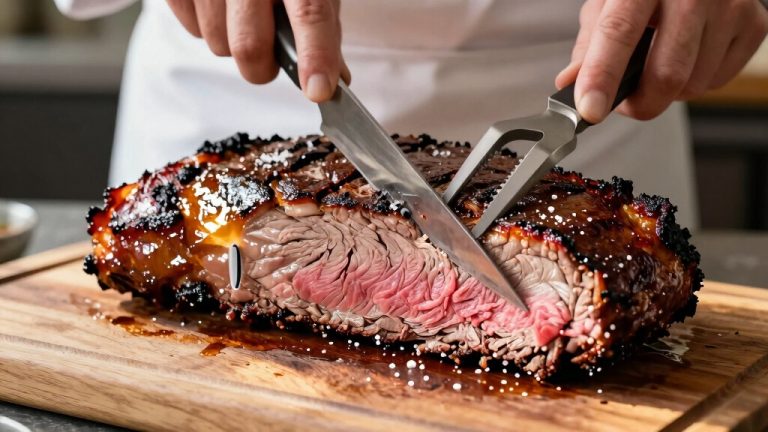
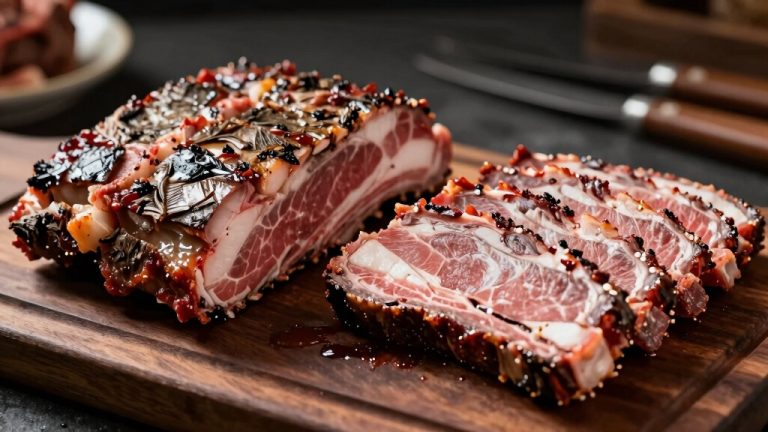
Offset Smoker vs Reverse Flow: Which One Is Better for BBQ?
If you want rich smoke flavor and bold bark with classic Texas-style control, an offset smoker’s direct heat zones suit you best. However, it requires careful meat rotation and fire management.
Reverse flow smokers deliver steadier, even heat with faster cook times and less fuss. This is thanks to a baffle that stabilizes temps and smoke distribution.
They also handle cold weather better and maximize cooking space. Understanding these differences helps you master your BBQ technique. Explore the details to optimize your smoker choice.
Key Takeaways
- Offset smokers have distinct hot and cool zones requiring frequent meat rotation; reverse flow smokers provide even heat distribution with minimal intervention.
- Reverse flow smokers cook brisket and ribs up to two hours faster due to consistent heat beneath the baffle plate.
- Offset smokers deliver about 5% stronger smoke flavor and thicker, crunchier bark from direct radiant heat near the firebox.
- Reverse flow smokers offer better temperature stability, fuel efficiency, and heat retention, especially in cold or wet weather.
- Offset smokers suit cooks who prefer active fire management and classic Texas-style smoking, while reverse flow suits those wanting ease and consistency.
Offset Smoker vs Reverse Flow Smoker – Comparison Table
| Feature | Offset Smoker | Reverse Flow Smoker |
|---|---|---|
| Heat Distribution | Direct heat flows from firebox to chimney, creating hot and cool zones | Heat travels under a baffle plate, then back across meat for even distribution |
| Temperature Stability | ±25°F swings common; requires active fire management | More stable temps with minimal fluctuation |
| Cooking Zones | Distinct zones allow multi-stage cooking | Uniform cooking surface with consistent temperatures |
| Meat Rotation Required | Yes, frequent rotation needed to avoid hot spots | Minimal rotation required |
| Brisket & Rib Cook Time | Longer cook times | Up to 2 hours faster due to even heat |
| Bark Development | Thicker, crunchier bark from direct radiant heat | Even bark formation, slightly less aggressive texture |
| Smoke Flavor Intensity | Slightly stronger smoke flavor (~5% more pronounced) | Balanced smoke flavor, slightly milder |
| Fuel Efficiency | Uses more fuel due to temp swings | More fuel-efficient; fewer logs needed |
| Cold Weather Performance | Requires insulation and frequent adjustments | Retains heat better in cold/wet weather |
| Cooking Space Usage | Less usable space near firebox | Maximizes usable cooking area |
| Fire Management | Hands-on, requires frequent monitoring | Low-maintenance, steady burn |
| Best For | Traditional Texas-style BBQ, pitmasters who enjoy control | Overnight cooks, consistency-focused BBQ enthusiasts |
| Learning Curve | Moderate to high | Beginner-friendly |
| Maintenance | Easier interior cleaning (no baffle) | Requires cleaning under baffle plate |
How to Choose Between Offset and Reverse Flow Smokers?
When deciding between an offset and a reverse flow smoker, you’ll want to weigh how much temperature management you’re willing to handle and the type of cooking experience you prefer.
If you enjoy actively monitoring your fire and adjusting to create distinct hot and cool zones, an offset smoker offers that hands-on control. This is ideal for multi-stage cooks and classic Texas-style smoking.
Offset smokers provide hands-on fire control, perfect for multi-stage cooks and traditional Texas-style smoking.
On the other hand, if you want more even heat distribution with less intervention, a reverse flow smoker simplifies temperature stability thanks to its baffle design. This makes it practical for longer, overnight cooks.
Consider your typical load size too. Reverse flow smokers maximize usable space, while offsets lose some near the firebox.
Ultimately, your choice hinges on balancing control, convenience, and the specific smoking challenges you’re ready to tackle. In cold weather conditions, offset smokers require more frequent adjustments and insulation to manage heat loss effectively, unlike reverse flow smokers which provide better temperature retention and fuel efficiency.
How Offset and Reverse Flow Smokers Differ in Design?
Although both offset and reverse flow smokers serve the same purpose, their internal designs create distinct cooking environments you should understand before choosing one.
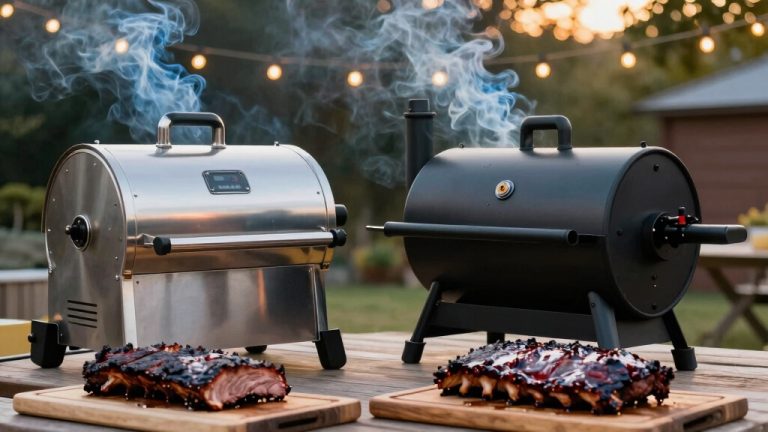
An offset smoker has a firebox attached to the side, allowing heat and smoke to flow directly across the cooking chamber to the chimney.
This design creates hotter zones near the firebox and cooler zones farther away, giving you control but requiring careful meat placement.
In contrast, a reverse flow smoker routes heat under a baffle plate before it rises over the meat and exits on the firebox side.
This baffle forces heat to take a 90-degree turn, equalizing temperatures across the cooking surface.
Reverse flow smokers typically use thinner steel and square fireboxes, maximizing usable space and promoting even cooking without frequent adjustments.
Understanding these design differences helps you match your cooking style to the smoker’s strengths. Additionally, knowing when and how to manage the stall in brisket cooking can help optimize your results regardless of smoker type.
Offset vs Reverse Flow Smokers: Heat Distribution and Temperature Control
When it comes to cooking with offset smokers, you’ll find that they direct heat straight across the cooking chamber. This setup creates distinct hot and cool zones, which means you’ll need to pay close attention to where you place your meat and when to rotate it. It can be a bit of a juggling act!
On the flip side, reverse flow smokers have a different approach. They use a baffle to channel heat evenly underneath the cooking surface. This design helps stabilize temperature fluctuations and makes the most of the cooking space you have.
Understanding how these heat flow patterns work is super important for managing temperature stability and optimizing your cooking zones. It can really make a difference in achieving those consistent results you’re after!
Maintaining a smoker temperature steady between 225°F and 250°F is essential for promoting even cooking and developing a flavorful bark formation.
Heat Flow Patterns
Because heat flow directly impacts cooking consistency and control, understanding the distinct patterns in offset and reverse flow smokers is essential for any pitmaster aiming for precision.
In an offset smoker, heat and smoke flow straight from the firebox across the chamber, creating a pronounced hot spot near the firebox side. You’ll need to rotate or reposition meat to avoid uneven cooking.
Conversely, a reverse flow smoker routes heat under a baffle plate, forcing it to circulate evenly before exiting near the firebox. This design promotes uniform temperature across the grate.
Consider these key differences:
- Offset has direct heat flow causing hot and cool zones.
- Reverse flow uses a baffle to distribute heat evenly.
- Reverse flow maximizes usable cooking space with consistent temperatures.
Mastering these patterns helps you optimize cooking strategy and results. Proper seasoning and maintenance of the smoker’s interior surfaces also play a crucial role in ensuring even heat distribution and protecting the metal from rust.
Temperature Stability
When managing temperature stability, you’ll find reverse flow smokers offer a significant advantage due to their baffle plate design that evenly distributes heat and restricts airflow. This results in minimal fluctuations across the cooking surface.
This design guarantees convective heat circulates gently under the plate, stabilizing temps within a few degrees, so you won’t need constant adjustments. In contrast, offset smokers often experience ±25°F swings at 250°F, requiring you to monitor and adjust fuel and vents frequently.
While offsets give you distinct hot and cool zones, their temperature inconsistencies demand more attention. With a reverse flow, you can maintain steady temps using fewer logs and enjoy more predictable cooking results.
To optimize stability in either smoker, seal gaps tightly and control airflow precisely, but reverse flow’s design inherently simplifies this process. Additionally, maintaining the smoker temperature between 225°F and 275°F and adjusting the burner and air shutter for a steady heat are crucial for consistent results, as explained in the temperature control guide.
Cooking Zone Management
Mastering cooking zone management hinges on understanding how heat distributes and behaves in offset versus reverse flow smokers.
With an offset smoker, you’ll find distinct hot and cool zones. Near the firebox, temperatures spike, demanding frequent meat rotation or strategic placement.
Conversely, reverse flow smokers use a baffle plate to evenly spread heat, delivering consistent temperatures across the cooking surface.
To optimize your cooking:
- In an offset smoker, position fattier cuts closer to the firebox to avoid drying out leaner meat.
- Rotate meats regularly to counteract hot spots and maintain even cooking.
- Use a reverse flow smoker’s even temperature to maximize space and minimize intervention.
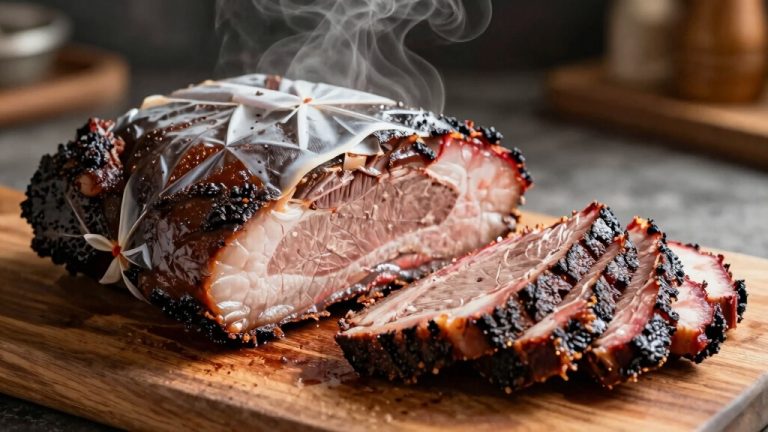
Additionally, using butcher paper to wrap meat during smoking can help manage moisture and improve cooking results by allowing smoke to penetrate while preventing sogginess.
Cooking Performance: Brisket, Ribs, and Bark Quality Compared
When you’re cooking brisket and ribs, it’s super important to know how each type of smoker affects tenderness and timing. You see, reverse flow smokers can actually finish ribs and brisket up to two hours faster. This is mainly because they distribute heat more evenly, which helps achieve that perfect probe tenderness quicker.
On the flip side, offset smokers have their own perks. They really shine when it comes to developing a richer bark texture and they tend to deliver about 5% more smoke flavor. This gives your meat a unique edge in flavor complexity that many BBQ enthusiasts love. So, it really comes down to what you’re aiming for with your cook!
Additionally, offset smokers often benefit from spritzing techniques to maintain surface moisture and enhance bark development during longer cooks.
Brisket Tenderness Comparison
Although both offset and reverse flow smokers produce tender brisket, you’ll notice key differences in how quickly and evenly the meat reaches probe tenderness.
Reverse flow smokers finish brisket about two hours earlier due to more consistent heat distribution beneath the baffle plate.
In contrast, offset smokers require careful placement and rotation to avoid hot spots near the firebox, which can cause uneven cooking.
Consider these points to optimize tenderness:
- Reverse flow’s radiant and convective heat gently cooks brisket from bottom to top, promoting uniform tenderness.
- Offset smokers’ direct radiant heat creates a stronger bark but demands vigilant temperature management to prevent overcooking thinner areas.
- Position the brisket point toward the heat source initially on offset smokers to render fat properly.
Choosing either depends on your preference for cook time versus bark texture control.
For the most accurate results, insert the temperature probe horizontally into the thickest part of the flat muscle to monitor core temperature and avoid premature doneness signals.
Rib Cooking Time Differences
Understanding rib cooking time differences between offset and reverse flow smokers can help you optimize your smoking strategy for both flavor and efficiency.
Reverse flow smokers cook ribs faster, often finishing about two hours earlier than offset smokers, thanks to even heat distribution under the baffle plate.
This consistent temperature reduces the need for frequent adjustments and minimizes hot spots that can cause uneven cooking.
In contrast, offset smokers generate intense heat near the firebox, requiring you to rotate ribs or position them away from the hot zone to avoid overcooking.
While offsets may take longer, they enhance smoke penetration.
To maximize results, use the reverse flow for quicker, more consistent ribs, and reserve the offset for when you want deeper smoke flavor despite longer cook times.
Keep in mind that rain can extend cooking time by lowering smoker temperatures, so monitor heat closely during wet weather.
Bark Texture And Flavor
Beyond cooking times, the texture and flavor of bark play a pivotal role in defining the smoking experience. When choosing between offset and reverse flow smokers, consider these factors:
- Bark Development: Offset smokers excel here, producing a thicker, crunchier bark due to direct radiant heat and higher surface temperatures near the firebox.
- Smoke Flavor: Offset units impart roughly 5% more pronounced smoke flavor, thanks to the unfiltered smoke path that enhances penetration.
- Consistency: Reverse flow smokers provide more even heat distribution, resulting in uniform bark texture but slightly milder smoke flavor.
To maximize bark quality on an offset, rotate your meat to avoid burnt spots and maintain a steady fire. On a reverse flow, leverage the consistent heat for longer cooks, knowing bark forms evenly with less risk of flare-ups. Using wood like oak for smoking can enhance bark flavor with its medium smoky taste and slow burn rate, ideal for these smoker types.
Pros and Cons of Offset and Reverse Flow Smokers
When choosing between an offset and a reverse flow smoker, you’ll want to weigh their distinct advantages and trade-offs carefully.
Offset smokers excel in smoke penetration and bark development, offering you precise control over hot and cool zones. This makes them ideal if you like multi-stage cooking and traditional Texas-style heat.
However, they demand frequent monitoring due to temperature swings and lose usable cooking space near the firebox.
Reverse flow smokers provide even temperature distribution with minimal intervention, maximizing cooking area and speeding up cook times, especially on brisket and ribs.
Their baffle plate stabilizes heat but restricts airflow, which might feel less intuitive.
Ultimately, your choice hinges on whether you prioritize classic smoky flavor with hands-on control or consistent, efficient cooking with less fuss.
Best Uses: Texas-Style BBQ and Overnight Cooking
Although both offset and reverse flow smokers can handle a range of barbecue styles, offset smokers truly shine when you want that authentic Texas-style BBQ experience.
Controlling distinct hot and cool zones lets you master multi-stage cooking and develop deep smoke flavor and rich bark.
When planning your cook, consider these offset smoker strengths:
- Multi-zone control lets you place fattier cuts near the firebox for rendering and leaner cuts farther away to avoid drying.
- Direct radiant heat enhances smoke penetration, producing that coveted bark texture.
- The simpler airflow means you can tweak fire management on the fly, vital for long cooks.
For overnight cooking, reverse flow’s even heat and efficient fuel use reduce monitoring.
This makes it a practical choice for unattended sessions.
Making the Final Decision: Which Smoker Is Right for You?
Deciding between an offset and a reverse flow smoker hinges on your cooking priorities and style. If you value traditional Texas-style BBQ with intense smoke flavor and bark, and don’t mind managing temperature zones and rotating meat, an offset smoker suits you.
Choosing between offset and reverse flow smokers depends on your BBQ style and how hands-on you want to be
It offers superior smoke penetration and allows precise multi-stage cooking through distinct hot and cool zones. Conversely, if you prefer consistent, even heat with minimal intervention, the reverse flow smoker excels.
Its baffle guarantees uniform temperatures and faster cook times, maximizing usable space. Consider your willingness to monitor temps closely; offsets demand more attention, while reverse flows stabilize heat efficiently.
Ultimately, choose based on how hands-on you want to be and the flavor profile you prioritize. Both deliver excellent results when matched to your cooking style.
Frequently Asked Questions
Can Reverse Flow Smokers Be Converted From Offset Smokers?
Yes, you can convert an offset smoker into a reverse flow by adding a baffle plate inside the cooking chamber.
You’ll need to weld or bolt a steel plate to direct heat under the plate, then over the meat, and toward the stack.
Make sure the plate fits snugly for proper heat flow.
Keep in mind, it requires precision and some fabrication skills to maintain even temperature and airflow for effective reverse flow performance.
How Does Fuel Consumption Compare Between Offset and Reverse Flow Smokers?
You might think both smokers consume similar fuel, but reverse flow smokers actually use less wood. Their baffle plate evenly distributes heat, reducing temperature swings and improving efficiency.
You’ll need fewer logs—often just one initially and two more over 25-30 minutes—to maintain steady temps. Offsets demand more frequent adjustments and extra fuel to manage hot spots, so expect higher consumption.
To save fuel, consider reverse flow for consistent, economical cooking.
What Maintenance Differences Exist Between Offset and Reverse Flow Smokers?
You’ll find offset smokers easier to clean since they lack a baffle plate, meaning less buildup underneath.
However, you’ll need to monitor and clean the firebox and chimney frequently to prevent creosote.
Reverse flow smokers require regular cleaning under the baffle plate to avoid soot and grease buildup, which can restrict airflow.
You’ll also want to inspect the baffle for rust or warping to maintain even heat distribution and prolong its lifespan.
Are There Size Limitations Unique to Offset or Reverse Flow Smokers?
Think of offset smokers as classic sports cars—compact, agile, but limited by design.
You’ll find offsets usually smaller due to the firebox and stack placement, restricting cooking chamber size. Reverse flow units resemble roomy SUVs, maximizing cooking space with even heat distribution under the baffle.
How Do Wind and Weather Affect Offset Versus Reverse Flow Smokers?
Wind and weather impact your offset smoker more because its open firebox and direct airflow make temperature swings more pronounced. This requires you to monitor and adjust fuel frequently.
Reverse flow’s baffled design stabilizes heat, so it handles gusts and cold better with less intervention. Position your offset smoker shielded from wind, while reverse flow smokers tolerate outdoor conditions more easily.
This allows you to focus on cooking instead of battling fluctuating temps.
The Final Smoke: Offset or Reverse Flow?
Choosing between an offset and reverse flow smoker comes down to your cooking style and patience.
You might worry reverse flow smokers limit airflow control, but they actually offer more even heat distribution, reducing hot spots without constant adjustments.
If you value hands-off temperature management and consistent results, reverse flow is ideal. However, if you enjoy fine-tuning your fire for that classic smoky bark, an offset smoker gives you that control. Ultimately, pick what suits your BBQ rhythm best.