How to Identify Wood by Bark: Confidently Identifying
You can identify wood by closely examining its bark’s color, texture, and patterns. Look for smooth, light gray bark like beech’s or shiny brown with reddish grooves typical of cherry.
Note peeling patterns: birch peels in thin, horizontal strips, while black birch forms thick plates. Assess ridges and fissures: oak has deep, irregular grooves; ash shows diamond-shaped ridges.
Bark also changes with age, roughening or darkening. Matching bark to adjacent wood samples sharpens accuracy. Explore these traits deeper to sharpen your identification skills.
Key Takeaways
- Observe bark color and texture: smooth light gray bark often indicates beech, while shiny brown with reddish grooves suggests cherry.
- Note peeling patterns: thin horizontal strips indicate paper birch, while thick irregular plates suggest black birch.
- Check bark texture: fibrous and stringy textures point to eastern redcedar, while deep fissures and ridges indicate oak or hickory.
- Consider age-related changes: smooth bark may roughen and develop fissures or plates as the tree matures.
- Look for unique features like cherry’s horizontal lenticels or London planetree’s camouflaged mosaic bark for precise identification.
How To Identify Wood By Bark Color?
How can you accurately identify wood by its bark color?
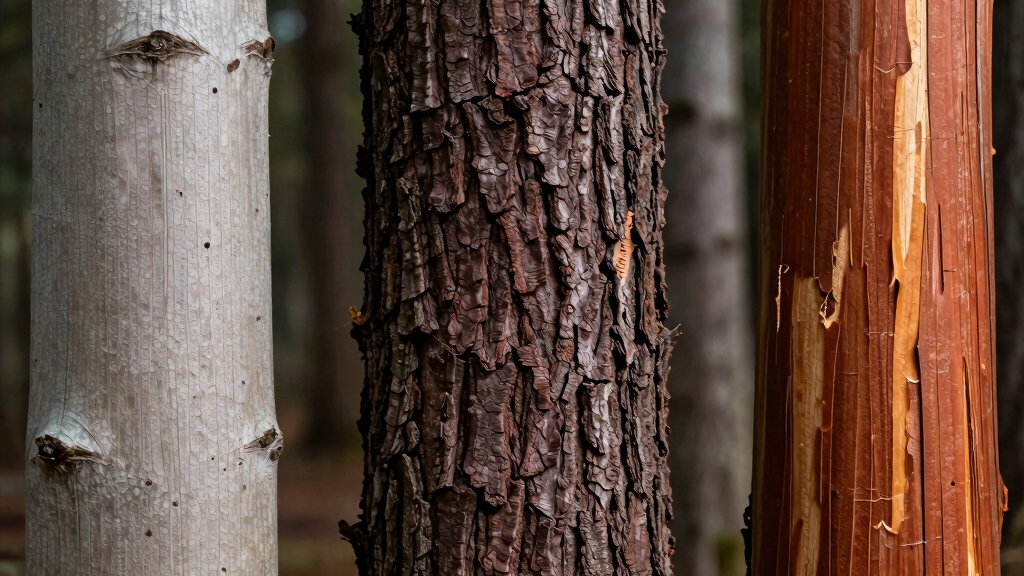
Begin by closely observing the dominant hue and any color shifts with age. For instance, beech bark is consistently light gray, while cherry bark presents a shiny brown or gray base with distinctive reddish-brown grooves.
Observe dominant bark hues and color changes with age to distinguish tree species accurately.
Aspen bark stands out with a green-white tint due to chlorophyll presence.
Silver birch bark features a striking shiny white, paper-like layer that contrasts sharply with other species.
Sequoia bark changes color over time, evolving from gray or purplish in youth to reddish-brown as it matures.
How To Identify Wood By Bark Texture And Feel?
Sure! Let’s break it down a bit more casually.
First off, you want to start by noticing if the bark is smooth. For example, the American beech has this nice, unbroken surface. On the flip side, you’ve got rough bark, like what you see on oak trees, which has those noticeable scales or deep fissures. It’s pretty distinct!
Then, take a moment to see if the bark peels off in thin, horizontal strips, like the paper birch does. It’s quite the sight! Alternatively, you might find bark that forms thick, irregular plates, which is what you get with black birch.
Both of these textures tell you a lot about the tree.
Finally, don’t forget to check for those fibrous textures. You know, like the eastern redcedar? It has this unique pattern with furrows within furrows that really stands out.
Each of these tactile patterns can help you identify the wood more easily. Happy tree spotting!
Smooth Versus Rough
Although bark texture varies widely among tree species, distinguishing between smooth and rough bark provides a fundamental starting point for wood identification.
When you encounter smooth bark, like that of the American beech, you’ll notice an unbroken, even surface, often light gray and consistent throughout the tree’s life.
In contrast, rough bark features pronounced textural elements such as ridges, fissures, or scales.
For example, oak bark displays deep fissures and a scaly surface, while eastern redcedar bark has a fibrous texture with nested furrows.
Pay close attention to the tactile sensation: smooth bark feels sleek and uninterrupted, whereas rough bark offers resistance and irregularity under your fingers.
This tactile difference narrows down species options quickly before examining other bark characteristics.
Additionally, recognizing oak bark is useful because oak wood is prized for its medium smoky flavor and durability in smoking meat.
Peeling And Plated
Observe the bark closely to identify peeling and plated textures, which reveal critical information about the wood species.
Peeling bark typically comes off in distinct strips or sheets, while plated bark breaks into irregular plates or scales. This texture difference helps you differentiate species efficiently.
For example:
- Paper birch bark peels in thin, horizontal, curly strips.
- American sycamore sheds irregular, brittle sheets.
- Black cherry develops scales between outer rhytidome layers.
- Black birch forms thick, irregular plates.
When handling bark, note the direction and thickness of the peeling. Peeling bark often indicates species adapting to environmental stress or growth patterns.
Plated bark, with its segmented plates, can suggest protective layering. These tactile and visual cues are essential for precise wood identification in the field.
Additionally, understanding the resin content in wood, such as the high resin levels found in pine, can further aid in identifying species by the texture and feel of their bark and underlying wood layers, since resin affects wood characteristics and texture.
Fibrous And Scaly
Frequently, identifying wood by bark texture involves distinguishing fibrous and scaly characteristics, which provide essential tactile and visual clues.
When you encounter fibrous bark, such as on eastern redcedar, you’ll notice furrows within furrows. This intricate layering creates a stringy, tough texture that feels coarse and rope-like to your touch.
In contrast, scaly bark, common on oak trees, displays deep fissures and ridges that form irregular, overlapping plates or scales. These scales often appear rough and flaky, detaching easily along the edges.
To accurately identify wood, run your fingers along the bark: fibrous types resist peeling and maintain a fibrous, thread-like quality, while scaly bark breaks away in distinct, plate-like segments.
Observing these tactile differences helps you narrow down species precisely.
How To Use Bark Peeling And Plating Patterns For Identification?
When identifying trees by their bark, you can rely heavily on peeling and plating patterns as distinctive markers.
These features provide key insights into species and age. For example, paper birch peels in thin horizontal curly strips, while American sycamore sheds irregular brittle sheets.
Black cherry bark forms scales between outer rhytidome layers, and black birch develops thick, irregular plates.
To utilize these patterns effectively, focus on:
- Direction and thickness of peeling strips or plates
- Regularity and shape of bark plates or scales
- Presence of curling or brittleness in peeling layers
- Differences in pattern between young and mature bark
How To Spot Ridged And Fissured Bark Patterns?
When you’re out in nature, it’s pretty cool to spot different types of tree bark. For instance, take the ash tree. Its bark has these neat diamond-shaped corky ridges that really stand out. Then there’s the northern red oak, which has these uninterrupted vertical ridges. They almost look like they’re lined up in a straight row!
Now, let’s talk about fissured patterns. These are the deep grooves that split bark segments apart. A great example is the white oak, which showcases horizontally broken ridges. It’s fascinating how these textures can help you figure out what tree species you’re looking at just by examining the bark.
Common Ridged Bark Types
Although ridged and fissured bark patterns can vary widely among tree species, you can identify common types by focusing on the shape, arrangement, and texture of the ridges.
Ridged bark often reveals distinct structural patterns that help differentiate species. For example, ash bark displays interlaced corky ridges forming diamond shapes, while white ash features intersecting ridges creating a crisscross pattern.
White oak bark has ridges broken horizontally, contrasting with northern red oak’s uninterrupted vertical ridges. Hickory bark shows gray flaky ridges with a rough texture.
Key characteristics to observe include:
- Ridge shape (diamond, linear, flaky)
- Ridge continuity (interrupted or uninterrupted)
- Surface texture (smooth, flaky, corky)
- Ridge arrangement (intersecting, parallel, irregular)
These details enable precise identification of ridged bark types.
Identifying Fissured Patterns
Since fissured bark patterns reveal distinct grooves and separations between ridges, you can identify species by examining the depth, width, and arrangement of these fissures.
For example, oak bark presents deep, irregular fissures creating a scaly texture, while hickory bark appears gray and flaky with ridges interspersed by fissures.
White oak’s ridges break horizontally, contrasting with northern red oak’s continuous ridges.
Ash species form diamond shapes through interlaced corky ridges, especially notable in white ash’s intersecting patterns.
When you observe these fissures, note whether they’re narrow or wide, shallow or deep, and if ridges are uniform or irregular.
This precise assessment helps differentiate species with similar bark colors but distinct fissure morphology, sharpening your identification skills in the field.
How To Tell A Tree’s Age By Bark Changes?
When examining a tree’s bark, you can estimate its age by observing specific changes that occur over time.
Observing bark changes over time offers a natural way to estimate a tree’s age and maturity.
Young trees generally have smooth, unbroken bark that gradually roughens as they mature. The texture, color, and presence of fissures evolve distinctly with age.
For example, cherry bark changes from smooth to ridged or fissured. Similarly, oak bark darkens and develops deep fissures, while Scotch pine bark thickens and shifts from grayish to orange flaky layers higher up.
Key age-related bark changes include:
- Smooth bark roughening and cracking over time
- Color shifts from lighter to darker or more varied hues
- Development of ridges, furrows, or fissures
- Increased bark thickness and flakiness
You can use these markers to approximate a tree’s maturity accurately.
Unique Bark Features That Help You Identify Wood
You can identify certain wood species by examining their bark’s unique features, which often stand out due to distinctive colors, patterns, or textures.
For example, cherry bark reveals horizontal lenticels, small, elongated dots facilitating gas exchange, while London planetree bark displays a camouflaged mosaic of green, yellow, white, and brown patches.
River birch bark is notable for its abundant thin, flaking layers, contrasting with the thick irregular plates of black birch.
American hornbeam bark forms sinewy, muscular ridges spaced widely apart, a distinct muscular pattern.
Additionally, cottonwood’s bark twists along its straight trunk, supporting its large canopy.
Recognizing these unique characteristics lets you accurately identify wood species without relying solely on leaf or overall tree form.
Identifying Smooth Bark Trees Like Beech And Cherry
You’ll easily spot the American beech thanks to its smooth, light gray bark, which stays unbroken throughout its life.
It really does have a unique and consistent look that makes it stand out.
Now, when it comes to cherry trees, the bark tells a different story.
You’ll notice it has a shiny brown or gray surface, and those distinctive reddish-brown grooves along with horizontal lenticels really catch the eye.
So, if you pay attention to these smooth bark traits, you’ll be well-equipped to identify these species in the field.
Choosing the right wood selection can influence flavor profiles in culinary applications.
Beech Bark Characteristics
Frequently, identifying beech bark on a tree is possible by noting its distinctive smoothness and uniform light gray color, which sets it apart from many other hardwoods.
When you examine a beech tree, you’ll notice the bark remains smooth and unbroken throughout its life, lacking the fissures or plates common in other species.
This consistency aids in quick recognition.
Key beech bark characteristics include:
- Light gray, almost silvery hue without significant color variation
- Smooth texture without peeling or scaling
- Thin bark layer that remains intact as the tree ages
- Occasional presence of horizontal scars from branch shedding
Cherry Bark Features
While beech bark is recognized for its consistently smooth, light gray surface, cherry bark offers a distinct combination of smoothness and complex coloration that aids identification.
You’ll notice cherry bark exhibits a shiny brown or grayish base, accented by reddish-brown vertical grooves.
These grooves are interspersed with horizontal lenticels, small, elongated pores facilitating gas exchange, giving the bark a finely textured appearance.
Unlike beech, cherry bark develops scales between outer rhytidome layers that may flake subtly with age, though the bark remains relatively smooth in younger specimens.
When examining a tree, focus on this glossy sheen and the reddish grooves as diagnostic traits.
These features distinguish cherry bark from similarly smooth-barked species, allowing you to identify it confidently in the field.
Smooth Bark Identification
When identifying smooth bark trees like beech and cherry, focus on their distinctive surface characteristics and coloration patterns.
Beech bark remains smooth and unbroken throughout its life, exhibiting a consistent light gray tone. Cherry bark also starts smooth but shows shiny brown or gray hues with reddish-brown grooves, often dotted with horizontal lenticels for gas exchange.
To accurately distinguish these species, examine these key features:
- Beech bark: uniformly smooth, light gray, matte texture
- Cherry bark: shiny surface, reddish-brown vertical grooves
- Lenticels: present on cherry, absent on beech
- Aging effects: beech maintains smoothness; cherry may develop fissures
How To Tell Birch Woods Apart By Bark Characteristics?
How can you distinguish different birch species by their bark? Focus on color, texture, and peeling characteristics.
Silver birch bark is shiny white and papery, peeling in thin horizontal strips. Black birch displays thick, irregular plates that don’t peel as readily.
River birch bark flakes abundantly in thin layers, often curling at edges. Each species has distinct bark features that aid identification in the field.
| Species | Bark Color | Bark Texture & Peeling |
|---|---|---|
| Silver Birch | Shiny white | Papery, peels in horizontal curls |
| Black Birch | Dark, thick plates | Plate-like, irregular, non-peeling |
| River Birch | Light brown | Thin flaky layers, abundant peeling |
Use these traits precisely for accurate birch wood identification.
Identifying Oak And Hickory Wood By Bark Patterns
Examine the bark patterns closely to differentiate oak and hickory species effectively.
Oak bark varies from light gray to near black, characterized by deep fissures that often create a rugged, scaly texture. Northern red oak features uninterrupted ridges, while white oak’s ridges break horizontally.
Oak bark ranges from light gray to near black with deep fissures and distinct ridge patterns in red and white oaks.
Hickory bark, in contrast, shows a distinctive gray flaky appearance with furrowed ridges that create a layered surface.
Key identification points include:
- Oak bark’s deep fissures and scaly texture
- Northern red oak’s continuous ridges versus white oak’s segmented ridges
- Hickory’s gray, flaky bark with overlapping ridges
- The overall ruggedness and pattern depth, where oak bark is more fissured and hickory bark more flaky
This precise observation helps you accurately identify these hardwood species by their bark.
Tips For Matching Bark To Wood When Collecting
Although bark can vary widely even within a single species, you can reliably match bark to wood by focusing on consistent physical traits such as color, texture, and pattern changes with age.
Begin by noting bark color; beech’s light gray or cherry’s shiny brown with reddish grooves offers clear cues. Examine texture: smooth bark like American beech contrasts with papery, peeling strips on birch or the fibrous furrows of eastern redcedar.
Assess pattern: diamond-shaped ridges on ash or horizontal lenticels on cherry are distinctive. Consider age; young trees often have smooth bark that roughens or fissures develop over time, as in cherry or oak.
When collecting, make certain you gather bark adjacent to wood cross-sections to compare grain and density, confirming species identification through combined anatomical evidence.
Proper handling and preservation techniques, such as wrapping bark in food-grade butcher paper, can help maintain sample integrity during transport and storage.
Frequently Asked Questions
Can Bark Color Indicate the Tree’s Health or Disease Status?
Yes, bark color can indicate a tree’s health or disease status. When you notice sudden discoloration, like unusual darkening, bleaching, or spotting, it often signals stress, fungal infection, or insect damage.
Healthy bark typically maintains its characteristic color, like beech’s light gray or cherry’s reddish grooves. Monitoring these color changes helps you detect early symptoms of disease, enabling timely intervention to preserve the tree’s health.
How Does Environmental Stress Affect Bark Texture Over Time?
You know what they say: “A smooth sea never made a skilled sailor.”
Environmental stress forces your tree’s bark to adapt, often thickening or developing deeper fissures to protect itself.
Over time, stress can cause bark to become more furrowed, scaly, or cracked, as seen in oak or cherry.
These texture changes improve resilience but also signal the tree’s response to drought, pests, or mechanical damage, altering bark’s typical smoothness or papery layers.
Are There Seasonal Changes in Bark Appearance to Consider?
Yes, you’ll notice seasonal changes in bark appearance. In spring and summer, bark may look greener due to chlorophyll in species like aspen.
Moisture levels also affect bark texture, making it softer or more pliable during wet seasons. During winter, bark often hardens and darkens, revealing fissures or ridges more clearly.
Peeling patterns, like those on paper birch, can intensify with seasonal drying, so always consider the time of year when identifying bark.
What Tools Assist in Measuring Bark Thickness Accurately?
You’ll want to use a bark gauge or a digital caliper to measure bark thickness accurately.
A bark gauge clamps onto the tree, providing precise millimeter readings without damaging the bark.
Digital calipers allow you to measure bark samples off the tree with high precision.
For fieldwork, a thickness micrometer designed for forestry is ideal, giving repeatable, accurate measurements critical for research or timber assessment.
Can Bark Identification Aid in Determining Wood Density or Strength?
You can’t rely solely on bark identification to determine wood density or strength.
Studies show bark thickness varies widely even within species, making it an inconsistent predictor.
However, bark texture and pattern sometimes correlate with wood properties; for example, thicker, fibrous bark often accompanies denser wood in species like eastern redcedar.
To accurately assess wood strength, you’ll need direct measurements of wood density or mechanical testing rather than just bark characteristics.
From Bark to Wood: Mastering Tree Identification
By closely examining bark color, texture, and peeling patterns, you can reveal the secrets each tree holds beneath its surface.
Paying attention to ridges, fissures, and smooth bark variations sharpens your identification skills. Remember, matching bark to wood is like piecing together a puzzle; each detail counts.
With practice, you’ll confidently distinguish species like oak, hickory, birch, and beech, making your wood identification both accurate and efficient every time you step into the forest.