How to Defrost Ribs Fast
To defrost ribs fast, remove any non-heat-resistant packaging and place the ribs in a heavy-duty, leak-proof plastic bag. For microwave thawing, use the defrost setting at about 30% power, thawing for roughly 7–8 minutes per pound while checking frequently to avoid partial cooking.
Alternatively, submerge the sealed ribs in cold water, changing it every 30 minutes, planning about 30 minutes per pound. Always cook ribs immediately after thawing to guarantee safety and quality.
Learn the best practices to maintain flavor and prevent contamination.
Key Takeaways
- Use the cold water thawing method by sealing ribs in a leak-proof bag and submerging in cold water, changing water every 30 minutes.
- Microwave ribs on defrost setting at 30% power, thawing about 7–8 minutes per pound, checking and rotating frequently to prevent partial cooking.
- Remove all non-heat-resistant packaging before microwave thawing and place ribs in a microwave-safe container or dish.
- Avoid warm water or room temperature thawing to prevent bacterial growth and ensure food safety.
- Cook ribs immediately after thawing using microwave or cold water methods to avoid bacterial contamination.
How To Prepare Ribs Before Thawing For Safety And Flavor?

Before you start thawing ribs, make sure to remove any non-heat-resistant packaging, especially if you plan to use the microwave method. This prevents melting or chemical leaching during thawing.
Next, inspect the ribs for any tears or holes in the packaging; reseal them in a leak-proof bag to avoid contamination or water exposure during cold water thawing. Always keep ribs refrigerated until ready to thaw to minimize bacterial growth.
For best flavor retention, avoid thawing at room temperature. If you’re using the refrigerator method, keep ribs on a plate or tray to catch drips, preventing cross-contamination.
Proper preparation guarantees safety by controlling temperature and exposure while preserving the ribs’ texture and taste. This foundational step sets you up for efficient, safe defrosting.
Remember to keep the refrigerator temperature between 34–40°F to ensure safe and effective thawing of your ribs, as recommended by USDA guidelines.
How To Thaw Ribs Quickly In The Microwave?
After preparing your ribs by removing unsuitable packaging and making sure they’re properly sealed, you can use the microwave to thaw them quickly.
Place the ribs in a microwave-safe container and cover them loosely to avoid splatters.
Place ribs in a microwave-safe dish, covering loosely to prevent splatters during thawing.
Use the microwave’s defrost setting or set power to 30%, thawing for about 7-8 minutes per pound. Rotate or flip the ribs occasionally to promote even thawing.
Monitor closely to prevent any partial cooking, which can affect texture and safety. Once thawed, cook the ribs immediately to avoid bacterial growth.
This method is the fastest but requires careful attention to avoid starting the cooking process during thawing. Always follow your microwave’s instructions for defrosting meat to guarantee optimal results.
After thawing, promptly clean and sanitize any surfaces or containers that came into contact with raw ribs to prevent cross-contamination during subsequent food preparation, following general cleaning guidelines.
How To Thaw Ribs Safely Using Cold Water?
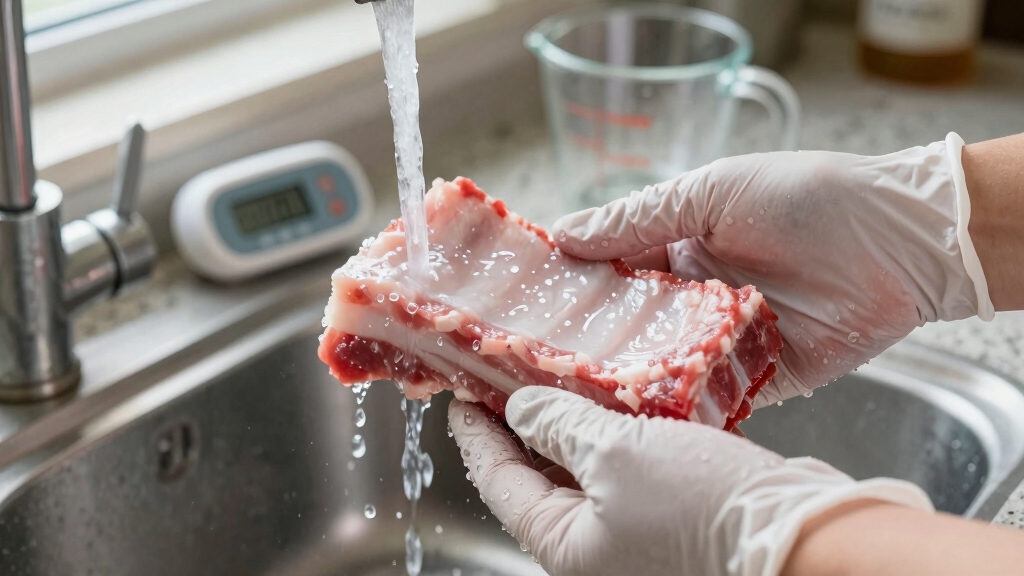
When thawing ribs using cold water, you’ll need to keep them sealed in a leak-proof bag to prevent water exposure and bacterial contamination.
Submerge the sealed ribs fully in cold tap water, ensuring the bag is airtight to avoid any water contact with the meat. Replace the water every 30 minutes to maintain a consistently cold temperature, which slows bacterial growth.
Plan on roughly 30 minutes of thawing per pound of ribs. Once thawed, cook the ribs immediately; don’t refreeze.
- Use a heavy-duty, leak-proof plastic bag to seal ribs tightly.
- Change water regularly to keep it cold and safe.
- Cook ribs right after thawing for food safety compliance.
Rapid cooling to ≤40°F (4°C) after thawing is essential to prevent bacterial growth and ensure food safety.
Why Thaw Ribs In The Refrigerator Despite The Longer Time?
Thawing ribs in the refrigerator is definitely the way to go. Why? Well, it keeps the temperature nice and cool, staying below 40°F, which helps prevent any bacterial growth.
Plus, this slow thawing process really does wonders for the meat’s natural texture because it minimizes moisture loss.
Sure, it takes a bit longer, but trust me, it’s worth the wait. This method not only ensures food safety but also maintains the quality of your ribs.
You don’t want to risk any partial cooking or contamination, right? So, take your time and let those ribs thaw in the fridge!
Maintaining a consistent low temperature during thawing is crucial to prevent bacterial growth and contamination.
Safety Against Bacterial Growth
Although thawing ribs in the refrigerator takes considerably longer than other methods, it effectively inhibits bacterial growth by keeping the meat consistently below 40°F.
This temperature range prevents pathogens from multiplying, ensuring food safety throughout the thawing process. Unlike cold water or microwave thawing, the fridge method maintains a stable, safe environment without sudden temperature spikes that encourage bacterial proliferation.
Key points to ponder:
- Thaw ribs at or below 40°F to avoid the “danger zone” (40°F–140°F) where bacteria thrive.
- Avoid warm water or room temperature thawing as they increase contamination risk.
- Keep ribs in sealed packaging to prevent cross-contamination with other foods.
For optimal food safety and quality, always use non-abrasive cleaning techniques on your cooking equipment after handling raw meat.
Preserves Meat Texture
Maintaining the ideal texture of ribs hinges on the controlled thawing environment provided by refrigeration.
When you thaw ribs in the fridge at 40°F or below, you slow the thawing process, preventing rapid temperature changes that cause ice crystals to rupture muscle fibers.
This preserves the meat’s natural juiciness and tenderness. Unlike microwave or cold water methods, refrigeration avoids partial cooking and excessive moisture loss.
Although it takes longer, about 24 hours per 5 pounds, the consistent low temperature inhibits bacterial growth while maintaining structural integrity.
If texture is your priority, you’ll want to plan ahead and thaw ribs in the fridge to retain peak mouthfeel and flavor. Quick methods may speed thawing but risk compromising rib quality.
Proper storage and moisture control during thawing are essential to prevent mold growth and maintain food safety, as outlined in preventative measures for mold.
How Long Does It Take To Thaw Ribs By Each Method?
Thawing ribs can be done in a few different ways, and each method has its own time frame.
If you’re in a hurry, you can use the microwave. Just set it to the defrost setting and plan for about 7 to 10 minutes per pound. Just be careful not to cook the edges while you’re at it!
Another option is the cold water method, which takes a bit longer—about 30 minutes per pound. Just make sure the ribs are sealed in packaging, and remember to change the water every half hour to keep things moving along.
But for the safest and most effective thawing, it’s best to plan ahead. If you can, try to thaw your ribs in the refrigerator. Just give yourself about 24 hours for every 5 pounds.
Keeping the temperature at 40°F or below is key to ensuring they stay safe to eat. Thawing slowly in the refrigerator is recommended because it helps prevent the growth of harmful bacteria by maintaining a safe temperature throughout the process, which is an important aspect of food safety.
Microwave Thawing Duration
Defrosting ribs in the microwave takes about 7 to 10 minutes per pound when using the defrost setting or 30% power.
You’ll want to remove any non-heat-resistant packaging and place the ribs in a microwave-safe container, loosely covered. Monitor the ribs closely to avoid partial cooking, as microwaves can unevenly thaw meat.
Keep these points in mind:
- Use the defrost function or set power to 30% for controlled thawing.
- Check and rotate ribs every few minutes for even thawing.
- Cook ribs immediately after thawing to prevent bacterial growth.
- This method is the fastest but requires attention to avoid starting to cook the meat prematurely.
For best results, use a calibrated thermometer to check that ribs reach safe temperatures during the cooking process.
Cold Water Timing
While microwave thawing offers a rapid solution, the cold water method provides a reliable alternative when speed and safety both matter.
To thaw ribs using cold water, seal them tightly in a leak-proof bag to prevent contamination. Submerge the bag in cold tap water, changing the water every 30 minutes to keep it cold.
This process typically takes about 30 minutes per pound of ribs. For example, a 3-pound rack will require roughly 1.5 hours to thaw fully.
Avoid using warm water, which risks bacterial growth. Once thawed, cook the ribs immediately; don’t refreeze.
This method balances thawing speed with food safety, making it a practical choice when you need to defrost ribs quicker than refrigeration but want to avoid partial cooking risks linked to microwaving.
When planning to smoke thawed ribs, keep in mind that humidity affects smoke absorption, so controlling moisture levels during cooking can enhance flavor penetration.
Refrigerator Defrost Period
Although refrigerator thawing demands the most patience, it guarantees ribs defrost evenly and safely without compromising texture or flavor. You should place ribs in a fridge set at 40°F (4°C) or below, allowing about 24 hours per 5 pounds.
This slow method prevents bacterial growth and maintains meat quality. For example, a 2-5 pound rack typically takes up to 24 hours to thaw fully. Keep ribs in their original packaging to avoid contamination and place them on a tray to catch drips.
- Small racks (2-5 lbs): ~24 hours
- Larger cuts (9 lbs): 3-5 days
- Store ribs below 40°F to inhibit bacteria
Refrigerator thawing is your safest bet when time permits. It is important to monitor temperature closely as maintaining the internal temperature below 40°F prevents bacterial growth and ensures food safety.
Tips To Avoid Partial Cooking When Thawing Ribs In The Microwave
To prevent partial cooking when thawing ribs in the microwave, you need to monitor the process closely and adjust power settings carefully.
Close monitoring and careful power adjustment prevent partial cooking when thawing ribs in the microwave.
Use the defrost function or set power to 30% to guarantee even heat distribution.
Place ribs in a microwave-safe container and cover loosely to retain moisture without trapping steam.
Stop the microwave every few minutes to check progress and manually separate any thawed sections to avoid cooking edges.
Rotate or flip the ribs if your microwave lacks a turntable.
Avoid exceeding 7-8 minutes per pound to minimize heat buildup.
This approach reduces overheating localized areas, preserving texture and preventing tough, cooked patches.
Always ensure you remove non-heat-resistant packaging before microwaving to prevent melting or chemical leaching.
How To Keep Ribs Safe From Bacteria While Thawing?
When you’re thawing ribs, it’s super important to keep them at safe temperatures, ideally below 40°F. This helps to prevent any nasty bacteria from growing.
Always remember to use leak-proof and heat-resistant packaging, especially if you’re microwaving or using the cold-water method to thaw. This way, you can avoid any contamination.
Temperature Control Importance
When thawing ribs, controlling temperature is critical to preventing bacterial growth that can cause foodborne illness. You need to keep the ribs at safe temperatures, ideally below 40°F, to inhibit harmful bacteria from multiplying.
Avoid letting the ribs enter the “danger zone” between 40°F and 140°F, where bacteria thrive rapidly. Use methods that maintain cold conditions or cook immediately after thawing.
Key points to ensure temperature control include:
- Use refrigerator thawing to keep ribs consistently below 40°F.
- If using cold water, change it every 30 minutes to maintain low temperature.
- When microwaving, monitor closely to prevent partial cooking and overheating.
Strict temperature management ensures safe thawing and reduces health risks during your rib preparation.
Proper Packaging Use
Proper packaging plays a crucial role in keeping ribs safe from bacteria during thawing.
When using the cold water method, make sure ribs stay in a leak-proof, airtight bag to prevent water contact, which can introduce contaminants.
For microwave thawing, remove any non-heat-resistant packaging and place ribs in a microwave-safe container covered loosely to avoid splatter while allowing steam to escape.
Avoid thawing ribs in damaged or torn packaging, as bacteria can enter. Maintaining packaging integrity also prevents cross-contamination in the refrigerator.
Always squeeze excess air from bags during cold water thawing to maximize water contact and ensure even thawing.
Proper packaging combined with correct thawing methods reduces bacterial growth risk, guaranteeing food safety and preserving meat quality during the defrosting process.
Can You Cook Ribs From A Partially Frozen State?
Although cooking ribs from a partially frozen state is possible, it requires adjusting your cooking time to guarantee even doneness. You’ll need to increase cooking time by at least 50% compared to fully thawed ribs to assure heat penetrates the frozen core.
Cooking ribs from partially frozen requires increasing cooking time by at least 50% for even doneness.
- Use a reliable meat thermometer to check the internal temperature reaches 145°F and allow a 3-minute rest.
- Keep these points in mind:
- Start with indirect heat to avoid burning the exterior.
- Monitor temperature frequently to prevent uneven cooking.
- Avoid partial thawing if ribs are frozen solid inside to reduce safety risks.
How To Handle Packaging When Thawing Ribs?
Handling packaging correctly during rib thawing guarantees food safety and maintains meat quality.
For microwave thawing, remove ribs from any packaging that isn’t heat-resistant to prevent melting or chemical leaching.
Place ribs in a microwave-safe container and cover loosely to allow steam release.
When using the cold water method, keep ribs sealed in a leak-proof plastic bag to avoid water contamination and bacterial growth.
Make sure you squeeze out excess air to improve water contact. Avoid opening or puncturing packaging until thawing finishes to reduce contamination risks.
For refrigerator thawing, keep ribs in their original packaging or transfer to a container to catch drips, preventing cross-contamination.
Proper packaging management reduces spoilage and makes certain safe, even thawing.
What To Do Immediately After Thawing Ribs?
Once your ribs have fully thawed, you should cook them immediately to prevent bacterial growth and guarantee food safety.
Cook thawed ribs immediately to ensure safety and prevent harmful bacteria growth.
Delaying cooking increases the risk of harmful bacteria multiplying, especially if thawed using microwave or cold water methods.
To assure best results, handle the ribs precisely post-thaw:
- Remove any remaining packaging that isn’t heat-resistant before cooking.
- Pat the ribs dry with paper towels to promote even browning and reduce steaming.
- Preheat your grill, oven, or smoker to the correct temperature (usually around 225–275°F) before placing the ribs on it.
Following these steps maintains food safety and preserves the ribs’ texture and flavor.
Frequently Asked Questions
Can Thawed Ribs Be Refrozen Safely?
You shouldn’t refreeze thawed ribs if they’ve been thawed using the cold water or microwave methods, as bacteria may have started growing.
However, if you thaw ribs in the refrigerator and keep them at 40°F or below, you can safely refreeze them within 1-2 days.
Always make sure ribs haven’t been left out at room temperature longer than two hours. Proper handling prevents bacterial growth and maintains meat quality when refreezing.
What Are the Best Marinades for Thawed Ribs?
The best marinades for thawed ribs combine acidity, sweetness, and umami.
Use vinegar or citrus juice to tenderize, brown sugar or honey for caramelization, and soy sauce or Worcestershire for depth.
Add garlic, onion powder, smoked paprika, and black pepper for seasoning.
Marinate ribs for at least 2 hours or overnight in the fridge to maximize flavor penetration.
Avoid overly salty marinades, as they can toughen the meat.
How Does Blast Freezing Affect Rib Texture?
Blast freezing preserves rib texture by rapidly lowering the temperature, minimizing ice crystal formation inside the meat.
When you use blast-frozen ribs, you avoid large ice crystals that can rupture cell walls, which usually causes a mushy texture after thawing.
This process keeps the ribs firmer, juicier, and closer to their fresh state.
Is It Safe to Thaw Ribs Using Warm Water?
You shouldn’t dunk ribs in warm water like they’re taking a hot bath. That’s a fast track to bacterial chaos.
Warm water accelerates bacteria growth, risking food poisoning. Instead, use cold water sealed in a leak-proof bag, changing it every 30 minutes.
This keeps the ribs safe while thawing efficiently. Always cook ribs immediately after thawing to assure safety.
Avoid warm water thawing at all costs for your health and flavor preservation.
How to Tell if Ribs Have Thawed Completely?
You can tell ribs have thawed completely when they’re flexible and soft throughout, without any ice crystals or hard spots inside. Press the meat gently; it should yield under slight pressure evenly.
Check the thickest parts carefully, as those thaw last. If the ribs feel cold but pliable and no frozen sections remain, they’re ready. Avoid partial thawing to guarantee even cooking and food safety.
From Frozen to Feast: Thawing Ribs the Right Way
So, you want ribs fast but also safe because nothing says “culinary genius” like a foodborne illness, right? Thawing ribs isn’t a race; it’s a science. Whether you zap them in the microwave or soak them in cold water, follow the rules to keep bacteria at bay.
Sure, fridge thawing takes longer, but it’s the MVP of safety. Remember, rushing ribs might save time but won’t save your stomach. Handle with care, then enjoy.