How Do You Know When Beef Jerky Is Done: Final Step
You’ll know beef jerky is done when its internal temperature hits 160°F, verified with a metal stem thermometer, ensuring pathogen elimination.
Dry strips evenly at 170°F–175°F for 3 to 4 hours, adjusting for thickness. After cooling, perform a bend test: jerky should be firm yet flexible, not brittle or sticky.
Avoid moisture by checking for wet or shiny spots. Finally, apply a 10-minute heat at 275°F for safety assurance. Understanding these steps refines your jerky process.
Key Takeaways
- Beef jerky is done when it is firm yet flexible, bending without snapping, indicating proper dryness and chewiness.
- Perform a bend test on fully cooled strips to check for slight flexibility and even texture without cracking.
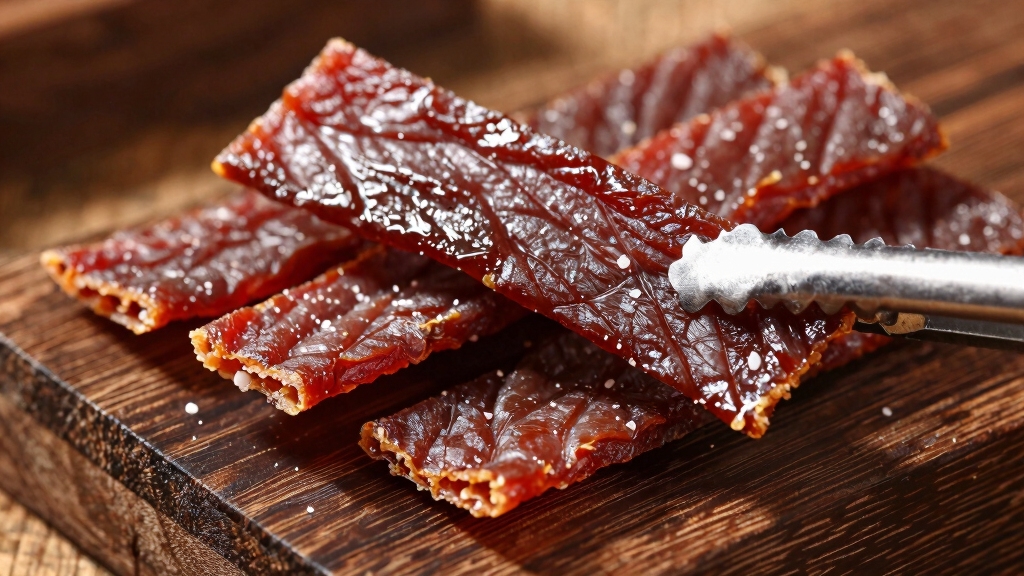
- Dry jerky has a uniform matte finish without wet, shiny, or sticky spots, signaling minimal residual moisture.
- Internal temperature must reach 160°F, verified with a metal stem thermometer, to ensure safety and pathogen elimination.
- Proper drying time varies by strip thickness, usually 3 to 4 hours at 170°F–175°F, with thicker cuts requiring longer drying.
What Internal Temperature Makes Beef Jerky Safe?

To make certain beef jerky is safe to eat, you need to reach an internal temperature of 160°F. This temperature eliminates harmful bacteria such as E. coli and Listeria, ensuring food safety.
Use a metal stem-type thermometer to measure multiple strips, confirming uniform heating throughout the batch. An instant-read temperature of 160°F, held momentarily, matches the bacterial reduction achieved by maintaining 145°F for three minutes.
Thicker strips, over ¼ inch raw thickness, demand longer heating to reach this threshold. After drying, apply a final safety step by heating jerky strips in a 275°F oven for 10 minutes to guarantee all pieces reach 160°F internally.
This precise temperature control is critical to minimize foodborne illness risk without compromising jerky texture. Additionally, drying until the water activity falls below 0.75 is essential to prevent bacterial growth and ensure safe preservation.
How Long Should You Dry Beef Jerky in the Oven?
Generally, you’ll dry beef jerky in the oven at the lowest available heat setting, typically between 170°F and 175°F, for about 3 to 4 hours.
Dry beef jerky in the oven at 170°F to 175°F for 3 to 4 hours.
This duration guarantees gradual moisture removal without overheating, preserving texture and safety.
Around the 3-hour mark, test a piece by cooling it completely and performing the bend test to assess flexibility and dryness.
If the jerky bends without snapping and lacks moist pockets, it’s nearly done.
Visual inspection should confirm uniform color and texture across all strips.
Remember, drying time varies with oven calibration and meat characteristics, so monitor carefully.
Proper drying at this temperature range balances microbial safety and product quality, making the 3-4 hour window the prime timeframe for most beef jerky preparations in a conventional oven.
Maintaining proper moisture control during drying is essential to prevent bacterial growth and ensure food safety.
How Does Thickness Affect Beef Jerky Drying and Safety?
While the typical drying time of 3 to 4 hours works well for standard jerky strips, the thickness of your beef greatly influences both drying duration and safety outcomes.
Thinner strips (around 1/8 inch) dry faster, often completing in 2.5 to 3 hours. Thicker cuts (over ¼ inch) require extended drying times, sometimes exceeding 4 to 5 hours.
Thickness directly affects heat penetration; thicker pieces take longer to reach the safe internal temperature of 160°F, essential for eliminating pathogens like E. coli.
Additionally, uneven drying increases the risk of moisture pockets, compromising safety. To guarantee thorough dehydration and bacterial reduction, you must adjust drying time based on thickness.
Verify internal temperature with a metal stem thermometer, especially for thicker strips that need longer heat exposure.
Patting meat dry before drying helps remove excess moisture and ensures faster, even dehydration for safer jerky.
How to Check Beef Jerky Texture for Doneness?
Assess the texture of your beef jerky by performing a bend test on fully cooled strips. Ensure they’re firm yet flexible without snapping. This test confirms proper moisture removal and drying consistency.
When you bend the strip, it should resist breaking while not feeling overly soft or pliable. Underdried jerky bends too easily, indicating retained moisture. Overdried jerky snaps or crumbles, signaling excessive dehydration.
Always test multiple strips from different areas for uniformity. Cool strips completely before testing. Bend gently to avoid false breakage. Look for firmness with slight flexibility. Avoid jerky that cracks or shatters. Confirm even texture and color across strips.
These steps help you precisely gauge doneness by texture alone. Proper drying also contributes to controlling water activity, which suppresses microbial growth and improves shelf life.
How to Spot Moisture in Beef Jerky and What It Means?
When you’re checking out your beef jerky, make sure to keep an eye out for any wet or shiny spots. Those little areas can be a sign that moisture is hanging around.
And let’s be honest, excess moisture isn’t a good thing—it can really mess with the shelf life and even raise food safety concerns since it creates a perfect environment for bacteria to thrive. Proper drying and storage at the correct temperature are essential to prevent bacterial growth and maintain quality, as outlined in bacterial considerations.
Identifying Wet Spots
Regularly checking for wet spots is essential when determining if your beef jerky has dried properly. Wet spots indicate incomplete moisture removal, which compromises texture and shelf life.
When inspecting, focus on these key indicators:
Look for shiny or glossy areas on the surface, signaling residual moisture.
Feel for tackiness or stickiness after the jerky cools to room temperature.
Identify translucent patches that contrast with the uniform, matte finish of dry jerky.
Note uneven coloration that may correspond with moisture pockets.
Test multiple strips across different drying zones to ensure consistency.
Spotting these wet spots early lets you adjust drying time to achieve peak dehydration, guaranteeing safety and the desired chewy but firm texture. Properly drying jerky is crucial because excessive moisture can promote microbial growth and spoilage, impacting food safety.
Effects Of Excess Moisture
Excess moisture in beef jerky often undermines both its texture and shelf stability. This signals incomplete dehydration that can harbor bacterial growth.
You can spot excess moisture by identifying shiny, wet spots or a tacky surface after cooling. These indicators mean the jerky needs more drying time to reach the safe internal temperature of 160°F.
Use the bend test to check flexibility. Too soft means moisture remains; too brittle means overdrying.
| Indicator | Meaning | Action Needed |
|---|---|---|
| Wet spots | Incomplete drying | Continue drying |
| Excess flexibility | High moisture content | Extend drying time |
| Brittleness | Overdrying | Reduce drying time |
Proper moisture removal guarantees safety and peak texture. For preserving quality and safety, it is also essential to follow evidence-backed steps in handling and storage.
How to Perform the Beef Jerky Bend and Break Test?
When evaluating beef jerky doneness, the bend and break test offers a direct measure of moisture content and texture. To perform this test, first let a sample strip cool completely to room temperature.
Then, gently bend it to assess flexibility without snapping. Properly dried jerky bends without breaking, signaling optimal moisture removal. Jerky that breaks cleanly is overly dry, while one that bends too easily contains residual moisture and needs further drying.
Key points to ponder:
- Test multiple strips from different sheet areas for consistency.
- Avoid testing while jerky is warm to prevent inaccurate results.
- Jerky should be firm but pliable, not brittle or rubbery.
- Visual uniformity accompanies physical flexibility.
- Excessive breakage indicates over-drying and texture degradation.
This test guarantees you achieve the ideal balance of dryness and chewiness. For enhanced flavor, consider finishing with smoked salt as a seasoning to complement the texture and moisture level.
Why You Need a Final Safety Heat at 275°F for Beef Jerky?
You really need that final safety heat at 275°F to make sure all your jerky strips hit an internal temperature of 160°F. This is crucial for getting rid of harmful pathogens like E. coli and Listeria.
Now, here’s the thing: you’ll want to heat it for at least 10 minutes. This ensures that any bacteria are thoroughly reduced, especially if you’re working with thicker cuts.
If you skip this step, you might think your jerky is perfectly dry and safe, but that could actually put you at risk for foodborne illness. So, trust me, don’t overlook this important heat treatment!
Applying the correct time and temperature balance, like the first-order kinetics of heat treatment, is essential to ensure complete safety and quality.
Ensuring Pathogen Elimination
Although drying removes much moisture from beef jerky, it doesn’t guarantee complete pathogen elimination. You need a final safety heat at 275°F to make certain all harmful bacteria, like E. coli and Listeria, are destroyed.
This step is vital because drying alone may not uniformly raise the internal temperature to safe levels.
To guarantee pathogen elimination, you should:
- Heat jerky strips at 275°F for at least 10 minutes after drying.
- Verify internal temperature reaches 160°F using a metal stem thermometer.
- Arrange strips without overlapping for even heat penetration.
- Extend heating time for strips thicker than ¼ inch.
- Recognize that this post-drying heat reduces foodborne illness risk substantially.
Following these protocols makes certain your beef jerky is both safe and shelf-stable. Using curing salt containing sodium nitrite during the preparation can further inhibit bacteria growth and enhance safety.
Heating Time Requirements
Achieving a final internal temperature of 160°F through heating at 275°F is necessary to eliminate residual pathogens that drying alone cannot reliably destroy. This final safety heat ensures all jerky strips reach a pathogen-killing temperature, especially thicker cuts.
You should preheat your oven to 275°F and heat your jerky for at least 10 minutes. Check that no pieces overlap for even heat exposure.
| Strip Thickness | Heating Time at 275°F | Internal Temp Goal |
|---|---|---|
| ≤ ¼ inch | 10 minutes | 160°F |
| > ¼ inch | 12-15 minutes | 160°F |
| Multiple strips | Spread evenly | Uniform heating |
| Cooling period | Complete before test | Guarantees accuracy |
Follow these guidelines to guarantee safety and quality.
Frequently Asked Questions
Can You Use a Microwave to Dry Beef Jerky Safely?
You shouldn’t rely on a microwave to dry beef jerky safely.
Microwaves heat unevenly, causing inconsistent moisture removal and risking bacterial survival.
Proper jerky requires controlled low heat for hours, ensuring uniform drying and reaching an internal temperature of 160°F.
Microwaving may leave pockets of moisture, increasing spoilage risk.
For safety and quality, use an oven or dehydrator with precise temperature control and thorough drying time instead.
What Types of Marinades Affect Drying Time?
Marinades heavy with sugar or honey act like a slow-moving river, prolonging drying time because their moisture binds tightly to the meat.
Acidic marinades with vinegar or citrus hasten drying by breaking down muscle fibers, allowing moisture to escape faster.
Salty or soy-based marinades draw out moisture through osmosis, slightly speeding drying.
When you choose your marinade, consider these chemical effects; they directly influence how long your jerky needs in the dehydrator or oven.
How Should Jerky Be Stored After Drying?
You should store your dried jerky in airtight containers or vacuum-sealed bags to prevent moisture reabsorption and microbial growth.
Keep it in a cool, dark place, ideally below 70°F, for short-term storage up to two weeks.
For longer preservation, refrigerate or freeze jerky, which extends shelf life considerably.
Always make certain jerky is fully cooled and moisture-free before sealing to maintain texture, flavor, and safety during storage.
Is It Necessary to Flip Jerky Strips During Drying?
Yes, you should flip jerky strips during drying to ensure even moisture removal and consistent texture.
Flipping prevents one side from drying too quickly, which can cause uneven doneness or texture inconsistencies.
Rotate strips every hour or so, especially if your drying method involves air circulation from one direction.
This practice promotes uniform color, flexibility, and safety by allowing all surfaces to reach the target internal temperature consistently.
Can Jerky Be Dried Using a Smoker Instead of an Oven?
You can absolutely dry jerky using a smoker, but it’s not just a walk in the park. The smoker must be set at a low temperature, around 160-175°F, to slowly remove moisture without cooking the meat.
You’ll want to monitor internal temperatures carefully, ensuring they hit 160°F to kill pathogens. Smoke adds flavor but requires precise control to avoid over-drying or uneven texture. Consistent airflow and temperature stability are your best friends here.
Seal the Deal: Heat Treatment for Perfect Jerky
Now that you know the critical temperatures, drying times, and texture tests, you might think your beef jerky is ready. But don’t rush; there’s one final step that seals safety and quality: the 275°F heat treatment.
Missing this could mean undercooked spots hiding moisture and bacteria, risking your snack’s safety. So, before you call it done, double-check with the bend and break test, then finish with that vital heat.
Your jerky’s safety depends on it.