Half Tray vs Full Tray: Choosing the Perfect Serving Option
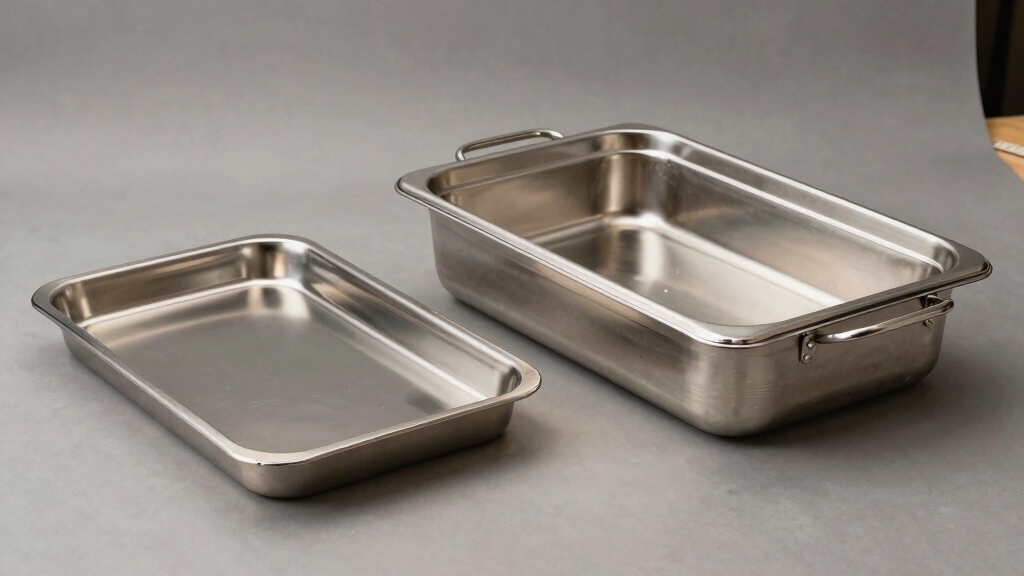
You’ll find full trays measure about 20″ x 12″ and typically serve 15–20 people. They fit standard ovens and chafing dishes efficiently.
Half trays are roughly half that size—around 10″ x 12″—and serve 8–12 portions. They are ideal for smaller groups or varied menus.
Tray depth affects capacity, with deeper pans holding up to twice the volume. Choosing between them depends on your event size, portion control, and equipment compatibility.
Keep exploring to optimize your catering setup.
Key Takeaways
- Full trays measure 20″ x 12″ and serve 15–20 people; half trays are about 10″ x 12″ and serve 8–12 people.
- Full trays maximize oven and chafing dish space, fitting two per standard oven; half trays fit four per oven for menu variety.
- Full trays hold roughly twice the volume of half trays, ideal for large portions and batch cooking; half trays aid precise portion control.
- Half trays suit smaller gatherings and side dishes, reducing waste; full trays are preferred for main courses and large events.
- Using full trays reduces cleaning, storage labor, and equipment costs, while half trays simplify refrigeration and handling for diverse menus.
Half Tray vs Full Tray Comparison Table
| Feature | Half Tray | Full Tray |
|---|---|---|
| Standard Dimensions | ~10″ x 12″ (or 12.75″ x 10.38″ depending on style) | ~20″ x 12″ |
| Serving Capacity | 8–12 people | 15–20 people |
| Food Volume (Approx.) | 80–120 oz (about 4 quarts at 4″ depth) | 175–340 oz (about 8 quarts at 4″ depth) |
| 6″ Depth Capacity | ~10.6 quarts | ~21.2 quarts |
| Best For | Small gatherings, side dishes, varied menus | Large events, main courses, batch cooking |
| Oven Fit (Standard Commercial Oven) | 4 trays side-by-side | 2 trays side-by-side |
| Steam Table Fit | 4 trays | 2 trays |
| Chafing Dish Fit | 2 trays | 1 tray |
| Portion Control | Easier for precise servings | Ideal for bulk serving |
| Food Waste Risk | Lower for small groups | Lower for large groups |
| Labor & Setup Time | More trays required for large events | Fewer trays needed, reduces setup time |
| Storage & Refrigeration | Easier to store and handle | Requires more space |
| Cost Efficiency | Better for menu variety | More cost-effective for high-volume catering |
| Environmental Impact | More trays may increase packaging/cleaning | Fewer trays reduce material use and transport load |
What Are Standard Half and Full Tray Sizes and Dimensions?
When selecting trays for catering or food service, you’ll find that standard half and full trays come with precise dimensions to guarantee compatibility with commercial equipment.
A full tray typically measures about 20 inches by 12 inches, while a half tray measures approximately 10 inches by 12 inches or 12.75 inches by 10.38 inches depending on the style.
Full trays measure 20 by 12 inches; half trays vary between 10 by 12 inches and 12.75 by 10.38 inches.
These dimensions follow uniform standards confirmed by the North American Association of Food Equipment Manufacturers, ensuring seamless integration with ovens and chafing dishes.
Variations, such as the half-size long pan at 6.38 inches by 20.88 inches, exist but remain compatible.
This standardization simplifies inventory management and equipment utilization, making it easier for you to plan and execute food service operations efficiently.
For optimal use and longevity, it is important to consider durable materials that withstand heat and weather when selecting trays.
How Full and Half Trays Fit in Commercial Equipment?
Within commercial kitchens, full and half trays are designed to fit seamlessly into standardized ovens, steam tables, and chafing dishes, optimizing space and workflow.
The North American Association of Food Equipment Manufacturers standardizes tray dimensions, ensuring compatibility and interchangeability. You can maximize oven capacity by stacking trays or mixing sizes efficiently.
| Equipment Type | Full Tray Fit (20″ x 12″) | Half Tray Fit (10″ x 12″) |
|---|---|---|
| Standard Oven | Holds 2 trays side-by-side | Holds 4 trays side-by-side |
| Steam Table | Accommodates 2 trays | Accommodates 4 trays |
| Chafing Dish | Fits 1 tray | Fits 2 trays |
This uniformity streamlines kitchen operations and reduces setup time. It lets you scale production precisely. Choosing the appropriate tray size also affects cooking and storage efficiency due to factors like breathability and moisture control in food packaging.
Food Volume and Serving Sizes Per Tray
Although full and half trays share similar widths and lengths, their food volumes and serving capacities differ substantially due to depth variations and overall size. A full tray typically holds twice the volume of a half tray, with capacities ranging from 175 to 340 ounces.
Half trays range between 80 and 120 ounces. This directly influences how many servings each tray provides, with full trays feeding 15-20 people and half trays catering to 8-12 servings.
Full trays at 4″ depth hold up to 8 quarts (64 oz/quart). Half trays at 4″ depth hold about 4 quarts. Proteins in half trays yield 8-10 servings at 6-8 oz each. Pasta or casseroles in half trays offer 10-12 servings at 8 oz each.
Full trays accommodate larger portions efficiently for main courses. When preparing smoked sausages, it is important to arrange them evenly spaced in the tray to ensure uniform heat distribution and consistent cooking results.
How Tray Depth Affects Capacity?
You’ll notice that increasing tray depth can really make a difference in volume. In fact, it nearly doubles capacity when you go from a depth of 1.5 inches to 3.25 inches or even more!
For instance, a full tray that’s 6 inches deep can hold over 21 quarts. On the other hand, a half tray at the same depth only accommodates about 10.6 quarts.
Understanding these differences is super helpful. It allows you to optimize food quantity and storage based on the size of your event and what’s on your menu.
When using trays for cooking or serving, consider the heat tolerance of any liners or wraps you use to ensure safety and food quality.
Depth Impact On Volume
When you increase the depth of a tray, its volume capacity nearly doubles, markedly impacting how much food it can hold.
Tray depth directly influences volume, allowing you to adjust servings without changing the tray’s footprint. For example, doubling depth from 3.25″ to 6″ nearly doubles the quart capacity, crucial for dense dishes like stews or casseroles.
Consider these technical points: full trays at 6″ depth hold about 21.2 quarts; half trays hold 10.6 quarts.
Standard depths range from 1.5″ to 6″, affecting volume proportionally. Increased depth suits foods requiring more liquid or layering.
Proper depth maximizes oven and steam table efficiency. Depth adjustments let you balance portion size with storage constraints.
Understanding depth’s impact helps you optimize food volume precisely. In cooking techniques such as brisket preparation, controlling moisture and heat retention through methods like wrapping during the stall can similarly optimize the final product’s texture and juiciness.
Capacity Differences By Depth
Since tray depth directly determines volume, adjusting it substantially changes the food capacity within standard footprint dimensions.
For example, a full tray at 2.25″ depth holds approximately 175 oz, while increasing depth to 6″ boosts capacity to 21.2 quarts (about 340 oz), nearly doubling the volume.
Half trays follow a similar pattern: at 2.25″ depth, they hold around 80 oz, but at 6″ depth, capacity rises to 10.6 quarts.
This linear relationship means you can tailor tray depth to the food type. Deeper trays suit stews or casseroles requiring more liquid volume, while shallower depths fit firmer dishes.
Understanding these distinctions guarantees efficient use of oven space and precise portioning, maximizing serving yield without wasting capacity or risking overflow in your commercial kitchen setup.
Proper preparation and moisture control, such as allowing a pellicle formation, are essential for dishes like ribs to achieve the best texture and flavor when cooked in trays of varying depths.
When to Choose Full Trays for Large Events?
Although planning for a large event demands careful consideration of food quantities and presentation, choosing full trays simplifies the process by maximizing serving capacity and minimizing setup time.
Full trays measure about 20″x12″, holding twice the volume of half trays, feeding 15-20 guests per tray efficiently. You’ll want full trays when you need to:
Full trays, measuring 20″x12″, serve 15-20 guests efficiently with double the volume of half trays.
Serve 50+ guests with consistent portion sizes.
Optimize oven and chafing dish space, using fewer trays.
Reduce labor by halving setup and replenishment frequency.
Provide popular entrees like proteins or large salads without frequent refills.
Achieve cost-efficiency by minimizing packaging and handling overhead.
Selecting full trays guarantees streamlined service, precise portion control, and operational efficiency critical for large-scale catering events. For best results, maintain proper holding temperatures during service to ensure food safety and quality.
Why Half Trays Work Better for Smaller Gatherings?
Half trays offer a practical solution for managing food quantities at smaller gatherings. They allow you to dial in portions accurately without excess waste.
Their standardized dimensions—approximately 10 to 12.75 inches wide and 10.38 to 12 inches long—fit seamlessly into commercial ovens and chafing dishes. This ensures efficient heating and serving.
With volumes ranging between 80 and 120 ounces at common depths, half trays serve 8 to 12 people. This enables precise portion control for proteins, pasta, or casseroles.
This scale prevents over-preparation and supports menu variety by accommodating multiple dishes. Additionally, the compact size simplifies storage and handling, reducing the need for excess refrigeration space.
To maintain the quality and longevity of your serving trays, it is important to follow proper cleaning and maintenance routines regularly.
Cost and Labor Benefits of Full vs Half Trays
When managing large-scale catering operations, choosing full trays can markedly reduce both cost and labor due to their capacity and efficiency.
Full trays hold twice the volume of half trays, meaning you serve more guests per tray with less handling. This efficiency cuts setup time and reduces the number of trays needed, lowering labor and equipment costs.
Consider these benefits of full trays over half trays:
- Serve approximately 18 guests per full tray vs. 8-12 for half trays
- Halve the number of trays, cutting cleaning and storage labor
- Maximize oven and chafing dish space with standardized full trays
- Reduce food waste through bulk preparation and consistent portioning
- Minimize transport and setup time by consolidating servings into fewer trays
Additionally, maintaining proper temperature control during holding ensures food safety and quality when serving from large trays.
Using full trays optimizes your workflow, saving time and money in busy catering events.
Matching Tray Sizes to Dish Types
Maximizing cost and labor benefits depends on selecting the appropriate tray size for each dish type. Use full trays for main courses and dishes requiring larger portions, such as fried chicken or casseroles. Their 20″x12″ dimension and 4-inch depth hold up to 8 quarts, feeding 15-20 people efficiently.
Half trays, measuring roughly 10″x12″, suit side dishes, appetizers, and smaller portions, providing precise servings for 8-12 guests. Their reduced volume, about 4 quarts at 4-inch depth, prevents waste and allows menu variety.
For high-moisture dishes like stews, deeper pans increase capacity nearly twofold, so match tray depth accordingly. When combining protein and vegetables, consider one-pan cooking to maximize flavor and efficiency in preparation.
Frequently Asked Questions
Are Half and Full Trays Reusable or Disposable?
You can find both reusable and disposable options for half and full trays.
Reusable trays, often made from stainless steel, are durable and designed for repeated use in commercial kitchens. They maintain consistent dimensions for compatibility with ovens and chafing dishes.
Disposable trays, typically aluminum, are convenient for single events to reduce cleanup.
When selecting, consider your event size and sustainability goals to choose between the efficiency of reusable trays or the convenience of disposable ones.
What Materials Are Half and Full Trays Typically Made From?
Imagine shiny aluminum reflecting light in a busy kitchen. That’s what your half and full trays are typically made from.
These trays use food-grade aluminum for excellent heat conduction, durability, and lightweight handling.
You’ll also find stainless steel versions, especially in commercial settings, prized for corrosion resistance and longevity.
Occasionally, heavy-duty polycarbonate plastic trays appear, offering impact resistance but less heat tolerance compared to metal trays.
How Do Tray Sizes Affect Cooking Time and Temperature?
Tray sizes directly impact cooking time and temperature control.
Since larger trays hold more volume, you’ll need longer cooking times to make sure heat penetrates evenly, especially at standard oven temperatures.
Smaller trays heat faster, allowing shorter cook times and more precise temperature settings.
You should adjust cooking duration based on tray depth and food density, as deeper pans require more time for uniform cooking, preventing undercooked centers or overcooked edges.
Can Half and Full Trays Be Stacked Safely During Transport?
Yes, you can stack half and full trays safely during transport if you follow certain precautions.
Make sure trays are properly covered with secure lids or foil to prevent spillage.
Use sturdy, insulated carriers designed for stacking to maintain temperature and prevent shifting.
Avoid stacking trays beyond recommended height, typically no more than 3-4 trays, to maintain stability and protect food integrity.
Proper stacking minimizes movement and preserves food quality during transit.
Are There Environmental Impacts to Consider Between Tray Types?
Imagine catering a wedding where you need fewer trays to transport food.
Using full trays reduces packaging waste and fuel consumption.
You’ll find that full trays, holding double the volume of half trays, cut down on the number of trays needed.
This lowers material use and transport emissions.
By choosing full trays, you minimize single-use plastics and energy spent on cleaning multiple smaller trays.
This makes your operation more environmentally efficient and sustainable.
Choosing the Perfect Tray for Perfect Service
Choosing between half and full trays is like picking the right tool from your culinary toolbox.
Full trays hold a banquet’s worth, fitting snugly in commercial ovens and serving large crowds efficiently, while half trays offer nimble flexibility for intimate gatherings and precise portion control.
Understanding their dimensions, capacities, and ideal uses lets you orchestrate your event with mechanical precision, ensuring every dish fits perfectly in your equipment and on your guest’s plates.