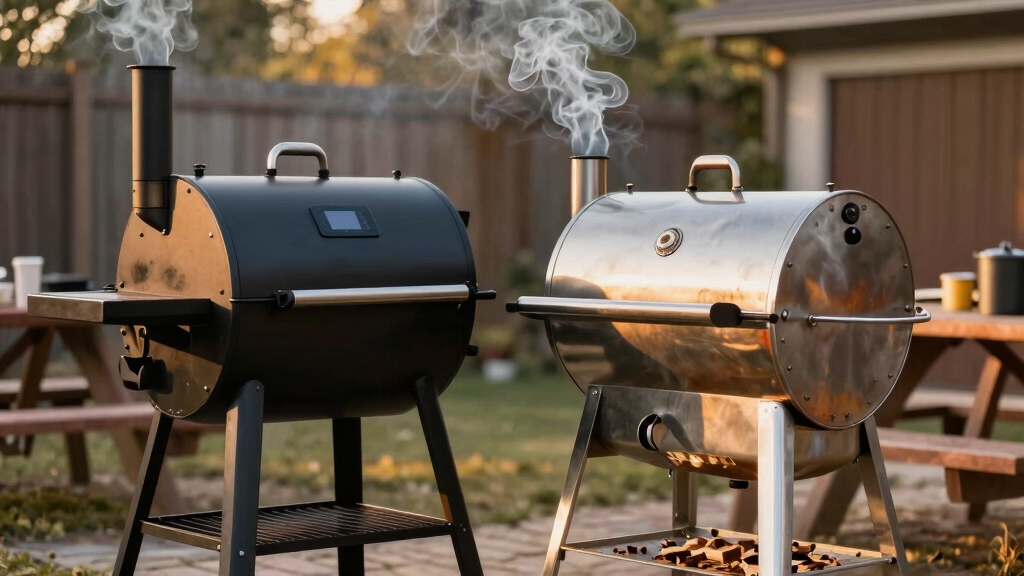
Electric Smoker vs Pellet Smoker: Which Is Better for BBQ?
You’ll find electric smokers offer precise, stable low-temperature control (100°F–275°F) with simple set-and-forget operation. This makes them ideal for delicate, low-and-slow cooking.
Pellet smokers provide broader temperature ranges (165°F–600°F), combining continuous pellet combustion for robust smoke. They also offer versatile functions like searing and grilling.
While they require more maintenance due to mechanical parts, they deliver richer flavor and greater capacity. Understanding these distinctions helps you choose the best fit for your smoking style and needs.
Key Takeaways
- Electric smokers use heating elements and wood chips for mild smoke and precise low-temperature control, ideal for delicate, low-and-slow cooking.
- Pellet smokers burn wood pellets continuously with automated feeding, producing robust smoke and higher temperatures up to 600°F for versatile cooking.
- Electric smokers typically cost less ($100–$400) and require minimal maintenance, while pellet smokers have higher costs ($400–$1,200) and more mechanical upkeep.
- Pellet smokers offer broader cooking options including grilling, baking, and searing, while electric smokers focus on steady low-and-slow smoking.
- Pellet smokers produce stronger, more consistent smoke flavor and longer smoke duration compared to the milder, intermittent smoke from electric smokers.
Pellet or Electric Smoker: What’s the Difference? (Quick Table)
| Feature | Electric Smoker | Pellet Smoker |
|---|---|---|
| Temperature Range | 100°F – 275°F (ideal for low-and-slow cooking) | 165°F – 600°F (wide range for smoking, grilling, searing) |
| Temperature Control | Highly precise, stable (digital/analog controls) | Automated via auger + combustion (slight fluctuations possible) |
| Ease of Use | Very easy, set-and-forget operation | Moderately easy, requires pellet management |
| Fuel Type | Electricity + wood chips | Wood pellets + electricity |
| Smoke Production | Intermittent, mild smoke | Continuous, strong smoke |
| Flavor Profile | Subtle, lighter smoky taste | Rich, robust, deep smoky flavor |
| Smoke Ring Formation | Minimal | Strong and pronounced |
| Moisture Retention | Good with water pan, but can be drier | Naturally moist due to combustion smoke |
| Cooking Versatility | Limited to smoking | Multi-functional: smoking, grilling, baking, searing |
| Heating Speed | Faster heat-up time | Slower, depends on pellet ignition |
| Capacity | Smaller, vertical racks (good for small families) | Larger cooking space (300–1000+ sq in) |
| Maintenance | Low (basic cleaning, chip refill) | Higher (hopper cleaning, mechanical parts upkeep) |
| Initial Cost | $100 – $400 | $400 – $1,200 |
| Operating Cost | Low (electricity only) | Moderate (pellets + electricity) |
| Noise Level | Very quiet | Moderate (fan + auger noise) |
| Best For | Beginners, low-and-slow cooking, convenience | Versatility, strong flavor, larger cooking needs |
| Indoor Use | Safer with ventilation | Not suitable for indoor use |
Electric vs Pellet Smokers: A Quick Comparison

While both electric and pellet smokers offer convenient smoking options, they differ markedly in operation, temperature range, and versatility.
Electric and pellet smokers provide convenient smoking but vary greatly in function, temperature, and cooking options.
You’ll find electric smokers easier to use if you want set-and-forget cooking, relying on heating elements controlled digitally or analog for precise temps up to 275°F. They heat faster and maintain low temps as low as 100°F, ideal for jerky.
Pellet smokers, though simple, require managing a hopper with wood pellets fed automatically by an auger. They reach higher temperatures, up to 600°F, enabling grilling and searing beyond smoking.
Both types need electricity, but pellet smokers combine igniter rods with pellet combustion for temp control, offering broader cooking flexibility.
Your choice hinges on whether you prioritize straightforward use and lower temps or versatility and higher heat ranges. Electric smokers provide precise temperature control that reduces monitoring and guesswork, making them ideal for beginners and delicate foods.
Flavor Profiles: How Electric and Pellet Smokers Differ?
Pellet smokers are pretty interesting. They burn wood pellets to create smoke, which gives your food that robust, smoky flavor we all love. Plus, they can really nail those distinct smoke rings, especially when cooking at lower temperatures. It’s like magic!
On the other hand, electric smokers work a bit differently. They use wood chips that are added periodically to generate smoke. This usually results in a milder taste, but one of the perks is that they tend to keep your food nice and moist thanks to their controlled heat.
Pellets burn slower and more evenly than wood chips, providing longer smoke duration and more consistent temperature control for extended cooking sessions.
Smoke Production Differences
Because pellet smokers rely on wood pellets as both the heat and smoke source, they generate a more robust smoky flavor and distinct smoke rings compared to electric smokers, which produce smoke by intermittently adding wood chips.
You’ll notice pellet smokers maintain consistent smoke due to continuous pellet combustion. In contrast, electric smokers produce sporadic smoke bursts linked to chip addition cycles.
| Aspect | Pellet Smoker | Electric Smoker |
|---|---|---|
| Smoke Source | Burning wood pellets | Wood chips added intermittently |
| Smoke Consistency | Continuous, controlled | Intermittent, less steady |
| Smoke Intensity | High, robust | Moderate, milder |
| Smoke Ring Formation | Pronounced | Minimal |
| Heat & Smoke Relation | Combined via pellet burn | Separate elements and wood chips |
This difference shapes the flavor complexity you achieve with each type. Proper pellet packing and ignition techniques are essential for achieving the rich, steady smoke pellet smokers are known for.
Taste And Moisture Impact
The distinct smoke production methods of pellet and electric smokers directly influence the taste and moisture retention in your food.
Pellet smokers generate smoke through combustion of wood pellets, producing robust, consistent smoky flavors and pronounced smoke rings.
This combustion also helps retain moisture by creating a humid cooking environment at lower temperatures.
Electric smokers rely on heating elements to generate heat, with smoke produced intermittently by adding wood chips.
This results in a milder smoke flavor and sometimes less moisture retention due to less consistent smoke generation and drier heat.
However, high-quality electric models separate heat and smoke sources, improving flavor and moisture balance.
Ultimately, pellet smokers excel in delivering richer, deeper smoky profiles and juicier results.
Electric smokers offer more controlled but subtler taste and moisture outcomes.
Pellet smokers typically operate between 165°F and 500°F, allowing for versatile cooking from low-and-slow smoking to high-heat searing.
Temperature Ranges and Control in Electric Vs Pellet Smokers
You know, electric smokers are all about that precise temperature control. They use heating elements and typically max out around 225-275°F. This range is perfect for low-and-slow cooking, and if you’re into making jerky, you can even set it to about 100°F. It really makes the process consistent and reliable.
On the flip side, pellet smokers can heat things up quite a bit more, reaching temperatures of 550-600°F! They achieve this by managing combustion with an igniter rod and an automated pellet feeding system. This versatility means you can smoke, grill, or even sear your food, giving you a lot of options in the kitchen.
For comparison, the Char Griller Gravity 980 offers a broad temperature range from 200°F to 700°F, controlled digitally with Bluetooth and WiFi connectivity for remote monitoring and adjustments.
Maximum Temperature Comparison
Explore how electric and pellet smokers differ markedly in their maximum temperature capabilities and control mechanisms.
Electric smokers typically max out between 225°F and 275°F, focusing on consistent low-and-slow cooking ideal for smoking meats. Their heating elements provide precise, steady heat control but limit high-temperature versatility.
Pellet smokers, however, can reach 550°F to 600°F, enabling grilling, searing, and baking beyond traditional smoking. This extended range stems from pellet combustion, which generates intense heat alongside smoke.
While electric units excel at maintaining lower temps — even as low as 100°F for jerky, pellet smokers offer greater flexibility with broader heat output.
Many pellet smokers also feature advanced temperature regulation systems that provide precise and consistent heat control across a wide range.
Temperature Control Mechanisms
Understanding how electric and pellet smokers manage temperature helps you optimize cooking results within their respective ranges.
Electric smokers rely on one or two heating elements controlled by digital or analog panels, offering precise temperature regulation typically between 100°F and 275°F. This precision enables you to maintain consistent low-and-slow cooking, essential for smoking delicate cuts or jerky.
Pellet smokers use an auger to feed wood pellets into a combustion chamber ignited by a rod. This allows temperatures from around 180°F up to 600°F. Their control system modulates pellet feeding and airflow to adjust heat, supporting a wide range of cooking methods including grilling and searing.
While electric models offer faster heat-up times and stable low temps, pellet smokers provide broader versatility through combustion-based temperature control.
For optimal smoking results, maintaining a recommended temperature range of 225°F–275°F is critical regardless of smoker type.
Low-Temperature Cooking Options
Mastering low-temperature cooking hinges on precise temperature control and range capabilities, where electric and pellet smokers differ markedly.
Electric smokers excel at stable, low temps, maintaining as low as 100°F, ideal for jerky or delicate smoking. Their heating elements offer fine-tuned, consistent heat.
Their maximum low-and-slow range caps around 225-275°F. Pellet smokers, however, deliver broader versatility with a range from low temps up to 550-600°F, enabling you to switch from smoking to searing.
Temperature control in pellet smokers involves managing pellet feed rates via an auger and combustion intensity. This can introduce slight fluctuations compared to electric models’ steady element heat.
While pellet smokers offer more flexibility, electric smokers provide superior precision at lower temperatures. They’re preferable if your focus is strictly low-and-slow cooking.
Many electric smokers also feature PID temperature control, which helps maintain precise temperature regulation within ±5°F for consistent cooking results.
Ease of Use: Which Smoker Is Better for Beginners?
Typically, electric smokers offer the most straightforward experience for beginners, thanks to their set-and-forget operation and simple temperature controls. You’ll appreciate the quick heating via electric elements and precise temperature regulation, which minimizes guesswork.
Pellet smokers are user-friendly but require managing the pellet hopper and auger system to maintain fuel flow. Both types feature digital or analog panels, but pellet smokers add complexity with automated pellet feeding and combustion control.
Proper temperature maintenance and monitoring are crucial in all smokers to ensure efficient combustion and optimal flavor, as recommended when using a Masterbuilt Gas Smoker.
| Feature | Electric Smoker | Pellet Smoker |
|---|---|---|
| Temperature Control | Precise, simple dial or digital | Automated auger, requires monitoring |
| Fuel Management | Add wood chips periodically | Continuous pellet feeding system |
| Heating Speed | Faster heat-up via electric element | Slower, depends on pellet ignition |
Electric smokers win in ease of use for novices.
Cooking Versatility and Capacity Compared
When comparing cooking versatility, pellet smokers clearly outperform electric smokers by offering multiple functions beyond smoking, including baking, grilling, and searing at temperatures up to 550-600°F.
Pellet smokers excel with versatile cooking options like baking, grilling, and searing up to 600°F.
This high heat range lets you sear steaks or grill vegetables, capabilities electric smokers lack due to their 225-275°F max temperature focused solely on low-and-slow cooking.
Regarding capacity, electric smokers typically have a vertical design with four racks suited for small families, while pellet smokers provide between 300 to 1,000 square inches of cooking space, accommodating larger loads and group gatherings.
Pellet models often match or exceed electric capacity, making them more suitable when you need to cook bulk quantities.
Many pellet smokers also feature multi-function racks and adjustable cooking configurations for tailored versatility.
Cost and Maintenance: What to Expect With Each Smoker?
Although pellet smokers demand a higher initial investment, you’ll find that electric smokers offer a more budget-friendly entry point with lower operating costs.
Electric models primarily consume electricity to power heating elements, keeping ongoing expenses minimal.
Pellet smokers, while costlier upfront due to complex auger and igniter systems, use pellets as fuel, which can add to maintenance routines.
Both require periodic cleaning and wood chip or pellet replenishment, but pellet smokers involve more mechanical upkeep.
| Feature | Electric Smoker | Pellet Smoker |
|---|---|---|
| Initial Cost | Lower ($100-$400) | Higher ($400-$1,200) |
| Operating Cost | Low electricity use | Pellets fuel cost + electricity |
| Maintenance | Simple cleaning, chip refills | Mechanical parts + hopper cleaning |
Frequently Asked Questions
Can Electric Smokers Be Used Indoors Safely?
Yes, you can use electric smokers indoors safely because they produce minimal smoke and don’t rely on open flames.
Their heating elements generate consistent heat, and smoke comes from wood chips in a controlled manner.
Unlike pellet smokers, electric models don’t emit heavy smoke or combustion gases, making them more suitable for indoor environments.
Just make sure proper ventilation to avoid any lingering odors and keep the unit away from flammable materials.
How Noisy Are Pellet Smokers During Operation?
Pellet smokers produce noticeable noise during operation due to the auger feeding pellets into the firepot, plus a fan circulating air.
You’ll hear a steady humming and occasional clicking, which is louder than the near-silent electric smoker’s heating element.
While it’s not disruptive, you won’t get full quiet. If noise concerns you, expect pellet smokers to run around 50-60 decibels, similar to a dishwasher, whereas electrics stay much quieter.
What Types of Wood Pellets Are Best for Pellet Smokers?
You’ll want to choose hardwood pellets like hickory, mesquite, apple, cherry, or oak for your pellet smoker.
Hickory offers strong, meat-like smoke, while mesquite delivers intense, earthy flavors ideal for beef.
Fruitwoods like apple and cherry provide mild, sweet smoke suitable for poultry and meat.
Oak balances between bold and mild, great for versatile use.
Avoid softwood pellets; they produce resinous, unpleasant smoke that ruins taste and clogs your smoker.
Do Electric Smokers Require Water Pans for Moisture?
Yes, electric smokers generally require water pans to maintain moisture during low-and-slow cooking.
You’ll place a water pan inside to create a humid environment that prevents meat from drying out.
Unlike pellet smokers, which generate more natural moisture through pellet combustion, electric models rely on this added water source to balance heat and humidity.
Using a water pan helps you achieve tender, juicy results consistently.
How Long Do Pellet Smoker Hoppers Typically Last Before Refilling?
Pellet smoker hoppers typically last anywhere from 6 to 20 hours before you need to refill, depending on the hopper size and cooking temperature.
You’ll get shorter runtime at higher temps because the auger feeds pellets faster.
Conversely, lower temps extend hopper life since pellet consumption slows.
Managing hopper levels is key to maintaining consistent heat and smoke throughout your cook.
Keep an eye on it during long smoking sessions.
Simplicity or Smoky Depth? Your Perfect Smoker Awaits
You might think choosing between an electric and pellet smoker is a toss-up, but here’s the coincidence: both deliver precise temperature control, yet their flavor profiles couldn’t be more different.
If you want convenience and simplicity, electric smokers excel. On the other hand, pellet smokers offer versatility with richer, wood-fired flavors.
Depending on your priorities, ease or depth of taste, you’ll find each has its technical strengths and maintenance demands tailored just for you.