Cold vs Hot Smoked Salmon: Taste, Texture & Cooking Compared
You’ll notice cold smoked salmon is cured and smoked below 85°F, preserving a silky, raw-like texture with delicate smoky flavor.
Hot smoked salmon is fully cooked at 145–275°F, resulting in a flaky texture and deeper, robust smoke taste.
Cold smoking relies on salt-curing for safety; hot smoking uses heat to cook the fish through.
Both differ in preparation, appearance, and use. Explore more to understand their unique processing and culinary applications further.
Key Takeaways
- Cold smoked salmon is smoked below 85°F, preserves a raw-like texture, and requires salt-curing for safety.
- Hot smoked salmon is smoked between 145–275°F, fully cooked, and safe to eat without curing.
- Cold smoked salmon has a silky, buttery texture with delicate smoky flavor, while hot smoked is tender, flaky, and robustly smoky.
- Cold smoked is ideal for elegant dishes and thin slicing, whereas hot smoked suits hearty meals and is often sold in firmer portions.
- Cold smoked salmon originates from East Coast traditions, hot smoked from West Coast indigenous methods, with different packaging and shelf life.
Cold and Hot Smoked Salmon Comparison Chart
| Feature | Cold Smoked Salmon | Hot Smoked Salmon |
|---|---|---|
| Smoking Temperature | Below 85°F (30°C) | 145–275°F (105–135°C) |
| Smoking Time | Up to 13 hours | 1–3 hours |
| Cooking Status | Not cooked (raw-like) | Fully cooked |
| Safety Method | Salt-curing before smoking | Heat cooking ensures safety |
| Texture | Silky, buttery, smooth | Tender, flaky, firm |
| Flavor Profile | Delicate, subtle smoke, briny | Robust, deep smoky, umami-rich |
| Moisture Content | Higher moisture, softer | Lower moisture, firmer |
| Appearance | Dark pink, translucent sheen | Lighter pink, opaque and flaky |
| Typical Packaging | Vacuum-sealed, thin deli slices | Firmer portions, often skin-on, fiberboard packs |
| Best Culinary Uses | Bagels, cream cheese, appetizers, sushi-style dishes | Salads, pasta, hearty meals, eaten directly |
| Regional Tradition | Irish & Central European (East Coast influence) | Pacific Northwest Indigenous (West Coast influence) |
| Shelf Life (Opened) | About 1 week (refrigerated) | About 1 week (refrigerated) |
| Freezing Capability | Freezes well up to 6 months | Can freeze up to 6 months (slight texture change) |
| Health Notes | Higher omega-3 retention | Higher protein bioavailability |
| Pregnancy Safety | Not recommended (not fully cooked) | Generally safer (fully cooked) |
Cold vs Hot Smoked Salmon: Key Differences

While both cold and hot smoked salmon rely on smoking to develop their distinctive flavors and textures, they differ fundamentally in temperature, processing time, and resulting characteristics.
Cold and hot smoked salmon differ primarily in temperature, processing time, and resulting flavor and texture.
Cold smoking uses temperatures below 85°F (30°C), extending over roughly 13 hours, preserving the raw state through salt-curing before smoking.
Hot smoking operates between 145-275°F (105-135°C), completing in 1-3 hours and fully cooking the fish.
Consequently, cold smoked salmon exhibits a silky, buttery texture with delicate smoky notes, while hot smoked salmon presents a tender, flaky consistency with robust, deep smoke flavor.
These temperature and time distinctions directly influence moisture content, texture, flavor intensity, and visual appearance, defining each product’s unique culinary and sensory profile.
Understanding these contrasts is essential for selecting the appropriate smoked salmon for specific gastronomic applications.
Proper preparation, including brining and seasoning, is crucial to achieving the ideal flavor and texture in either smoking method.
How Cold And Hot Smoked Salmon Are Made?
Producing cold and hot smoked salmon involves distinct temperature controls and preparation steps that directly impact texture, flavor, and safety.
When you prepare cold smoked salmon, you start by salt-curing the fillet to inhibit bacterial growth. Then smoke it at temperatures below 85°F (30°C) for up to 13 hours.
Hot smoked salmon requires cooking the fish fully, smoking it between 145-275°F (105-135°C) for 1-3 hours.
Key differences in the process include:
Cold smoking preserves the raw state; hot smoking cooks the salmon.
Cold smoking uses long, low-temperature exposure; hot smoking uses shorter, high-temperature exposure.
Salt-curing precedes cold smoking; hot smoking doesn’t require prior curing.
Temperature control guarantees safety: cold smoking relies on curing, hot smoking on heat cooking.
Cold-smoked salmon typically freezes better than hot-smoked due to its lower moisture content and texture retention when vacuum-sealed, making cold smoking preservation an important consideration for storage.
Texture, Flavor, And Culinary Uses
Because cold and hot smoked salmon undergo different processing methods, their textures and flavors diverge markedly, influencing their culinary applications.
Cold and hot smoked salmon differ greatly in texture and flavor, shaping how they’re best enjoyed.
Cold smoked salmon has a silky, buttery texture that melts in your mouth, with a subtle, delicate smoky flavor and a salty, briny burst. This makes it ideal for refined dishes where salmon’s raw essence stands out, like bagels with cream cheese or elegant appetizers.
Hot smoked salmon, fully cooked with higher heat, presents a tender, flaky texture and a robust, intensely smoky, umami-rich flavor. You’ll find it well-suited for hearty meals or eaten directly from packaging.
Both types work in salads, but cold smoked offers delicacy, while hot smoked adds chew and boldness, guiding your choice based on desired mouthfeel and flavor intensity.
Cold smoking requires careful curing with non-iodized salts and specific nitrite use such as Prague Powder #1 to ensure safety during extended cold smoking.
Visual Appearance And Packaging
When you compare cold and hot smoked salmon, their visual characteristics and packaging methods distinctly reflect their processing styles.
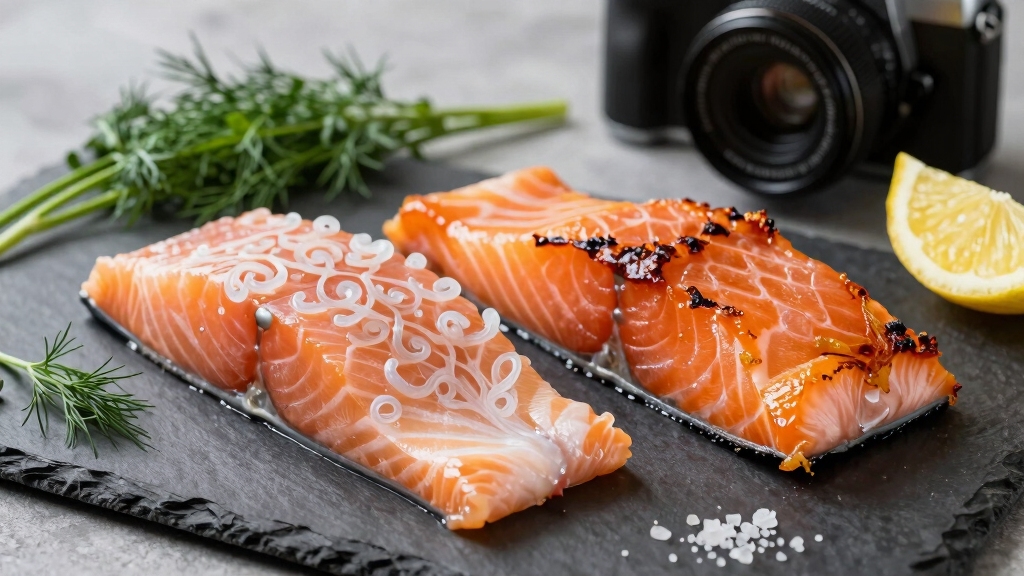
Cold smoked salmon appears dark pink with a translucent sheen, maintaining a raw-like texture.
Hot smoked salmon shows a lighter, flaky look indicative of full cooking.
Packaging also varies: cold smoked salmon comes vacuum-sealed in flat, deli-style packs, emphasizing thin slicing and freshness.
Hot smoked salmon is sold in firmer portions, often with skin intact, in printed fiberboard containers that highlight its cooked nature.
- Cold smoked salmon: darker, translucent red hue
- Hot smoked salmon: lighter, flaky appearance
- Cold smoked: vacuum-packed, thin slices
- Hot smoked: firm portions, skin-on, fiberboard packaging
The internal temperature reached during hot smoking is a key factor in the salmon’s flaky texture and safe doneness.
Regional Traditions And Shelf Life
Although cold and hot smoked salmon share the common goal of preserving fish, their regional traditions reflect distinct cultural origins: cold smoking stems from Irish and Central European practices favored on the East Coast, while hot smoking traces back to Pacific Northwest indigenous methods prevalent on the West Coast.
Cold and hot smoked salmon reflect unique cultural origins: Irish and Central European for cold, Pacific Northwest indigenous for hot.
This geographic divergence influences not only flavor profiles but also traditional consumption patterns. When it comes to shelf life, both varieties maintain quality for about one week once opened, provided proper refrigeration.
Freezing extends usability up to six months, though with gradual flavor degradation. Understanding these regional and temporal factors enables you to optimize storage and consumption, ensuring you experience the intended texture and taste distinctive to each smoking method.
This precision is essential for maintaining product integrity and culinary authenticity. Proper refrigeration and handling are crucial to prevent spoilage and extend the safe consumption period of smoked salmon.
Frequently Asked Questions
Can Cold Smoked Salmon Be Safely Eaten by Pregnant Women?
You should avoid cold smoked salmon during pregnancy because it’s not fully cooked and may harbor Listeria bacteria, posing risks to you and your baby.
The cold smoking process preserves the fish raw, without heat sufficient to kill pathogens.
Instead, opt for hot smoked salmon, which is fully cooked and safer.
Always consult your healthcare provider for personalized advice regarding fish consumption while pregnant.
How Should Leftover Smoked Salmon Be Stored for Best Freshness?
You should store leftover smoked salmon in an airtight container or tightly wrapped in plastic wrap to minimize air exposure.
Keep it refrigerated at or below 40°F (4°C) to maintain freshness.
Consume within one week of opening to guarantee safety and flavor integrity.
For prolonged storage, freeze the salmon in vacuum-sealed packaging or freezer-safe bags.
This preserves quality for up to six months without significant flavor loss.
Are There Health Benefits Unique to Cold or Hot Smoked Salmon?
Imagine your body as a machine needing precise fuel.
Cold smoked salmon, minimally heated, preserves more omega-3 fatty acids, essential for heart and brain health.
Hot smoked salmon, cooked at higher temperatures, offers easier digestion and higher protein bioavailability.
So, if you want maximum omega-3 intake, cold smoked is your go-to.
But for a protein boost with robust flavor, hot smoked suits you better.
Both benefit your health in distinct ways.
What Type of Wood Is Best for Smoking Salmon?
You’ll find alder wood is often the best choice for smoking salmon because it imparts a mild, sweet flavor that complements the fish without overpowering it.
Maple and fruitwoods like apple or cherry also work well, offering subtle sweetness and delicate smoke tones.
Avoid hardwoods like mesquite or hickory, which produce intense flavors that can mask salmon’s natural taste.
Choose your wood carefully to balance smoky complexity with salmon’s inherent richness.
Can Smoked Salmon Be Used in Sushi or Raw Fish Dishes?
Imagine a delicate dance of flavors on your palate. Smoked salmon can indeed star in sushi or raw fish dishes.
You’ll want to use cold smoked salmon, as its silky texture and subtle smokiness complement raw preparations without overpowering. Cold smoking preserves the raw state, maintaining safety and freshness.
Hot smoked salmon, being fully cooked with a flaky texture, isn’t suitable for raw dishes but works well in cooked recipes.
Cold or Hot Smoked Salmon: Which Experience Wins?
When choosing between cold and hot smoked salmon, you’re not just picking a flavor. You’re selecting an entire experience.
Cold smoking preserves a silky texture and delicate taste, while hot smoking delivers a firmer bite with a robust, cooked flavor.
Understanding these differences helps you match the salmon to your culinary needs precisely. With such distinct qualities, deciding your favorite feels like solving a deliciously complex puzzle that could redefine your palate forever.