Chuck Roll Vs Chuck Roast: Which Cut Should You Choose?
If you want versatility and value, choose chuck roll. It’s a large primal cut with multiple muscles, allowing you to customize portions and cooking methods like grilling or slow roasting.
Chuck roast, cut from the chuck roll, offers convenience as a smaller, pre-portioned cut ideal for braising and oven roasting. It’s tougher but yields tender results with low, slow heat.
Understanding their differences helps optimize flavor, tenderness, and cost. Explore how cooking and muscle composition impact each cut.
Key Takeaways
- Chuck roll is a large primal cut from the shoulder, while chuck roast is a smaller, pre-cut portion sliced from the chuck roll.
- Chuck roll offers versatile cooking options like slicing for steaks, slow roasting, or smoking, whereas chuck roast is best for braising and pot roasting.
- Chuck roll contains multiple muscles with varied textures; chuck roast usually involves tougher muscles with more connective tissue.
- Chuck roll is generally cheaper per pound due to bulk purchase, while chuck roast costs more for convenience and pre-cut packaging.
- Both cuts benefit from low-and-slow cooking to break down collagen and enhance tenderness and flavor, but chuck roast requires moist heat methods.
Side-by-Side Comparison of Chuck Roll and Chuck Roast
| Feature | Chuck Roll | Chuck Roast |
|---|---|---|
| Cut Type | Large primal cut from the shoulder/neck section of the cow | Smaller cut portion sliced from the chuck roll |
| Size | Very large, usually sold whole or in bulk | Smaller, pre-portioned roast |
| Muscle Composition | Contains multiple muscles with varied tenderness | Typically from tougher, heavily used shoulder muscles |
| Texture | Mixed texture (some tender, some tough) | Generally tougher due to connective tissue |
| Marbling | Well-distributed marbling across multiple muscles | Moderate marbling with dense connective tissue |
| Flavor Profile | Rich beefy flavor with slight variations between muscles | Deep, uniform beef flavor when slow cooked |
| Best Cooking Methods | Smoking, slow roasting, slicing into steaks, grinding | Braising, pot roast, crockpot cooking |
| Cooking Flexibility | Highly versatile for multiple recipes and cuts | Mostly suited for slow, moist cooking methods |
| Price Per Pound | Usually cheaper because it’s sold as a large primal cut | More expensive due to butchering and convenience |
| Convenience | Requires trimming and portioning before cooking | Ready-to-cook cut with minimal prep |
Chuck Roll Vs Chuck Roast: Definition and Differences

While both come from the same general area of the cow, the chuck roll is a large primal cut taken from the neck and shoulder region. The chuck roast is a smaller, specific portion sliced from that primal.
The chuck roll is a large primal cut; the chuck roast is a smaller portion from it.
The chuck roll includes multiple muscles and represents the entire primal section, incorporating a variety of textures and muscle groups. When you purchase a chuck roast, you’re selecting an individual cut fabricated from the chuck roll’s bulk, often ready for direct cooking.
Understanding this hierarchy helps you manage portion control and cooking methods effectively. The chuck roll offers versatility through its multiple muscles, while the chuck roast simplifies preparation by providing a pre-portioned segment.
This fundamental distinction informs price, usage, and culinary outcomes. The chuck roll’s muscle composition and marbling significantly influence its flavor and tenderness, making it ideal for slow cooking methods that break down connective tissue.
Muscle Composition and Tenderness in Chuck Roll and Chuck Roast
Because the chuck roll comprises multiple muscles, it presents a complex texture profile ranging from tender to moderately tough.
You’ll find muscles like the Chuck Eye Roll that are relatively tender, while others, such as the Chuck Under Blade, contain more connective tissue and require longer cooking to break down.
In contrast, the chuck roast is a specific portion of the chuck roll, typically sourced from well-used muscles with significant connective tissue, making it inherently tougher.
When handling these cuts, you need to tailor your cooking method to the muscle type.
Tender sections benefit from quicker cooking, whereas tougher muscles demand slow, moist heat to achieve palatability.
Understanding this muscle composition helps you optimize tenderness and texture in your final dish.
For example, the teres major muscle within the shoulder offers a tender, fine-grained texture that can be cooked quickly to preserve its melt-in-the-mouth quality.
Marbling and Flavor Comparison Between Chuck Cuts
Both chuck roll and chuck roast deliver remarkable flavor profiles, largely due to their marbling and connective tissue content.
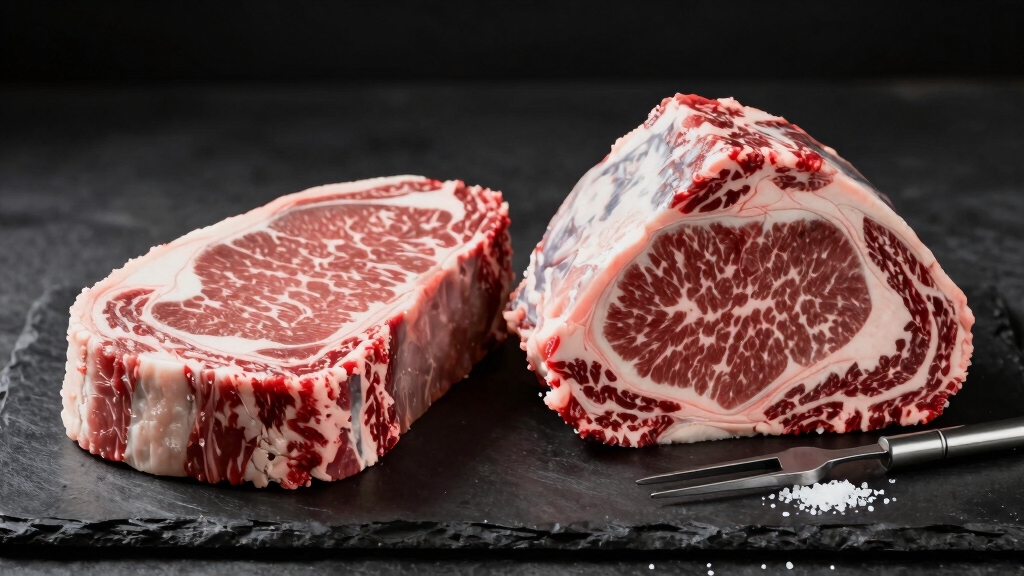
The chuck roll features heavy marbling that enhances juiciness without excessive fat, providing a rich, beefy taste. This marbling, coupled with intramuscular fat distribution, guarantees consistent flavor across its multiple muscles.
In contrast, chuck roast, coming from specific portions of the chuck roll, contains concentrated connective tissue alongside marbling. This connective tissue breaks down during cooking to intensify flavor and tenderness.
While both cuts boast robust beefiness, the chuck roll’s broader muscle variety presents subtle flavor nuances. The chuck roast offers a uniform richness due to its focused composition.
Understanding these differences helps you select the ideal cut for your desired flavor intensity and texture. Choosing cuts with proper marbling and fat distribution is essential for achieving optimal juiciness and tenderness in slow-cooked beef.
Best Cooking Methods for Chuck Roll and Chuck Roast
Mastering the best cooking methods for chuck roll and chuck roast requires understanding their muscle composition and connective tissue content.
You’ll find the chuck roll contains varying muscles, some tender, some tough, necessitating versatile techniques. Slow smoking or low-and-slow braising works excellently to break down collagen and render fat, delivering juicy, flavorful results.
Chuck roasts, rich in connective tissue, demand similar slow cooking. Pot roasts and crockpot braises excel here, turning tough fibers tender. Avoid high-heat, quick methods that toughen these cuts.
When fabricating chuck roll into steaks or roasts like Denver or boneless country-style ribs, you can apply grilling or roasting but must closely monitor doneness to preserve tenderness.
Ultimately, patience with low-temperature, extended cooking frees the full potential of both chuck roll and chuck roast. Maintaining an internal temperature between 195–210°F is essential for shreddable tenderness in chuck-style pot roasts.
Price Differences and Buying Tips for Chuck Cuts
When you’re checking out prices, you’ll notice that buying a whole chuck roll is actually cheaper per pound than picking up individual chuck roasts. It’s a great way to save some cash!
Plus, with a chuck roll, you can customize your cuts and control your portions, which is super handy if you’re cooking for a crowd or just want to stock up.
Knowing these differences really helps you make smarter buying decisions. It’s all about matching your choices to your cooking plans and sticking to your budget.
Additionally, understanding the anatomical differences between cuts can guide you in selecting the best option for your recipe.
Cost Comparison Overview
Several factors influence the cost differences between chuck roll and chuck roast, making your purchasing decisions essential for budget and meal planning.
Chuck roll typically costs less per pound since it’s a larger primal cut. Chuck roasts, being pre-cut portions, carry a premium due to added butchering and convenience.
Buying whole chuck roll offers cost efficiency if you need larger quantities and want to customize cuts.
Conversely, chuck roast suits immediate use but at a higher price point.
Consider these points:
- Chuck roll’s bulk purchase reduces per-pound cost.
- Chuck roast includes labor and packaging costs.
- Larger chuck roll purchases allow for portion control and versatility.
- Chuck roast pricing reflects retail convenience and readiness.
Understanding the fat content of chuck cuts can also help you balance flavor and nutrition when selecting your meat.
This knowledge helps you optimize cost relative to your cooking needs.
Buying Strategies
To get the most value out of chuck cuts, you’ll want to weigh the price differences between purchasing a whole chuck roll versus individual chuck roasts.
Chuck roll typically costs less per pound and offers bulk savings, especially if you need larger quantities or want to customize your cuts.
Buying a whole chuck roll allows you to fabricate multiple cuts, controlling portion size and tailoring muscle selection based on cooking methods.
In contrast, chuck roasts are pre-cut, ready-to-cook portions that save prep time but usually come at a higher price per pound.
When buying, consider your cooking plan: select chuck roll for versatility and cost efficiency, or chuck roast for convenience.
Always inspect marbling and freshness to assure peak flavor and tenderness regardless of choice.
For optimal cooking results, keep in mind that heavier cuts may require 20–30% longer cooking time than lighter ones.
Practical Uses and Cooking Recommendations for Chuck Roll and Chuck Roast
Maximize the potential of chuck roll by leveraging its robust muscle variety and rich marbling for whole roasting or smoking applications. Slow, low-temperature cooking allows connective tissues to break down and self-baste the meat.
Chuck roast, being pre-cut, suits oven roasting and braising. It’s especially great for pot roasts or crockpots, which help tenderize well-used muscles. Both cuts benefit from long, gentle cooking to render collagen and enhance flavor.
When cooking chuck roll or chuck roast, follow these guidelines:
- Use low and slow heat to convert connective tissues into gelatin.
- Opt for smoking or slow roasting with chuck roll for juiciness.
- Braise chuck roast in moist environments to guarantee tenderness.
- Slice chuck roll strategically to create steaks or ribs before cooking.
- Consider wrapping the meat during cooking to manage moisture retention and tenderness through the stall phase.
Frequently Asked Questions
How Long Can Chuck Roll and Chuck Roast Be Stored in the Freezer?
You can store both chuck roll and chuck roast in the freezer for up to 6 to 12 months without significant loss of quality.
To maintain peak flavor and texture, wrap the meat tightly in heavy-duty aluminum foil, freezer paper, or vacuum-seal it to prevent freezer burn.
Label packages with the date, and avoid frequent thawing and refreezing, which can degrade the meat’s integrity and tenderness over time.
Are Chuck Roll and Chuck Roast Suitable for Grilling?
You can grill chuck roll and chuck roast, but you’ll need to be careful.
Chuck roll contains a mix of muscles, some tougher, so grilling requires slicing into thinner steaks or marinating to tenderize.
Chuck roast, from well-used muscles, is typically tougher and benefits more from slow-cooking.
However, if you cut chuck roast into thinner portions and grill over medium heat, you can get decent results without drying it out.
Can Chuck Roll Be Used for Making Ground Beef?
Yes, you can use chuck roll for making ground beef. Its mix of tender and tougher muscles, along with ample marbling, gives the ground meat rich flavor and good fat content.
This is essential for juicy burgers or meatloaf. Just make sure you trim excessive fat if needed.
Grinding chuck roll allows you to control fat ratios and customize blends.
This makes it a versatile choice for quality homemade ground beef.
What Is the Nutritional Difference Between Chuck Roll and Chuck Roast?
Imagine a tapestry of muscle fibers and fat weaving subtle differences in nutrition.
You’ll find chuck roll slightly richer in marbling, boosting its fat and calorie content compared to chuck roast.
Both deliver comparable protein levels, but chuck roast often has marginally less fat due to its leaner, trimmed portions.
When choosing, consider your dietary goals: chuck roll offers deeper flavor from fat, while chuck roast leans toward leaner nutrition with robust protein.
How Does the Aging Process Affect Chuck Roll and Chuck Roast?
The aging process enhances both chuck roll and chuck roast by breaking down connective tissues and muscle fibers, improving tenderness and flavor.
Dry-aging intensifies beefy notes, while wet-aging preserves moisture and juiciness.
Since chuck roll contains multiple muscles, aging affects each differently; you’ll notice more tender sections soften faster.
Chuck roast, being a smaller cut, generally ages more uniformly, so you’ll get consistent texture and richer taste with proper aging techniques.
The Final Bite: Understanding Chuck Roll and Chuck Roast
When choosing between chuck roll and chuck roast, you’re really weighing tenderness, flavor, and cooking method.
Chuck roll offers a more uniform texture and works well for slow cooking. Chuck roast provides richer marbling and deeper flavor.
Both cuts reward low and slow techniques, but knowing their muscle composition helps you pick the perfect cut. Remember, the proof is in the pudding; your cooking method will make or break the final dish.