Can You Inject a Prime Rib Roast? Step-by-Step Guide
Yes, you can inject a prime rib roast to boost moisture and flavor inside the meat. Inject a seasoned broth, melted beef tallow, or butter-based marinade about 2–3 hours before cooking for even distribution.
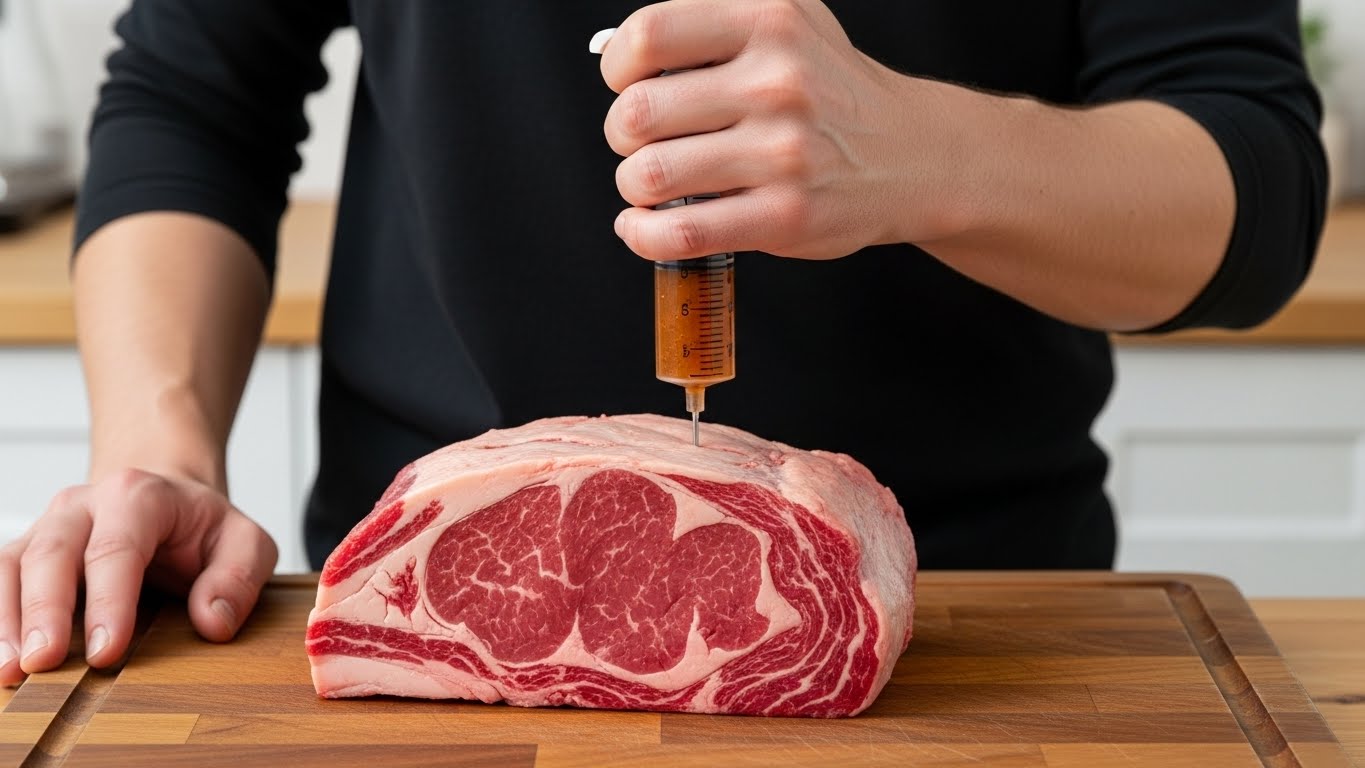
Use multiple injection points spaced 2–4 inches apart and deposit liquid slowly while withdrawing the needle. This technique enhances juiciness and seasoning depth beyond surface rubs.
Proper injection timing and solution prep are key to success. Explore detailed methods and recipes to maximize your results.
Key Takeaways
- Yes, injecting a prime rib roast enhances internal flavor and moisture retention beyond surface seasoning alone.
- Use a flavorful injection solution like beef tallow, broth, or soy-Worcestershire marinade for best results.
- Inject 2–3 hours before cooking in a grid pattern with 1–4 inch spacing to ensure even distribution.
- Insert the needle 2–3 inches deep, depositing marinade while withdrawing to saturate muscle fibers thoroughly.
- Warm the injection liquid for smoother flow and allow the roast to rest 20–30 minutes post-injection before cooking.
Understanding Injection Feasibility for Prime Rib
Although prime rib is naturally flavorful, injecting it can markedly enhance moisture retention and deepen taste profiles. You’ll prevent drying out lean sections by introducing a salt-based solution that binds moisture within the muscle fibers, reducing evaporation during cooking.
Injection also delivers marinade components directly into the interior, intensifying the roast’s beefy flavor, especially if you use beef drippings mixed with water and salt. To maximize effectiveness, you must inject before cooking starts, avoiding muscle damage and leakage that would cause dryness.
Proper sanitation of injection tools is essential to prevent cross-contamination during this process. Apply injections at multiple points in a grid pattern, spaced 1–4 inches apart, to guarantee even distribution throughout the roast. This technical approach guarantees the juiciest, most flavorful prime rib by optimizing internal moisture and seasoning penetration. Additionally, using a melted Wagyu beef tallow as the injection ingredient can boost flavor and juiciness significantly.
Recommended Timing for Injecting Prime Rib
Injecting your prime rib before cooking is a great way to keep those juices in and ensure the marinade gets distributed evenly. To maximize flavor and moisture retention, consider injecting the roast before allowing it to rest wrapped in butcher paper.
If you’re planning to cook it the same day, it’s best to inject it about 2-3 hours beforehand. This timing strikes a nice balance between letting the flavors soak in and fitting with your meal schedule.
Now, if you’re smoking the prime rib, you might want to tweak that timing a bit. Giving the marinade some time to penetrate is key, but you also want to be careful not to dry the meat out. Injection should always be performed before smoking the roast to avoid puncture holes that cause juice leakage and dry out the meat pre-smoke injection.
Ideal Injection Window
Because injecting the prime rib before cooking prevents juice loss from puncture holes, you should complete the injection within a specific window.
Ideally, inject your prime rib 2 to 3 hours before cooking to allow the solution to distribute evenly throughout the muscle fibers.
This timing guarantees that the salt-based injection retains moisture and flavor during heat application.
Some prefer injecting the night before, especially after dry brining for 24 to 36 hours, which further enhances flavor penetration. However, injecting the day of cooking is generally recommended for better results to avoid potential issues such as discoloration or flavor dilution caused by early injection suggested improvement. Additionally, maintaining the meat at a safe temperature during resting helps preserve moisture and flavor.
Avoid injecting too close to cooking time, as the solution won’t fully absorb, and injecting too early risks flavor dilution.
Keep your injection solution warm for easier penetration, and space injections 2 to 4 inches apart for even distribution.
This precise timing maximizes juiciness and taste in the final roast.
Day-Of Injection Tips
Typically, injecting your prime rib 2 to 3 hours before cooking guarantees peak absorption of the flavorful solution.
On the day of cooking, warm your injection liquid, like beef tallow or Cajun butter, to improve flow through the needle and ensure even muscle penetration.
Distribute injections systematically across the entire roast, especially between muscle sections in bone-in cuts, to avoid dry spots.
For best results, ensure your roast has a good fat cap to help retain moisture and flavor during cooking. Using a fine mist sprayer to lightly spritz the surface after injection can help maintain exterior moisture and enhance flavor.
After injecting, let the roast rest at room temperature for about 20 minutes, allowing the liquid to evenly disperse through muscle fibers.
Apply any leftover injection liquid externally, then add your dry rub seasoning.
Secure the meat with a rotisserie skewer if using one. This timing and preparation optimize flavor distribution and set the stage for a consistently tender, flavorful prime rib roast.
Pre-Smoking Injection Timing
Although injecting your prime rib is essential for flavor infusion, the timing must be carefully controlled to prevent moisture loss and muscle damage.
You should complete all injections before the smoking process begins, ideally 2-3 hours prior or even the evening before, refrigerated overnight. This allows the injection mixture, such as the recommended Calcutta beef injection, to fully penetrate the meat for maximum flavor. Wrapping the roast after injection and before smoking can help retain moisture and accelerate cooking by reducing evaporative cooling during the initial smoking phase, similar to the stall effect seen in brisket.
Injecting after heat application causes muscle fibers to relax and leak juices through needle punctures, resulting in dry, flavorless meat.
Rest your roast at room temperature for 30 minutes before injection to optimize absorption.
Use multiple injection points, especially targeting the ribeye eye, to make certain of even marinade distribution.
Warm injection solutions flow better through the needle, facilitating thorough saturation.
Once the roast enters the smoker, the injection window closes, so plan accordingly to maximize flavor without compromising texture or moisture retention.
Popular Injection Recipes for Prime Rib
Frequently, prime rib injections transform the roast by infusing moisture and layered flavors deep within the meat. You can choose from several proven recipes, each designed for specific flavor profiles and cooking methods. Proper handling and injecting can help maintain moisture retention during cooking.
Use a warm injector for beef tallow or broth-based liquids to guarantee even distribution. Inject 2-3 hours before cooking for peak absorption. Allowing the roast to come to room temperature before roasting helps ensure even cooking and juiciness.
| Injection Type | Key Ingredients & Notes |
|---|---|
| Beef Tallow-Based | Melted Wagyu tallow; apply as binder; pairs with bourbon mushroom cream sauce |
| Soy-Worcestershire Marinade | Soy & Worcestershire sauces; browning sauce; rub salt & pepper after injection |
| Broth and Seasoning | Beef broth with brisket rub; inject 2-3 hours pre-cook; retains moisture |
| Cajun Butter | Butter with Cajun spices; inject before smoking; boosts richness and drip flavor |
Techniques for Effective Prime Rib Injection
When you’re getting ready to inject your prime rib, it’s all about planning your injection patterns. You really want to target the eye of the ribeye and make sure to distribute the injection evenly through multiple entry points. This way, each bite will be bursting with flavor!
Now, before you start, you need to prepare your injection mixture. A little tip: warm it up to a liquid state. This helps ensure a smooth flow through the needle, which makes the whole process a lot easier. Plus, make sure you’re mixing the concentrates just as the recipe suggests. Many chefs actually recommend using a nice rub and smoky flavor to enhance the prime rib without covering its natural taste. Applying a balanced dry rub before cooking can help improve flavor penetration and create a delicious crust.
Oh, and don’t forget that timing plays a huge role here! Aim to inject your prime rib about 2 to 3 hours before you start cooking. This timing is key for optimizing flavor absorption while still keeping that perfect texture you want in your meat. Happy cooking!
Injection Patterns
When injecting a prime rib roast, adopting a systematic grid pattern guarantees even distribution of marinade throughout the meat.
Space injection sites 1-2 inches apart, covering the top, sides, and ends to reach multiple muscle layers. For a 10-pound roast, aim for 20-30 injection points.
Insert the needle 2-3 inches deep, depositing marinade while withdrawing to saturate the eye of ribeye and surrounding muscles evenly. This approach helps manage the fat content for optimal flavor absorption.
Follow these injection pattern guidelines:
- Create a grid covering all surfaces for uniform flavor penetration.
- Target major muscle groups at varying depths.
- Inject from multiple directions—top, sides, ends—to avoid uneven seasoning.
- Expect some surface leakage; pat excess marinade to ensure proper absorption.
This method enhances juiciness and consistent cooking throughout. Injection distributes moisture and flavor throughout the entire roast, reaching thick muscle sections for better doneness consistency injection benefits.
Timing and Preparation
Proper timing and preparation directly influence how effectively your prime rib absorbs the injection, impacting juiciness and flavor depth. Trim excess fat and silver skin, then tie the roast uniformly to guarantee even cooking. Using a two-zone fire setup on your grill allows you to sear and then slow-cook the roast efficiently. Ensuring the meat surface is dry before injection helps the solution penetrate better and promotes a more even seasoning.
Dry brine the prime rib for 24–36 hours before injection to enhance seasoning penetration. Inject 2–3 hours before cooking rather than overnight, using a solution like Cajun butter, beef drippings diluted with salted water, or a Worcestershire-based mix for peak flavor retention. It is important to avoid injecting during cooking to prevent juice loss from punctures.
Avoid injecting during cooking to prevent juice loss from punctures. After injection, coat the roast with olive oil before applying rubs. Use temperature probes to monitor internal heat during smoking at 290°F, aiming for 124°F internal temperature. Controlling the cooking temperature steadily helps maintain moisture and improves flavor development throughout the roast.
Make certain the injection enhances moisture and flavor without compromising texture.
Cooking Methods After Injecting Prime Rib
Although injecting a prime rib roast enhances its juiciness and flavor, choosing the right cooking method is essential to preserve those qualities. You need to select a technique that maintains moisture and evenly cooks the meat without causing juice loss through punctures.
Injecting prime rib boosts flavor and juiciness, but the right cooking method is vital to lock in moisture.
Consider these four best cooking methods after injecting prime rib:
- Rotisserie Grilling: Cook at 325°F over indirect heat. Season exterior before skewering to avoid flare-ups.
- Smoking: Inject a salty broth pre-smoking. Avoid puncturing once smoking starts to retain juices.
- PK Grill Roasting: Inject in a grid pattern. Use low-and-slow heat; coat with olive oil and season heavily.
- Direct Grilling with Sear: Inject butter mixture hours before. Sear after cooking for a caramelized crust; rest to stabilize temperature. Using a milk marinade with Creole butter injection can further tenderize and infuse deep flavor before cooking.
Follow these methods precisely for peak flavor and texture.
Benefits and Considerations of Injecting Prime Rib
Because injecting prime rib introduces flavors and moisture directly into the muscle fibers, you gain significant advantages in taste, juiciness, and texture that surface seasoning alone can’t achieve. This technique can also help in achieving moisture retention during longer cooking processes.
Injection evenly distributes seasoning and fat internally, enhancing flavor depth and moisture retention. Phosphates bind water molecules, maintaining juiciness during cooking, while fat injections improve succulence and mouthfeel. Using a high-quality injection syringe ensures even distribution and prevents over-injection.
Timing the injection 3-24 hours before cooking guarantees full integration. Consider the injection solution’s composition; fat sources like Wagyu tallow or hydrolyzed vegetable protein affect flavor and texture distinctly.
| Benefit | Consideration |
|---|---|
| Enhanced internal flavor | Requires precise timing |
| Improved moisture retention | Proper solution formulation |
| Tenderized muscle fibers | Injection before surface seasoning |
Frequently Asked Questions
Can Injecting Prime Rib Affect Its Cooking Time?
Injecting prime rib doesn’t appreciably affect its cooking time.
You should rely on weight and temperature guidelines—typically 32 minutes per pound at 180°F for rare.
The injection mainly alters flavor, not heat transfer. Carryover cooking varies by size, rising 5-20°F post-oven.
Focus on internal temperature rather than injection status to judge doneness.
Is It Safe to Inject a Frozen Prime Rib?
Imagine trying to inject a frozen prime rib. Your needle won’t distribute the solution evenly because the muscle fibers are rigid.
It’s not safe to inject frozen meat since you can’t control temperature or guarantee even solution absorption. This raises risks of bacteria surviving uneven cooking.
Instead, thaw completely before injecting to guarantee safe, uniform flavor enhancement and proper cooking throughout your prime rib roast.
What Type of Injector Needle Is Best for Prime Rib?
You’ll want a marinade injecting needle designed specifically for roasts when working with prime rib.
Opt for a stainless steel needle with dual openings to guarantee even distribution of your marinade throughout the meat.
A 3 ¾-inch length fits perfectly for deep penetration in prime rib sections.
This type allows you to inject larger flaked contents smoothly and prevents clogging, guaranteeing consistent flavor and moisture inside the roast during cooking.
Can Injecting Prime Rib Cause Uneven Cooking?
Injecting prime rib can absolutely cause uneven cooking if you’re not careful. It’s like poking your roast with a thousand tiny holes!
Repeated injections create multiple puncture sites, leading to uneven heat distribution and inconsistent doneness.
To avoid this, use the same hole for all injections and monitor internal temperature closely. Ideally, grill at 325°F.
This minimizes risks and helps maintain even cooking throughout your prime rib roast.
How Does Injection Impact the Prime Rib’s Crust or Bark?
Injection doesn’t negatively impact your prime rib’s crust or bark because it targets internal flavor without adding surface moisture.
You’ll want to pat the roast dry and season generously to make sure a crisp crust forms during cooking.
Since injection avoids wetting the surface, it won’t interfere with Maillard reactions essential for bark development.
This way, you get flavorful interior meat alongside a perfectly textured, well-seasoned exterior.
Turn a Classic Prime Rib Roast Into a Show-Stopping Centerpiece
Think of injecting a prime rib like tuning a fine instrument before a concert.
By carefully timing and applying the right injection, you enhance its natural flavors and juiciness, much like adjusting strings for perfect resonance.
Using precise techniques guarantees even distribution, setting the stage for a flawless cooking performance.
While injection isn’t mandatory, it’s a practical tool to elevate your prime rib from good to exceptional with consistent, measurable results.