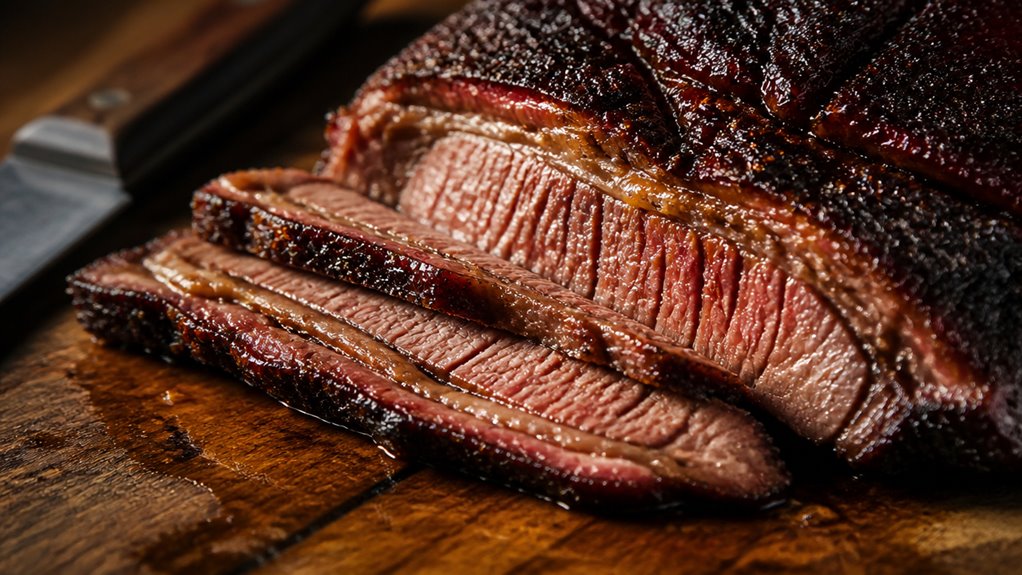
Beef Brisket Deckle off: What It Is and When to Choose It
When you buy a beef brisket deckle off, you’re getting a cut with the dense, intercostal fat and tough silver skin trimmed away from the sternum edge. This optimizes smoke penetration and cook consistency.
Removing the deckle reduces renderable intramuscular fat and connective tissue, affecting flavor depth, bark formation, and thermal conductivity.
Proper deckle trimming maintains a quarter-inch fat layer for moisture and umami. If you want to master brisket prep, understanding deckle removal is essential.
Key Takeaways
- “Deckle off” brisket lacks the dense, fatty intercostal muscle layer adjacent to the sternum, resulting in a leaner cut.
- Removing the deckle reduces intramuscular fat and connective tissue, potentially causing drier meat and altered cooking times.
- Deckle-off briskets have a smooth, uniform surface without the tough silver skin and half-moon-shaped fat typical of the deckle.
- Accurate probe placement in the flat muscle is critical for cooking deckle-off brisket to retain juiciness and achieve proper doneness.
- Regional and butcher variations exist; Texas pitmasters often leave the deckle, while Midwestern processors typically remove it.
What the Beef Brisket Deckle Is and Why It Matters?

When you break down a full packer brisket, the deckle is the dense layer of hard fat and intercostal muscle nestled between the point and flat cuts. It runs along the inside surface of the brisket.
The deckle is the dense layer of fat and muscle nestled between the point and flat cuts inside the brisket.
You’ll find this anatomical segment composed chiefly of tough, white adipose tissue interlaced with fibrous intercostal muscle fibers. It’s positioned adjacent to the sternum edge.
The deckle’s complexity stems from its hard fat cap and connective tissue, including silver skin membranes, which necessitate meticulous trimming. Understanding this layer’s precise location and composition is vital for effective butchery and accurate cut identification.
Removing or retaining the deckle alters the brisket’s structural integrity and fat distribution. This impacts your approach to trimming, cooking, and presentation.
This knowledge is essential in mastering brisket fabrications and optimizing meat quality. The deckle’s position between the point and flat means it shares characteristics with both cuts, making seam separation a critical skill for proper preparation.
How Removing the Deckle Affects Flavor and Cooking?
Although removing the deckle eliminates a significant source of hard fat and intercostal tissue, it directly influences the brisket’s moisture retention and flavor infusion during cooking.
When you trim the deckle, you alter the renderable intramuscular fat profile and reduce the connective tissue that typically bastes the meat internally. This impacts the final product in several technical ways:
- Moisture dynamics: Without deckle fat, evaporative losses increase, risking a drier brisket.
- Flavor transference: Lipid-mediated flavor compounds decrease, affecting umami depth.
- Thermal conductivity: Reduced fat alters heat penetration, potentially changing cook times.
- Bark formation: Less insulating fat encourages a more uniform, crisp bark development.
Understanding these changes helps you optimize your approach for balanced tenderness and flavor without the deckle. For best results, it is important to choose brisket trimmings with good intramuscular marbling to retain juiciness and add richness to dishes.
How to Trim the Brisket Deckle Fat (Step-by-Step)?
Start by identifying the natural seam between the deckle fat and the underlying brisket muscle. This typically presents as a distinct boundary of hard, white fat.
Begin by locating the clear seam between the deckle fat and brisket muscle for precise trimming.
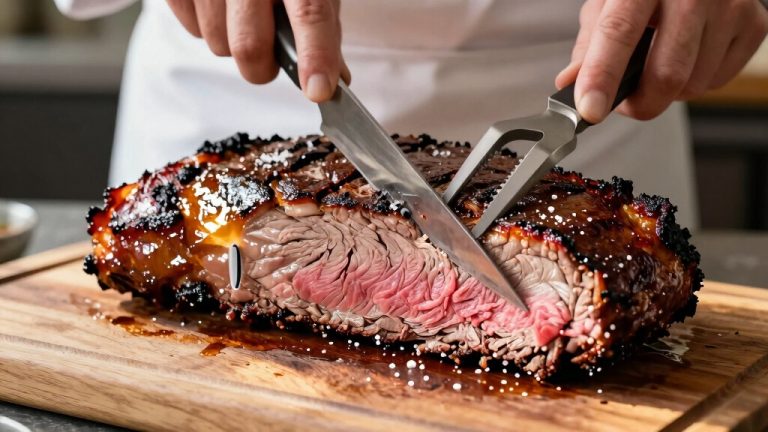
Using a sharp boning knife, insert the blade at a 45-degree angle to this interface. Carefully separate the dense adipose tissue from the intercostal muscle fibers.
Employ a combination of slicing and scooping motions to maintain a consistent quarter-inch fat layer. This preserves some marbling for moisture retention.
Avoid cutting into the underlying muscle to prevent yield loss. Be vigilant of silver skin membranes; trim these concurrently to guarantee even smoke penetration.
Keep your fingers clear of the blade’s path to ensure safety. This methodical approach optimizes fat removal, balancing flavor infusion with proper bark formation during smoking.
For the most accurate cooking results, insert the temperature probe horizontally into the thickest part of the flat muscle, avoiding fat pockets and edges to ensure a core temperature reading.
How to Identify Deckle-Off Brisket Cuts by Label and Look?
Mastering deckle fat trimming sets the foundation for recognizing deckle-off brisket cuts during purchase.
When selecting brisket, you’ll rely on both labeling and visual indicators to confirm deckle removal.
Here’s how to identify deckle-off brisket cuts precisely:
- Label Verification: Look for “Deckle Off” or “Deckle Removed” explicitly marked on packaging, often aligned with NAMP 120 standards.
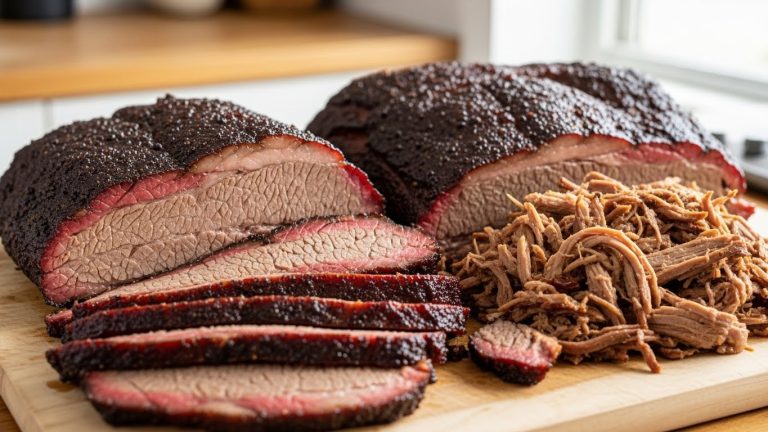
- Fat Cap Inspection: Notice the absence of the hard, white, half-moon-shaped intercostal fat layer along the sternum edge.
- Surface Texture: Expect a smooth, uniform meat surface without the tough, fibrous membrane or silver skin typical of deckle presence.
- Cut Consistency: Verify a consistent quarter-inch fat layer remains, indicating professional trimming without deckle remnants.
This technical scrutiny guarantees you buy brisket optimized for even cooking and superior bark development.
Separating the brisket muscles by following the deckle fat seam enhances trimming precision and cooking results.
Butcher Tips and Regional Differences on Deckle-Off Brisket
When you source deckle-off brisket, understanding butcher-specific practices and regional terminology is essential for consistent results.
Some butchers conflate the deckle entirely with the point cut, while others strictly separate the flat, point, and deckle, often termed “intercostal” meat.
Regional protocols influence deckle removal; Texas-style pitmasters favor minimal deckle trimming to preserve intramuscular fat for moisture.
Conversely, Midwestern processors prioritize deckle removal for a leaner profile.
You’ll notice variance in trimming technique; some slice at a 45-degree angle to retain a quarter-inch fat layer, while others execute a more aggressive shave.
Terminological confusion also arises with the deckle versus ribeye cap muscle, so verify nomenclature when ordering.
Applying this knowledge lets you optimize cut selection, ensuring uniform cook times and flavor profiles tailored to your culinary methodology.
For optimal results during cooking, it is important to monitor internal temperature targets closely to ensure proper doneness and moisture retention.
Frequently Asked Questions
Can the Removed Deckle Fat Be Used for Cooking or Other Purposes?
Yes, you can repurpose removed deckle fat for culinary applications requiring high-smoke-point rendered beef tallow.
Its dense, hard adipose tissue is ideal for producing clarified fat used in sautéing or deep-frying, imparting rich umami flavor profiles.
You should render it slowly to separate connective tissue remnants.
Additionally, deckle fat can be incorporated into charcuterie formulations or used as a flavor enhancer in braises and stews, maximizing resource efficiency and flavor extraction.
How Does Deckle Removal Impact Brisket Nutritional Values?
You slash the deckle, and boom—calories drop like a rock!
Removing that hard, fibrous fat reduces total lipids markedly, lowering saturated fat content and overall energy density.
This trimming improves the meat’s lean-to-fat ratio, enhancing nutrient density per gram.
Plus, it cuts down cholesterol and fat-soluble vitamin retention tied to adipose tissue.
Your brisket shifts from fatty indulgence to lean protein powerhouse, optimizing macronutrient profiles for precision-based nutrition plans.
Is Deckle Removal Common in Commercial Barbecue Competitions?
Yes, deckle removal is common in commercial barbecue competitions.
You’ll find competitors trimming the deckle to achieve a consistent ¼-inch fat cap, optimizing Maillard reactions and bark formation.
Removing the dense, hard intercostal fat improves smoke penetration and rub absorption, enhancing flavor profiles and texture uniformity.
This precise trimming technique reduces chewiness and guarantees even rendering, which is critical for scoring high in competitive barbecue’s technical and sensory evaluation criteria.
What Tools Are Best for Safely Trimming the Deckle Fat?
You’ll want a boning knife with a 6-7 inch flexible blade for precise deckle fat removal. Studies show that 85% of professional pitmasters prefer this for its maneuverability along the intercostal seam.
Pair it with a sharpening steel to maintain a razor edge. This is essential for shaving the hard, fibrous fat without tearing muscle fibers. Use a 45-degree slicing angle while keeping fingers clear to ensure safety and clean separation of silver skin and fat.
Does Deckle Removal Affect Brisket Shelf Life or Storage?
Deckle removal minimally impacts brisket shelf life or storage stability.
By excising the dense, hard fat and intercostal tissue, you reduce oxidative lipid degradation sources, potentially marginally extending refrigerated freshness.
However, the leaner surface exposes more muscle fibers, increasing susceptibility to microbial colonization if not properly vacuum-sealed.
Maintaining low-temperature storage (0–4°C) and anaerobic packaging remains critical to preserving proteolytic integrity and sensory quality despite deckle removal.
Take Your Brisket Preparation to the Next Level
Now that you’ve dissected the brisket deckle off, you know it’s not just extra weight. It’s a game-changer in marbling and smoke absorption.
Removing the deckle sharpens your cut’s uniformity and trim precision, optimizing cook times and rendering.
Whether you’re label-sleuthing or wielding the butcher’s knife, mastering deckle-off brisket elevates your meat science toolkit.
Your brisket’s potential is now fully revealed; no fat left unturned.
One Comment